
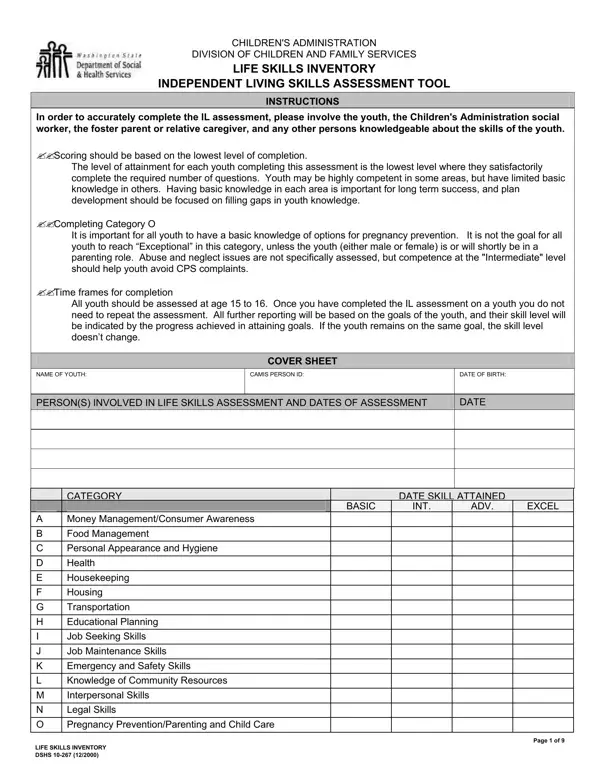
The Assessment Sheet Life Skills form is a structured evaluation tool used by the Children's Administration Division of Children and Family Services to measure how well young individuals can manage their own lives. It helps social workers and caregivers identify which skills a youth has already mastered and which areas still need development. Completing this assessment is often the first step in creating a personalized plan for successful independence.
The form evaluates nine broad life skill categories. These include money management (budgeting, banking, and check writing), food and nutrition (grocery shopping, meal planning, and food storage), and personal hygiene and health care (medical appointments, first aid, and hygiene routines). The assessment also covers housing skills such as basic home maintenance and housekeeping, transportation and mobility, legal knowledge, and both job seeking and workplace readiness. Pregnancy prevention and parenting skills complete the full scope of the evaluation.
The assessment process is collaborative by design. The youth, their social worker, foster parent, relative caregiver, and any other adults familiar with the young person's abilities all contribute to the evaluation. For each skill, raters mark the lowest level at which the youth consistently performs the task. This approach ensures the assessment reflects a realistic baseline rather than peak performance in a single instance.
Once the assessment is complete, the results guide goal-setting and action planning. Social workers use the findings to prioritize which skill areas to address first and to connect youth with training programs, workshops, or one-on-one coaching. Progress is tracked over time by repeating the assessment every six months or after significant life changes. For youth with complex support needs, pairing this tool with a biopsychosocial assessment form provides a fuller picture of individual strengths and challenges.
The scoring system focuses on foundational knowledge rather than advanced ability. A youth who can manage a basic budget but cannot yet handle complex financial decisions will score at the basic level for money management, even if they excel in other areas. This detailed approach makes the Assessment Sheet Life Skills form one of the most reliable tools for planning long-term independence for youth aging out of foster care. Agencies may also use a 1915-C functional assessment when determining eligibility for additional support services.
| Question | Answer |
|---|---|
| Form Name | Assessment Sheet Life Skills Form |
| Form Length | 9 pages |
| Fillable? | No |
| Fillable fields | 0 |
| Avg. time to fill out | 2 min 15 sec |
| Other names | CSO, WIC, Independent, FICA |
Assessment Sheet Life Skills Form isn’t the one you’re looking for?