Ccg N001 Form PDF Details
What Is the CCG N001 Form?
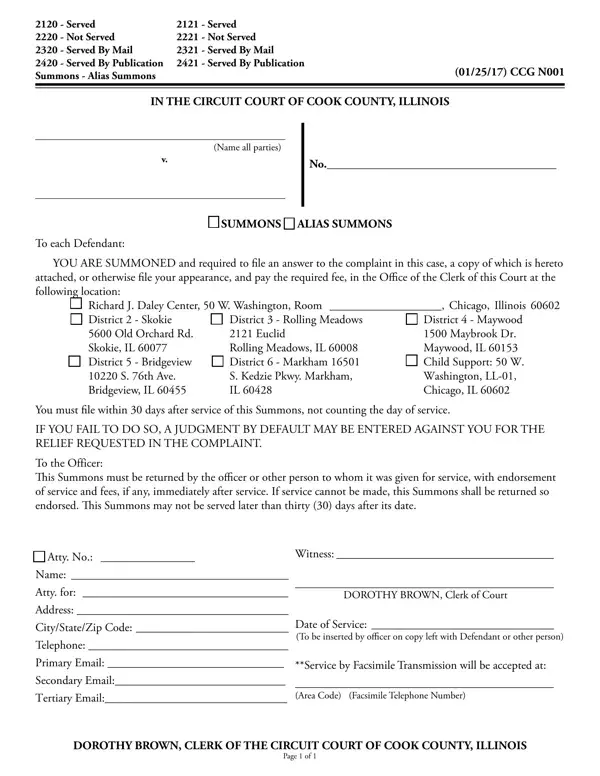
The CCG N001 form, officially titled "Summons - Alias Summons," is the standardized legal document issued by the Circuit Court of Cook County, Illinois, for civil lawsuits. It serves two related functions within the Illinois court system: it operates as an original summons when filed alongside the initial complaint, and it functions as an alias summons when a first service attempt did not reach the defendant. Both versions of this Cook County court document carry identical legal authority once properly served.
This form is part of the Cook County General Forms (CCG) series, which standardizes legal filings across the court’s multiple divisions and districts. When a plaintiff files a civil action in Cook County, the Clerk of the Circuit Court issues a signed copy of the CCG N001 form. That copy is then delivered to the defendant through one of several state-approved service methods, officially putting the defendant on notice that a legal proceeding has begun against them.
Who Needs the CCG N001 Form?
The Cook County Alias Summons is relevant to several groups in the civil litigation process:
- Plaintiffs and their attorneys use the form to initiate the service process after filing a civil complaint in Cook County Circuit Court.
- Defendants who receive the form must review it carefully, understand the 30-day response window, and take action to avoid a default judgment.
- Process servers and sheriff’s deputies complete the Return of Service section after delivering the document to the defendant.
- Self-represented litigants (pro se parties) who file cases in Cook County without an attorney must obtain, complete, and arrange service of this form on their own behalf.
- Legal aid organizations and law clinics serving Cook County residents frequently work with this document when assisting defendants who have been served.
Key Information Captured on the Form
The N001 document is organized into distinct blocks, each capturing specific case information:
- Case caption: The full names of the plaintiff and defendant, the case number assigned by the Clerk of the Circuit Court, and the court calendar or division handling the matter.
- Attorney information block: The filing attorney’s Illinois ARDC registration number, law firm name, mailing address, telephone number, and primary email address. Self-represented parties enter their own contact information here.
- Instructions to the defendant: A pre-printed section stating the legal requirement to appear or answer within 30 days of service and warning that a default judgment may be entered for failure to respond.
- Service method checkboxes: Indicates how service was accomplished, covering the categories of Served, Not Served, Served By Mail, and Served By Publication.
- Return of service: Completed by the officer or process server after service, recording the date and specific location of service, the fee charged, and an official endorsement.
- Facsimile transmission section: Available when the court has authorized service by fax under Illinois Supreme Court Rule 11, including the area code and fax number used.
Defendant Response Requirements and Deadlines
Once a defendant receives this alias summons, Illinois procedural rules impose a firm deadline. The defendant must file either a formal answer to the attached complaint or a written appearance with the Clerk of the Circuit Court within 30 days after the date shown on the return of service. The day service was made is excluded from the count.
Failing to respond within this window gives the plaintiff grounds to seek a default judgment. In a default judgment, the court may grant the relief requested in the original complaint without holding a hearing on the merits. Default judgments can include monetary awards, injunctive orders, or other civil remedies depending on the nature of the case. Defendants who miss the 30-day deadline may petition the court to vacate the default judgment, but doing so requires showing both a reasonable excuse for the delay and a valid defense to the original complaint.
Service Methods Covered by the Form
Illinois law recognizes several legally valid methods for serving defendants in civil cases:
- Personal service: The summons is placed directly in the hands of the defendant by a licensed process server or a sheriff’s deputy. This is the most common and legally straightforward method.
- Abode service: The document is left at the defendant’s usual place of residence with a person over 13 years of age who lives there. This method is permitted when the defendant is temporarily absent.
- Substitute service on a registered agent: Used for corporate defendants when service is made on the company’s designated agent or officer.
- Service by mail: Allowed in certain civil matters with prior court authorization. A copy of the summons and complaint is sent by certified mail, return receipt requested.
- Service by publication: Reserved for cases where the defendant’s location cannot be found after a diligent search. Requires court approval and notice published in a newspaper of general circulation.
Filing Locations Within Cook County
The Circuit Court of Cook County operates across several districts, and the N001 alias summons form directs defendants to file their response at the courthouse assigned to their case:
- First Municipal District: Richard J. Daley Center, 50 W. Washington St., Chicago, IL 60602. Handles the majority of civil cases filed in Chicago.
- Second Municipal District: Skokie Courthouse, 5600 Old Orchard Rd., Skokie, IL 60077.
- Third Municipal District: Rolling Meadows Courthouse, 2121 Euclid Ave., Rolling Meadows, IL 60008.
- Fourth Municipal District: Maywood Courthouse, 1500 Maybrook Dr., Maywood, IL 60153.
- Fifth Municipal District: Bridgeview Courthouse, 10220 S. 76th Ave., Bridgeview, IL 60455.
- Sixth Municipal District: Markham Courthouse, 16501 S. Kedzie Ave., Markham, IL 60428.
The correct district is identified in the case caption. Defendants unsure of where to file their response should contact the Clerk of the Circuit Court of Cook County directly.
Step-by-Step: How Plaintiffs Serve the Form
For plaintiffs and their attorneys, the service process for the Cook County alias summons follows a defined sequence:
- File the complaint with the Clerk: Submit the complaint and a completed CCG N001 to the Clerk of the Circuit Court. The Clerk stamps and signs the summons, which gives it official authority.
- Deliver the signed summons to a process server: Provide the stamped, clerk-signed summons and complaint to a licensed process server or the Cook County Sheriff’s office. Include the defendant’s last known address and any alternative locations where they may be reached.
- Monitor the service deadline: Under Illinois Supreme Court Rule 102, the summons must be served within 30 days of issuance. If not served in that window, the summons expires and an alias summons must be requested from the Clerk.
- Receive the return of service: After completing service, the process server completes the return section of the N001, notes the date, method, and location of service, and returns the document to you. File this completed return with the Clerk’s office to place it in the case record.
- Monitor the defendant’s 30-day response window: After service is confirmed, count 30 calendar days from the service date. If no answer or appearance is filed by the defendant within that period, you may file a motion for default judgment with the court.
Common Errors When Using the N001 Form
Attorneys and court clerks in Cook County regularly encounter the same mistakes with this document. Avoiding them at the drafting stage saves time and prevents delays in the litigation process:
- Incorrect defendant name: The name on the summons must match the name used in the complaint. A discrepancy, even a minor spelling difference, can give the defendant grounds to challenge service.
- Wrong courthouse district: Filing the return of service in the wrong Cook County district creates confusion in the court record and may require re-filing at the correct location.
- Missing case number: Failing to include the clerk-assigned case number leaves the summons disconnected from the case file.
- Altering a previously returned summons: Once a process server has completed the Return section and the original has been filed, that document becomes a court record. A new N001 alias summons must be issued for any subsequent service attempt.
Alias Summons vs. Original Summons
The Alias Summons designation has a specific legal meaning in Illinois. An alias summons is issued when an original summons was either returned unserved or expired before successful service was completed. Illinois Supreme Court Rule 102 permits the issuance of an alias summons without leave of court when the original summons was not served within 30 days of issuance.
The alias summons carries the same legal weight as the original: once served on the defendant, the 30-day response clock begins. Courts in Cook County and across Illinois treat alias summons documents as equivalent to original summons documents for all procedural purposes.
For federal civil matters filed in the U.S. District Court for the Northern District of Illinois, the applicable document is the AO 440 Summons, which is governed by the Federal Rules of Civil Procedure. The CCG N001 applies exclusively to Cook County state court proceedings.
Once served, defendants who wish to respond to the lawsuit should review the response to a summons template as a starting point for structuring a proper legal reply before consulting with an attorney or proceeding pro se.
| Question | Answer |
|---|
| Form Name | Ccg N001 Form |
| Official Title | Summons - Alias Summons |
| Issuing Court | Circuit Court of Cook County, Illinois |
| Case Type | Civil Actions |
| Form Length | 1 pages |
| Response Period | 30 days from date of service |
| Fillable? | No |
| Fillable fields | 0 |
| Avg. time to fill out | 15 sec |
| Service Methods | Personal, Abode, Certified Mail, Publication |
| Other names | alias summons cook county form, ccg 0001 a, il alias, cook county alias summons form |