
KORUS Certificate of Origin: PDF Form Details

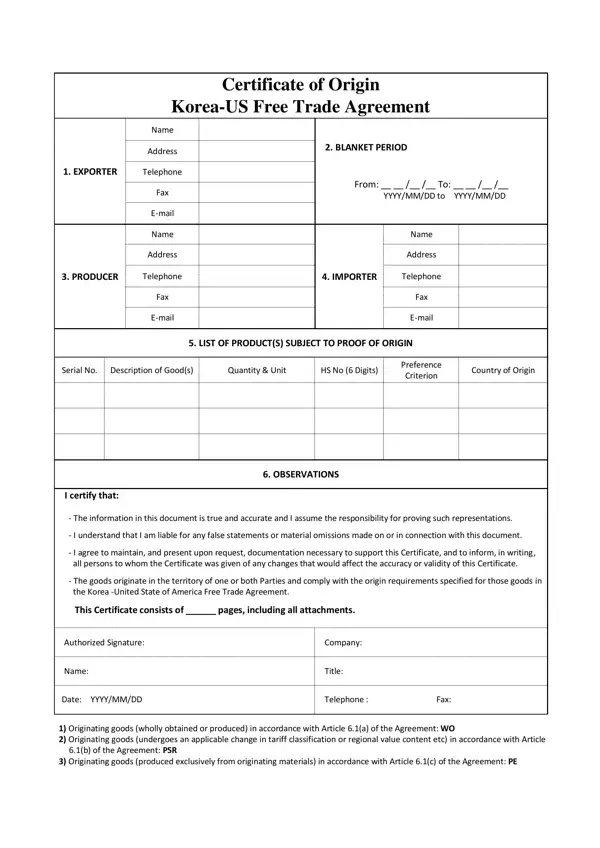
The certificate of origin for the KORUS Free Trade Agreement verifies that products shipped between the United States and the Republic of Korea meet specific rules of origin. Exporters or producers complete this two-page document to claim preferential (reduced or zero) tariff rates on qualifying goods. Without a valid certificate, customs officials assess standard Most Favored Nation (MFN) duty rates, which can be significantly higher.

The form captures several critical data points across 11 numbered fields. Exporter, producer, and importer legal names, addresses, phone numbers, and tax identification numbers go into Fields 1 through 3. Field 4 holds a blanket period, which allows one certificate to cover multiple shipments of identical goods for up to 12 consecutive months. Field 5 is the core section. Each line in Field 5 requires the goods description, quantity, Harmonized System (HS) tariff classification number at the six-digit level, the invoice number, and the preference criterion (A through F) that demonstrates the item qualifies as an originating good. If you also ship goods to other destinations, consider the general certificate of origin form for non-FTA trade.

Preference Criteria Explained

Each product listed on the form must cite one of six preference criteria to justify its originating status:

Record Retention and Compliance

The exporter or producer who signs the certificate takes on binding legal obligations. They must keep all records that support the origin claim, including purchase invoices, production cost records, and shipping documents, for a minimum of five years from the date the certificate was issued. Customs authorities in either country can request these records during a verification audit. Providing false information on the form can result in civil penalties, denial of preferential treatment for future shipments, and in serious cases, criminal prosecution under customs fraud statutes.

This certificate is similar in purpose to forms used for other U.S. trade agreements. For trade with North American partners, see the NAFTA certificate of origin. Businesses importing goods through U.S. ports may also need to file a CBP Form 1302 for vessel entry. Australian trade uses the US-Australia FTA form.

QuestionAnswer
Form NameCertificate of Origin Korea Form
Form Length2 pages
Fillable?No
Fillable fields0
Avg. time to fill out30 sec
Other namesKORUS FTA certificate of origin, certificate of origin US trade, trade agreement certificate form

How to Edit Certificate Origin Korea Form Online for Free

FormsPal's online PDF editor lets you fill in or update this certificate of origin directly in your browser. The editor supports text entry, checkboxes, and electronic signatures. No software installation is required. Follow the steps below to complete every field correctly.

Step-by-Step Filling Guide

Step 1: Click the "Get Form" button at the top of this page to open the PDF in the editor.

Step 2: Work through the form fields in numerical order.

KORUS FTA certificate of origin form page 1, exporter and product fields

Field 1 (Exporter): Enter the full legal name, street address, city, country, postal code, and telephone or fax number of the exporter. This must match the name on the commercial invoice.

Field 2 (Producer): Enter the producer's legal name and address. If the exporter and the producer are the same entity, write "Same." If multiple producers contributed to the shipment, write "Various" and attach a separate list.

Field 3 (Importer): Provide the importer's legal name, address, and contact details in the destination country.

Field 4 (Blanket Period): If this certificate covers multiple shipments of identical goods, enter the start and end dates. A blanket period can span up to 12 months. Leave this blank for a single-shipment certificate.

Field 5 (Goods Description): For each product, enter the goods description in plain language, the six-digit HS tariff classification number, the invoice number, the preference criterion letter (A through F), and whether the exporter is the producer. Use one row per distinct product.

KORUS FTA certificate page 2 showing the certification statement and signature block

Fields 6 through 10 (Certification): Read the printed certification text carefully. By signing, the exporter confirms the goods qualify as originating under the agreement, agrees to maintain records for five years, and accepts liability for inaccurate information.

Field 11 (Signature): Sign, print your name and title, enter the date in YYYYMMDD format, and provide a telephone or fax number. Only an authorized company representative may sign.

KORUS FTA form page 2, blanket period dates and origin criteria codes

Step 3: Click "Done" to save your completed document. Download the PDF or send it directly by email to your customs broker or importer.

Tips for Accurate Completion

  • Use the six-digit HS number, not the ten-digit HTS number, when listing goods in Field 5.
  • Double-check that the preference criterion letter matches the product-specific rule in Annex 6-A of the KORUS FTA text.
  • If a blanket period is used, every shipment during that window must contain the same goods described on the certificate.
  • Keep copies of the signed certificate together with the supporting commercial invoice, packing list, and bill of lading for at least five years.

Related Trade Forms

Exporters handling goods for multiple trade agreements may also need these documents: