
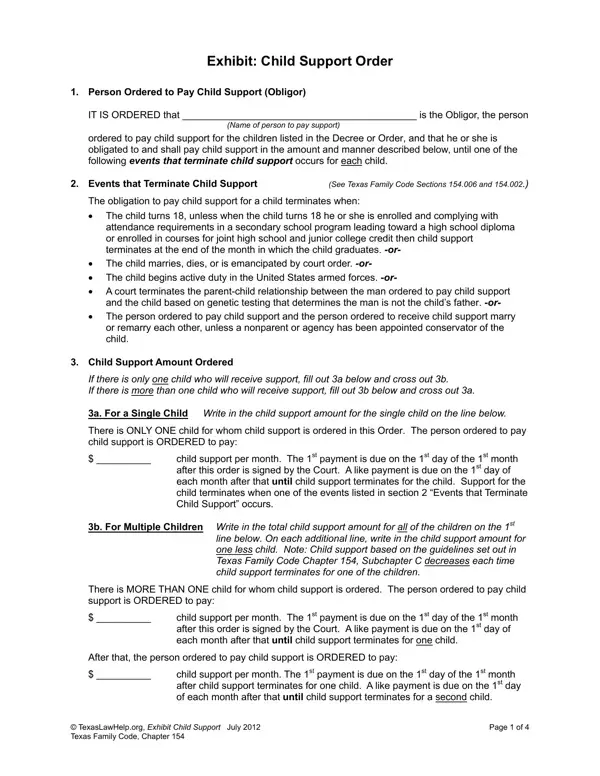
Child support forms in Texas are legal documents used to establish, enforce, or modify financial support obligations between parents. Whether you are the obligor paying support or the obligee receiving it, filling out these forms correctly helps the process move forward without delays or legal complications.
What You Need Before Filling Out the Form
Gather the following information before starting your Texas child support forms to ensure accuracy:
- Full legal names, addresses, and Social Security numbers for both parents
- Names and dates of birth of all children covered by the support order
- Current income details for the obligor, including recent pay stubs or tax returns
- Information about any existing custody arrangements or prior legal agreements
- Court case number if a case has already been filed with a Texas family court
How to Complete the Child Support Order Form
Follow this step-by-step guide to complete your Texas child support forms correctly:
- Enter obligor and obligee details. Provide complete and accurate identifying information for both parties, including addresses used for official legal notices.
- Calculate the monthly support amount. Texas uses income-based guidelines to determine payment amounts. The calculation depends on the obligor's net monthly income and the number of children receiving support.
- Specify payment methods. All payments go through the Texas Child Support State Disbursement Unit, which records every payment and forwards funds to the obligee for legal tracking.
- Identify termination conditions. State the conditions under which child support obligations will end, such as the child turning 18 or graduating from high school.
- Address income withholding provisions. The form includes fields for automatic income withholding directly from the obligor's paycheck, which is the default method in Texas.
- Review, sign, and file. Both parties and the court must review and authorize the completed support order before it becomes a legally binding guide for payments.
Payment and Enforcement in Texas
All child support payments in Texas are processed through the State Disbursement Unit. Using this official channel creates a legal record of every payment, which both parties can reference if a dispute arises in court.
If the obligor fails to make payments, the Texas Office of the Attorney General can enforce the order using income withholding, license suspension, tax refund interception, and other legal tools. Staying current protects the interests of the child and avoids serious legal consequences for the obligor.
Modifying a Child Support Order
Life circumstances change, and Texas law allows either parent to request a modification of an existing child support order. A modification may be approved if there has been a significant change in income, a change in custody arrangements, or if three years have passed since the last order and the new calculation differs by at least 20% or $100 per month. Use an Agreed Motion to Terminate Child Support when both parents agree to end the obligation, or a Child Support Addendum Form to amend specific terms of an existing order.
Frequently Asked Questions
How long does a child in Texas receive support?
Child support in Texas generally continues until the child turns 18 or graduates from high school, whichever occurs later. A court may extend support beyond this point for a child with a disability who requires ongoing care.
Can parents create their own child support agreement?
Yes. Parents can reach a private agreement, but a Texas family court must review and approve it to make the agreement legally enforceable. An official child support certification confirms the terms once both parties and the court sign the document.
What happens if the obligor's income changes?
Either parent can petition the court for a modification based on a substantial change in financial circumstances. The court will recalculate the monthly amount using current income figures and updated Texas legal guidelines.
Are child support forms different for each custody situation?
Yes. The specific forms you need depend on your custody arrangement and legal status. For temporary custody matters, refer to a temporary custody form to address support obligations during pending court proceedings.
