

Form CMS-R-131 at a glance
What it is: The ABN (OMB Approval Number: 0938-0566) is a notice given to beneficiaries in Original Medicare to convey that Medicare is not likely to provide coverage in a specific case.
Who signs: The beneficiary (or representative) must sign the notice to indicate that he or she has received the notice and understands its contents.
Notifiers include physicians, providers, practitioners and suppliers paid under Part B, as well as hospice providers and religious non-medical health care institutions (RNHCIs) paid exclusively under Part A.
A filled-in Form CMS-R-131 example: a patient chooses Option 1
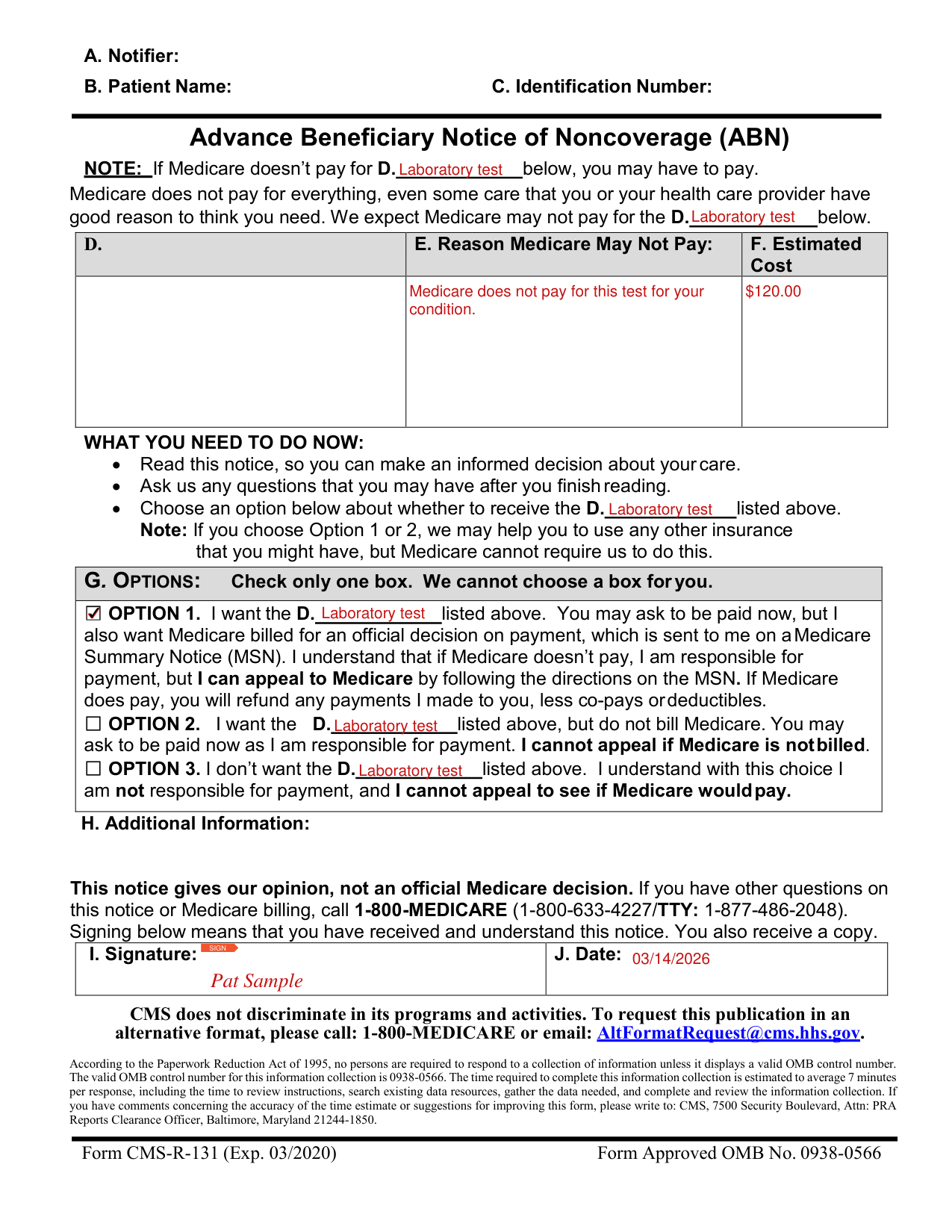
How to fill out Form CMS-R-131, box by box
D. Items, E. Reason Medicare May Not Pay and F. Estimated Cost
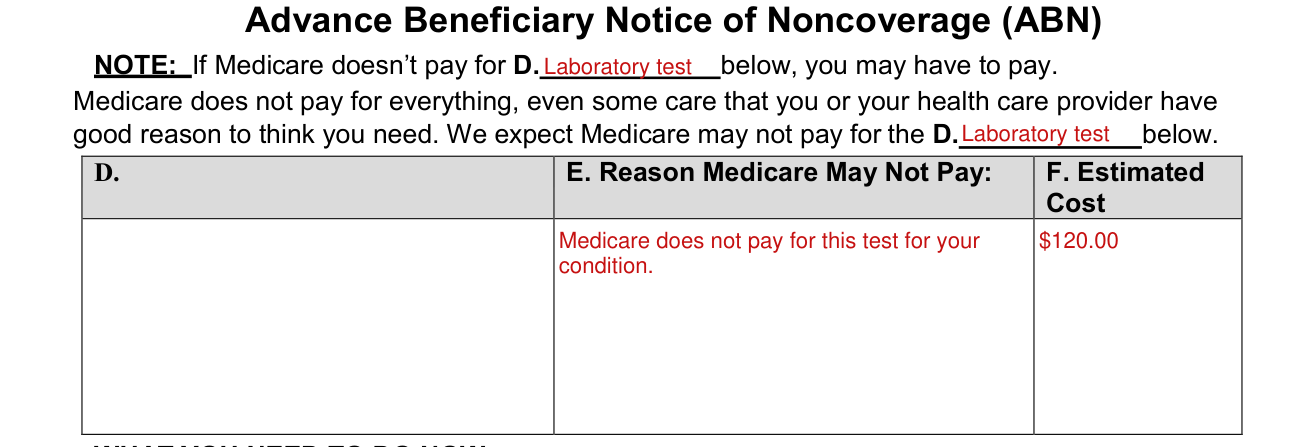
The notifier must list the specific names of the items or services believed to be noncovered in the column directly under the header of Blank (D).
For repetitive or continuous noncovered care, notifiers must specify the frequency and/or duration of the item or service. In the case of partial denials, notifiers must list in the column under Blank (D) the excess component(s) of the item or service for which denial is expected.
The notifier must also insert the blank (D) header information into all of the blanks labeled (D) within the Option Box section, Blank (G). All Blank (D) fields must be completed on the ABN in order for the notice to be considered valid.
In the column under Blank (E), notifiers must explain, in beneficiary friendly language, why they believe the items or services listed in the column under Blank (D) may not be covered by Medicare.
To be a valid ABN, there must be at least one reason applicable to each item or service listed in the column under Blank (D).
Notifiers must make a good faith effort to insert a reasonable estimate for all of the items or services listed under Blank (D).
If for some reason the notifier is unable to provide a good faith estimate of projected costs at the time of ABN delivery, the notifier may indicate in the cost estimate area that no cost estimate is available.
G. Options: Check only one box
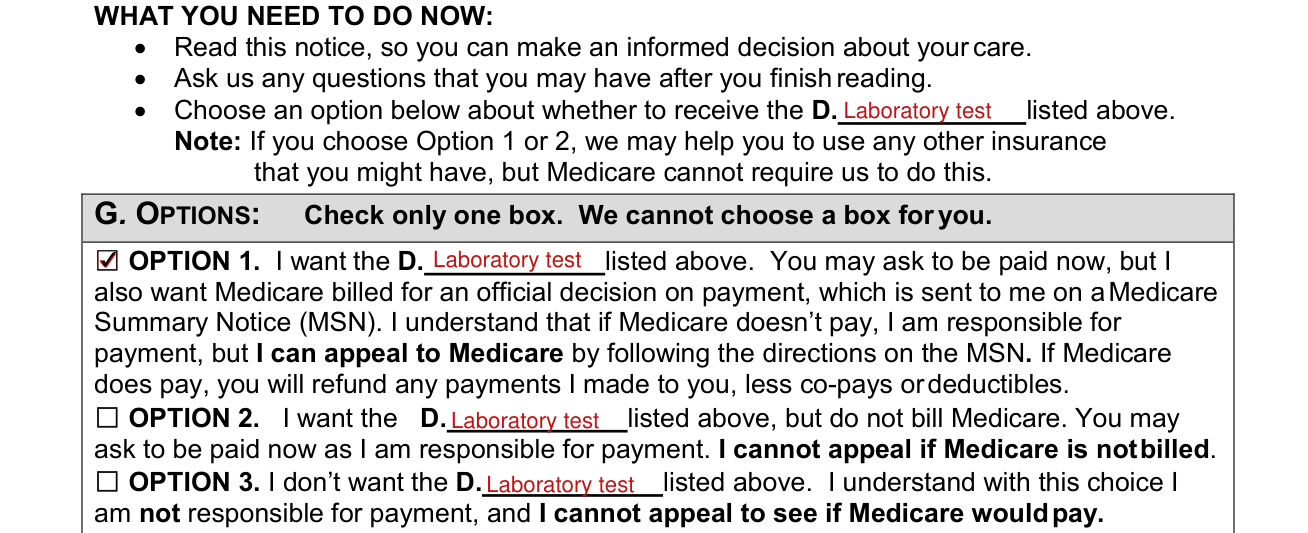
The beneficiary or his or her representative must choose only one of the three options listed in Blank (G).
Under no circumstances can the notifier decide for the beneficiary which of the 3 checkboxes to select. Pre-selection of an option by the notifier invalidates the notice.
Option 1 allows the beneficiary to receive the items and/or services at issue and requires the notifier to submit a claim to Medicare. This will result in a payment decision that can be appealed.
Beneficiaries who need to obtain an official Medicare decision in order to file a claim with a secondary insurance should choose Option 1.
Option 2 allows the beneficiary to receive the noncovered items and/or services and pay for them out of pocket. No claim will be filed and Medicare will not be billed. Thus, there are no appeal rights associated with this option.
Option 3 means the beneficiary does not want the care in question. By checking this box, the beneficiary understands that no additional care will be provided; thus, there are no appeal rights associated with this option.
If there are multiple items or services listed in Blank (D) and the beneficiary wants to receive some, but not all of the items or services, the notifier can accommodate this request by using more than one ABN.
At the beneficiary's request, notifiers may enter the beneficiary's selection if he or she is physically unable to do so. In such cases, notifiers must annotate the notice accordingly.
If the beneficiary cannot or will not make a choice, the notice should be annotated, for example: "beneficiary refused to choose an option."
I. Signature and J. Date

Once the beneficiary reviews and understands the information contained in the ABN, the Signature Box is to be completed by the beneficiary (or representative). This box cannot be completed in advance of the rest of the notice.
Blank (I) should be a cursive signature, with printed annotation if needed in order to be understood.
If a representative signs on behalf of a beneficiary, he or she should write out "representative" in parentheses after his or her signature. The representative's name should be clearly legible or noted in print.
The beneficiary (or representative) must write the date he or she signed the ABN. If the beneficiary has physical difficulty with writing and requests assistance in completing this blank, the date may be inserted by the notifier.
More rules for Form CMS-R-131
ABNs are never required in emergency or urgent care situations.
Medicare inpatient hospitals and skilled nursing facilities (SNFs) use other approved notices for Part A items and services when notice is required; however, these facilities must use the ABN for Part B items and services.
Header Blanks A-C, the header of the notice, must be completed by the notifier prior to delivering the ABN. Blanks (A)-(F) and blank (H) may be completed prior to delivering the notice, as appropriate.
Notifiers must place their name, address, and telephone number (including TTY number when needed) at the top of the notice.
Notifiers must enter the first and last name of the beneficiary receiving the notice, and a middle initial should also be used if there is one on the beneficiary's Medicare (HICN) card.
Use of the Identification Number field is optional. The absence of an identification number does not invalidate the ABN. Medicare numbers (HICN) or Social Security numbers must not appear on the notice.
The ABN must be reviewed with the beneficiary or his/her representative and any questions raised during that review must be answered before it is signed. The ABN must be delivered far enough in advance that the beneficiary or representative has time to consider the options and make an informed choice.
Once all blanks are completed and the form is signed, a copy is given to the beneficiary or representative. In all cases, the notifier must retain a copy of the ABN delivered to the beneficiary on file.
The ABN may also be used to provide voluntary notification of financial liability for items or services that Medicare never covers. When the ABN is used as a voluntary notice, the beneficiary doesn't choose an option box or sign the notice.
Notifiers may use Blank (H) to provide additional clarification that they believe will be of use to beneficiaries.
Common questions about Form CMS-R-131
Is there a deadline?
Physicians, suppliers, practitioners, and providers must complete the ABN and deliver the notice to affected beneficiaries or their representative before providing the items or services that are the subject of the notice.
Sources
[1] Form CMS-R-131 (Exp. 03/2020), Advance Beneficiary Notice of Noncoverage (ABN), Centers for Medicare & Medicaid Services.
