


DA Form 3881 at a glance
What it is: DA Form 3881 is the Rights Warning Procedure/Waiver Certificate.
Who signs: In Section B. Waiver, the interviewee signs under SIGNATURE OF INTERVIEWEE and the investigator signs under SIGNATURE OF INVESTIGATOR.
A filled-in DA Form 3881 example: a soldier waives his rights
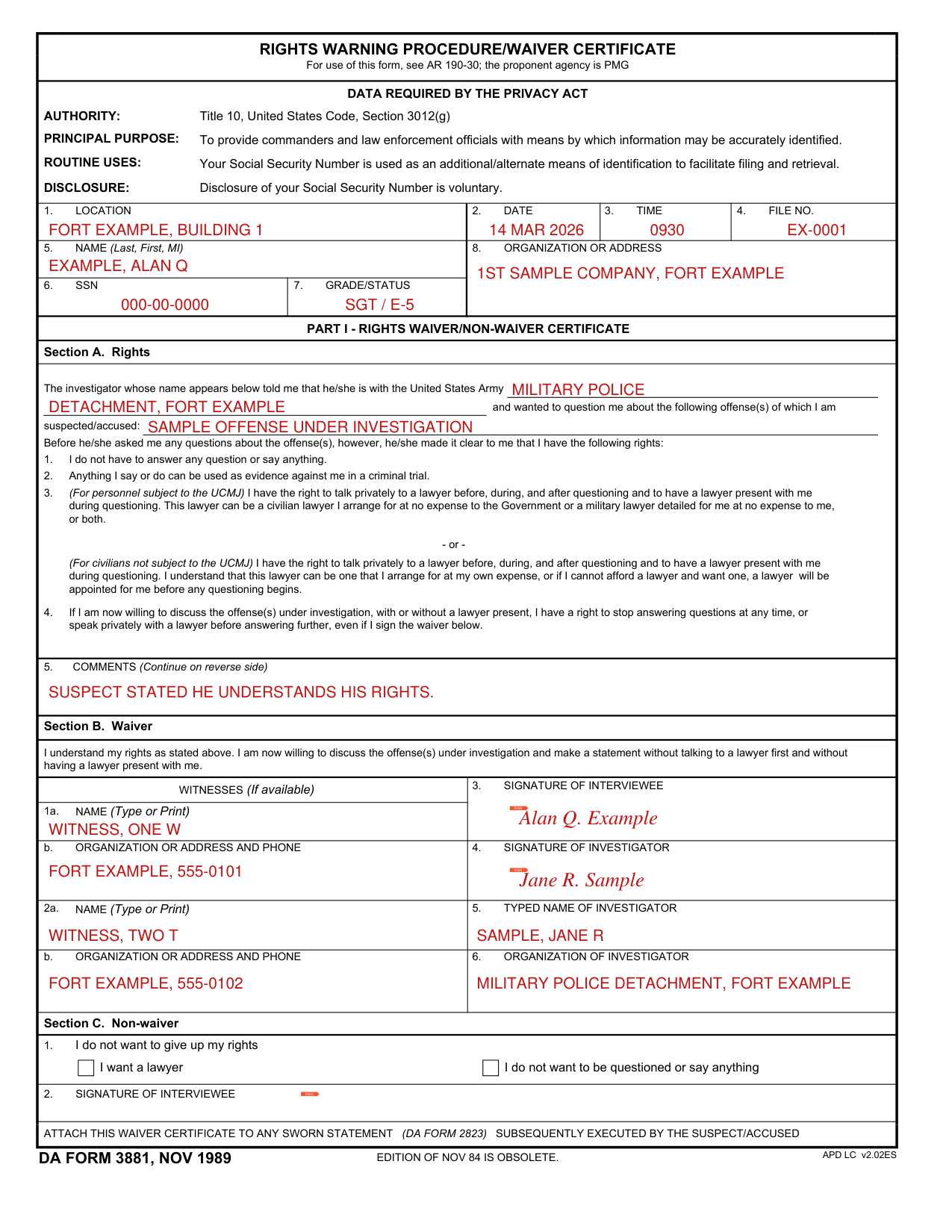
How to fill out DA Form 3881, box by box
Location, date, time and file number

Fill in LOCATION, DATE, TIME and FILE NO.
Name, SSN, grade and organization

Fill in NAME (Last, First, MI), SSN, GRADE/STATUS and ORGANIZATION OR ADDRESS.
Disclosure of your Social Security Number is voluntary.
Your Social Security Number is used as an additional/alternate means of identification to facilitate filing and retrieval.
Section A. Rights

Section A. Rights: "The investigator told me that he/she is with the United States Army and wanted to question me about the following offense(s) of which I am suspected/accused:"; fill in the offense(s) after "suspected/accused:".
Section A. Rights: "I do not have to answer any question or say anything."
Section A. Rights: "Anything I say or do can be used as evidence against me in a criminal trial."
Section A. Rights, for personnel subject to the UCMJ: I have the right to talk privately to a lawyer before, during, and after questioning and to have a lawyer present with me during questioning. This lawyer can be a civilian lawyer I arrange for at no expense to the Government or a military lawyer detailed for me at no expense to me, or both.
Section A. Rights, for civilians not subject to the UCMJ: I have the right to talk privately to a lawyer before, during, and after questioning and to have a lawyer present with me during questioning. I understand that this lawyer can be one that I arrange for at my own expense, or if I cannot afford a lawyer and want one, a lawyer will be appointed for me before any questioning begins.
Section A. Rights: if I am now willing to discuss the offense(s) under investigation, with or without a lawyer present, I have a right to stop answering questions at any time, or speak privately with a lawyer before answering further, even if I sign the waiver.
Comments

Write in COMMENTS (Continue on reverse side).
NOTE: If 1 or 2 applies, the fact that the suspect/accused was advised accordingly should be noted in the comment section on the waiver certificate and initialed by the suspect/accused.
Comments (Continued)
Write in COMMENTS (Continued).
Section B. Waiver
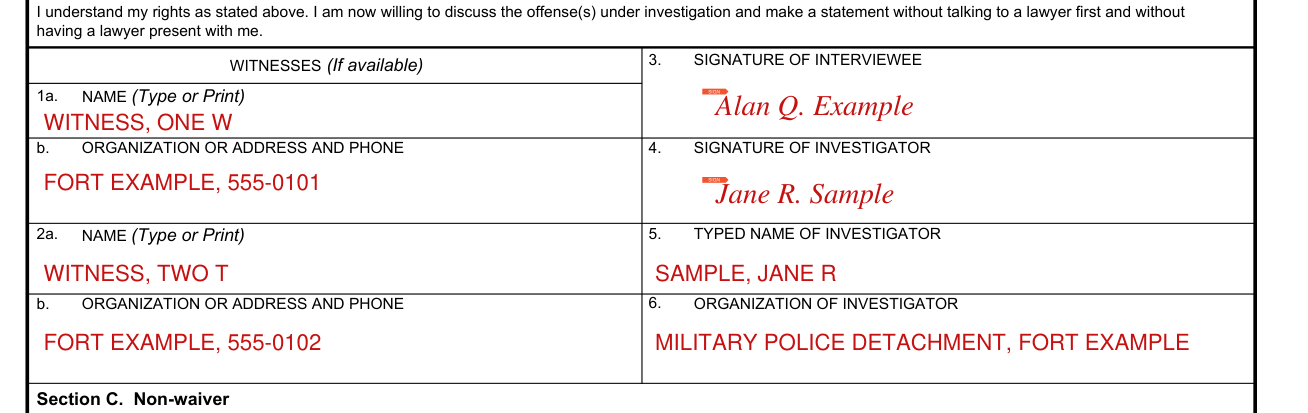
Section B. Waiver: "I understand my rights. I am now willing to discuss the offense(s) under investigation and make a statement without talking to a lawyer first and without having a lawyer present with me."
Under WITNESSES (If available), fill in NAME (Type or Print) and ORGANIZATION OR ADDRESS AND PHONE.
Fill in TYPED NAME OF INVESTIGATOR and ORGANIZATION OF INVESTIGATOR.
Section C. Non-waiver

Section C. Non-waiver: "I do not want to give up my rights"; mark "I want a lawyer" or "I do not want to be questioned or say anything", and sign under SIGNATURE OF INTERVIEWEE.
More rules for DA Form 3881
ATTACH THIS WAIVER CERTIFICATE TO ANY SWORN STATEMENT (DA FORM 2823) SUBSEQUENTLY EXECUTED BY THE SUSPECT/ACCUSED.
The warning, the waiver questions and special instructions
The warning and the waiver questions
THE WARNING: inform the suspect/accused of your official position, the nature of offense(s), and the fact that he/she is a suspect/accused. Advise the suspect/accused of his/her rights as follows: "Before I ask you any questions, you must understand your rights."
THE WAIVER: ask "Do you understand your rights?" If the suspect/accused says "no," determine what is not understood, and if necessary repeat the appropriate rights advisement. If the suspect/accused says "yes," ask "Have you ever requested a lawyer after being read your rights?" If the suspect/accused says "yes," find out when and where. If the request was recent (i.e., fewer than 30 days ago), obtain legal advice whether to continue the interrogation. If the suspect/accused says "no," or if the prior request was not recent, ask "Do you want a lawyer at this time?" If the suspect/accused says "yes," stop the questioning until he/she has a lawyer. If the suspect/accused says "no," ask "At this time, are you willing to discuss the offense(s) under investigation and make a statement without talking to a lawyer and without having a lawyer present with you?" If the suspect/accused says "no," stop the interview and have him/her read and sign the non-waiver section of the waiver certificate. If the suspect/accused says "yes," have him/her read and sign the waiver section of the waiver certificate.
The suspect/accused refuses to sign the waiver certificate
When the suspect/accused refuses to sign the waiver certificate: if the suspect/accused orally waives his/her rights but refuses to sign the waiver certificate, you may proceed with the questioning. Make notations on the waiver certificate to the effect that he/she has stated that he/she understands his/her rights, does not want a lawyer, wants to discuss the offense(s) under investigation, and refuses to sign the waiver certificate.
The waiver certificate cannot be completed immediately
If the waiver certificate cannot be completed immediately: in all cases the waiver certificate must be completed as soon as possible.
Every effort should be made to complete the waiver certificate before any questioning begins. If the waiver certificate cannot be completed at once, as in the case of street interrogation, completion may be temporarily postponed. Notes should be kept on the circumstances.
The suspect/accused displays indecision about requesting counsel
When the suspect/accused displays indecision on exercising his or her rights during the interrogation process: if during the interrogation, the suspect displays indecision about requesting counsel (for example, "Maybe I should get a lawyer."), further questioning must cease immediately. At that point, you may question the suspect/accused only concerning whether he or she desires to waive counsel. The questioning may not be utilized to discourage a suspect/accused from exercising his/her rights. (For example, do not make such comments as "If you didn't do anything wrong, you shouldn't need an attorney.")
The suspect/accused made incriminating statements before being advised
Prior incriminating statements, 1: if the suspect/accused has made spontaneous incriminating statements before being properly advised of his/her rights he/she should be told that such statements do not obligate him/her to answer further questions.
Prior incriminating statements, 2: if the suspect/accused was questioned as such either without being advised of his/her rights or some question exists as to the propriety of the first statement, the accused must be so advised. The office of the serving Staff Judge Advocate should be contacted for assistance in drafting the proper rights advisal.
Sources
[1] DA Form 3881 (NOV 1989), Rights Warning Procedure/Waiver Certificate, Department of the Army (the Official source link on this page).