
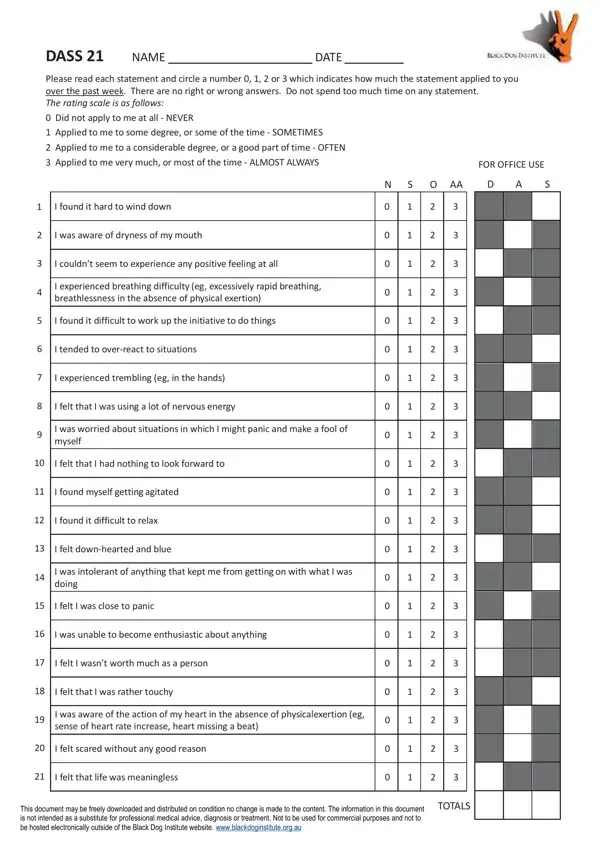
DASS 21 at a glance
What it is: The DASS is a quantitative measure of distress along the 3 axes of depression, anxiety1 and stress2.
A filled-in DASS 21 example: one person rates the 21 statements
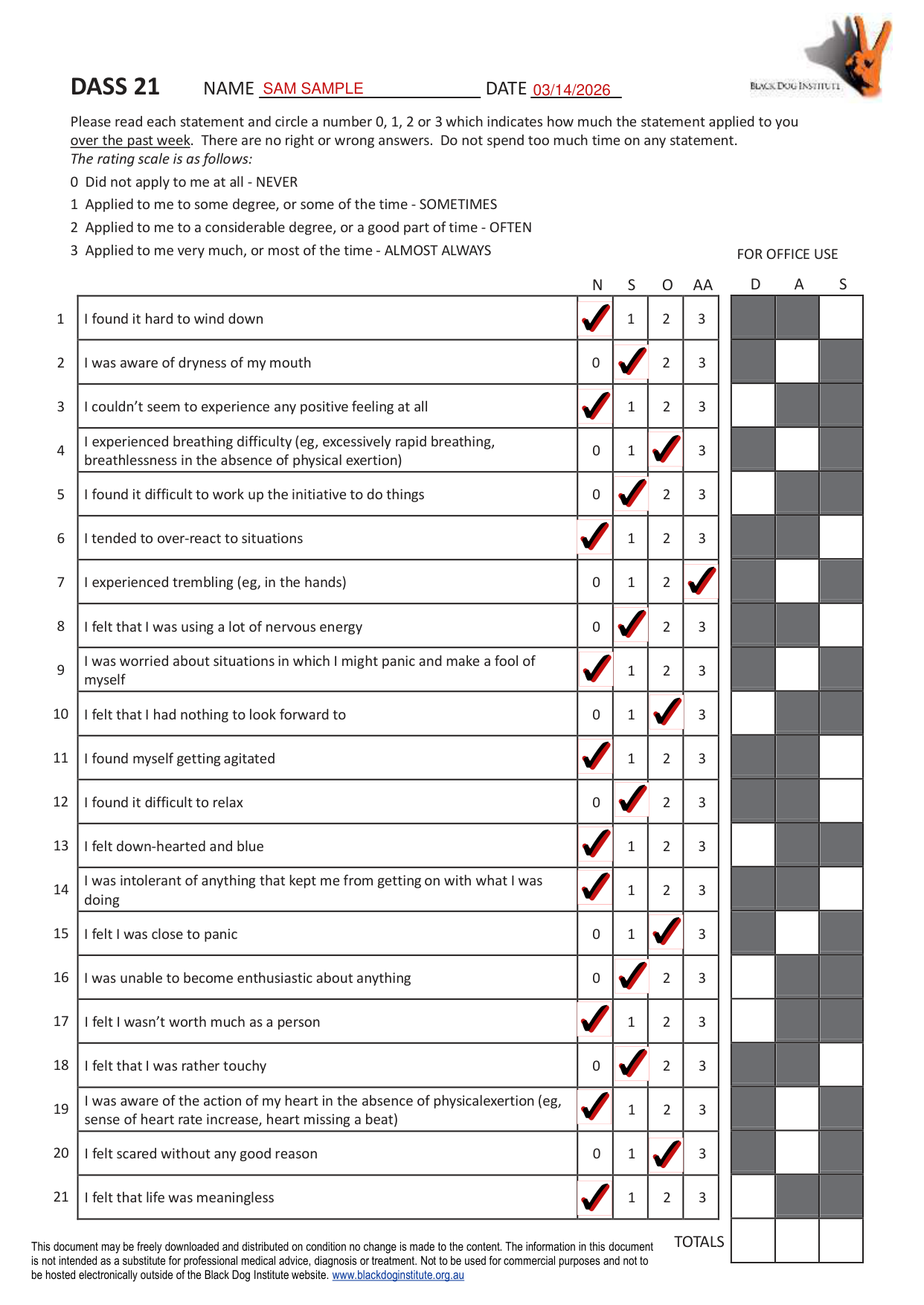
How to fill out DASS 21, box by box
Name and date

Write your NAME and the DATE at the top of the form.
Rating each statement
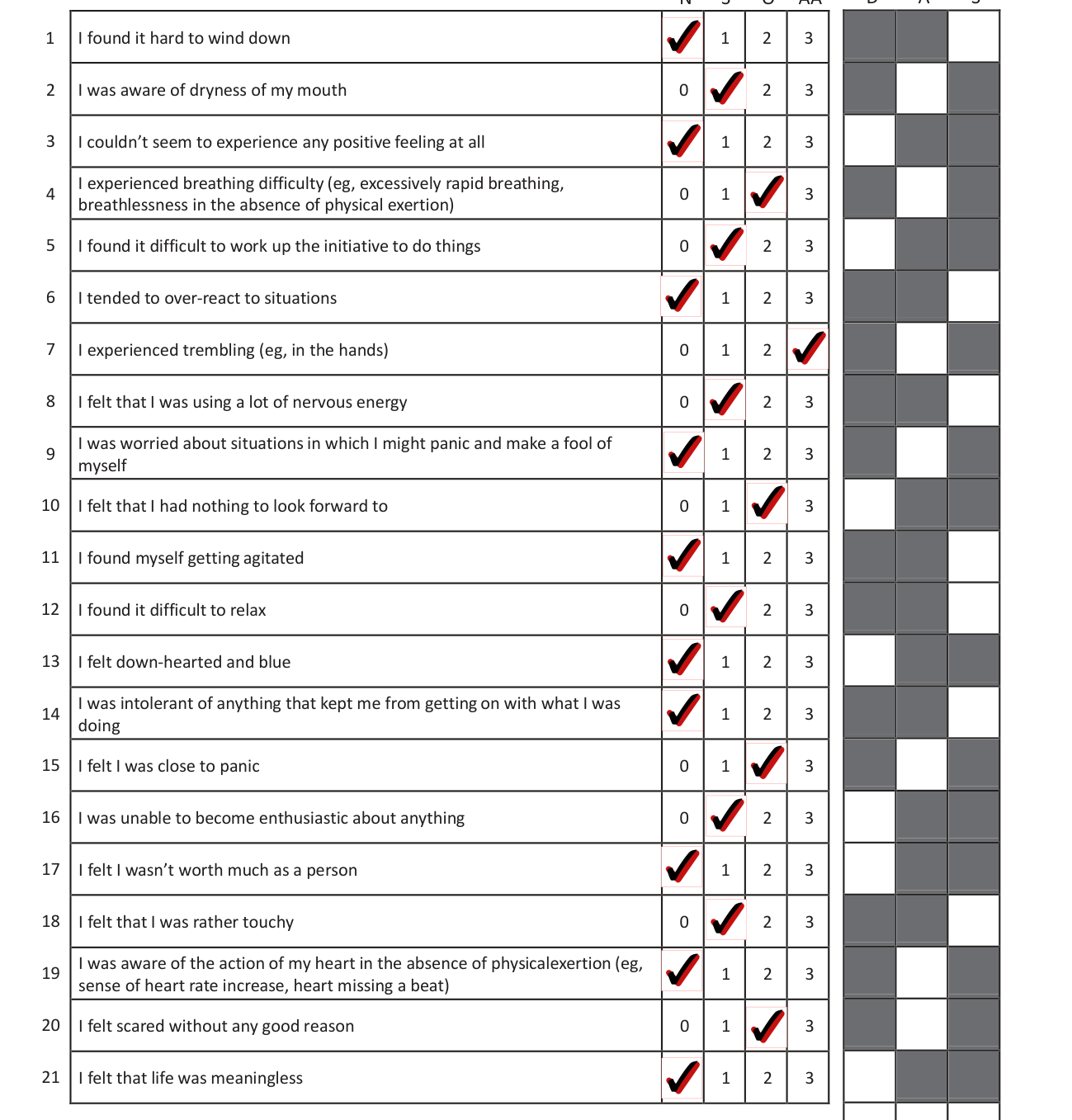
Please read each statement and circle a number 0, 1, 2 or 3 which indicates how much the statement applied to you over the past week. There are no right or wrong answers. Do not spend too much time on any statement. The rating scale: 0 Did not apply to me at all - NEVER 1 Applied to me to some degree, or some of the time - SOMETIMES 2 Applied to me to a considerable degree, or a good part of time - OFTEN 3 Applied to me very much, or most of the time - ALMOST ALWAYS.
DASS 21 scores

Page 2 has the DASS 21 SCORE with a DEPRESSION SCORE, an ANXIETY SCORE and a STRESS SCORE.
Thus the following cut-off scores have been developed for defining mild/moderate/severe/ extremely severe scores for each DASS scale.
Depression: Normal 0 - 4, Mild 5 - 6, Moderate 7 - 10, Severe 11 - 13, Extremely Severe 14 +. Anxiety: Normal 0 - 3, Mild 4 - 5, Moderate 6 - 7, Severe 8 - 9, Extremely Severe 10 +. Stress: Normal 0 - 7, Mild 8 - 9, Moderate 10 - 12, Severe 13 - 16, Extremely Severe 17 +.
More rules for DASS 21
It is not a categorical measure of clinical diagnoses.
Hence the selection of a single cut-off score to represent clinical severity is necessarily arbitrary.
The individual DASS scores do not define appropriate interventions. They should be used in conjunction with all clinical information available to you in determining appropriate treatment for any individual.
Please note that there are differences in scoring between this measure and the DASS 21 as published on the DASS website.
Common questions about DASS 21
What is the Dass-21?
The DASS is a quantitative measure of distress along the 3 axes of depression, anxiety1 and stress2. Emotional syndromes like depression and anxiety are intrinsically dimensional - they vary along a continuum of severity (independent of the specific diagnosis).
When is this form not the right one?
Not to be used for commercial purposes and not to be hosted electronically outside of the Black Dog Institute website. This document may be freely downloaded and distributed on condition no change is made to the content.
Sources
[1] DASS 21 questionnaire, Black Dog Institute version (the served file; no issuer file found) (the Official source link on this page).