
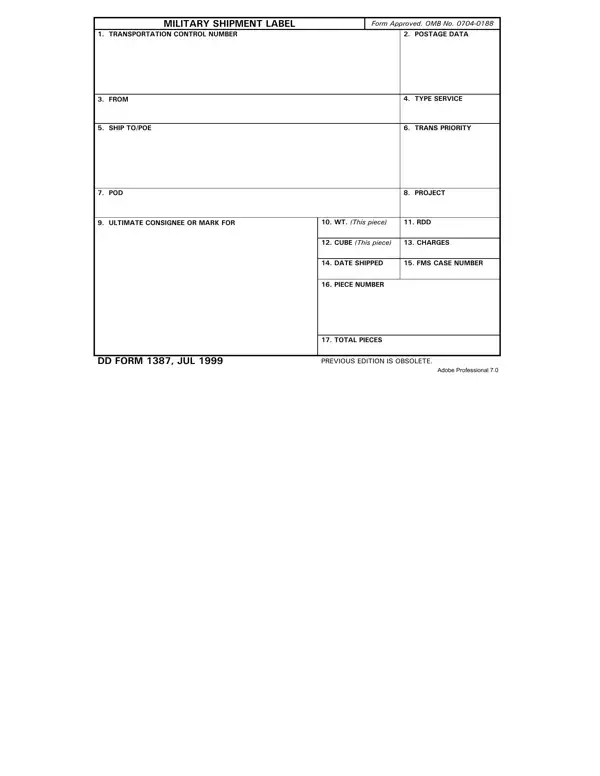
Military Shipment Label (MSL) PDF Details

The Military Shipment Label is the official Department of Defense transportation form used to identify and track every shipment moving through the military supply chain worldwide. Governed by Military Standard 129R (MIL-STD-129R), this label ensures accurate routing, handling, and delivery of military cargo from origin to final destination. The form received approval from the Office of Management and Budget under control number 0704-0188, reflecting its standing as a mandatory government document across all branches of the armed forces.

The label is divided into distinct data blocks, each serving a specific logistical function. The Transportation Control Number (TCN) is a 17-character alphanumeric code assigned to each shipment for end-to-end tracking through the Defense Transportation System. The Department of Defense Activity Address Code (DODAAC) identifies the receiving unit, and a full mailing address including ZIP code and unit name is required for every shipment. The type of service field specifies the transportation mode: air, surface, or water. The transportation priority level (Priority 1 for urgent, Priority 2 for routine, Priority 3 for deferred) is assigned based on mission impact and operational need. The Required Delivery Date (RDD), recorded in Julian date format, indicates when the shipment must arrive at the consignee. Weight in pounds, cube in cubic feet, and piece number fields allow tracking of individual pieces within multi-piece shipments.

Modern military shipment labels also incorporate passive RFID technology per MIL-STD-129R requirements. RFID tags must be applied to each individual piece and encoded with data matching the printed label. This enables automated identification without line-of-sight scanning, improving supply chain visibility for Department of Defense logistics managers. The label must be applied to all sides of a shipping container that do not already carry markings from prior shipments. For sensitive or classified cargo, a companion label with distinctive markings is required to ensure appropriate security handling. Proper use of the label is a regulatory requirement under the Defense Transportation Regulation.

QuestionAnswer
Form NameMilitary Shipment Label (DD 1387)
Form Length1 pages
Fillable?No
Fillable fields0
Avg. time to fill out15 sec
Other namesdd 1387 2 fillable, dd 1387 fillable, dd1387, 1387
Governing StandardMIL-STD-129R
Issued byOffice of the Secretary of Defense (OSD)
OMB Control No.0704-0188
Label TypesStandard and Sensitive Cargo

How to Edit Dd Form 1387 Online for Free

By using the online PDF tool by FormsPal, you can fill out or download the Military Shipment Label right here. Our team designed this editor to help military personnel, defense contractors, and government agencies complete the form quickly and accurately. Follow the steps below to complete each required data block.

Step 1: Open the Form

Click the "Get Form" button at the top of this page. The label PDF opens in FormsPal's online editor without any downloads or registration required.

Part number 1 for submitting dd form 1387 2

Step 2: Enter Shipment Identification Data

Begin with the identification block at the top of the label. Enter the Transportation Control Number (TCN) in full. The TCN is a 17-character code assigned by your unit's transportation management office or shipping officer. Enter the consignee DODAAC and complete delivery address, including unit name, ZIP code, and country if applicable.

Step number 2 in completing dd form 1387 2

Step 3: Complete Transportation and Priority Fields

Select the mode of transportation (air, surface, or water) and the transportation priority level. Enter the Required Delivery Date in Julian date format. Record the gross weight in pounds and the cube in cubic feet for each piece. For a multi-piece shipment, record each piece number and the total quantity of pieces in the lot.

Step 4: Apply RFID Tags and Attach the Label

Once all fields are filled, save the completed label as a PDF or print it directly. Apply passive RFID tags to each piece as required by MIL-STD-129R and your unit's standard operating procedures. Attach the label to all sides of the container that do not have markings from prior shipments.

Frequently Asked Questions

What is the difference between the standard label and the sensitive cargo version?
The standard Military Shipment Label covers routine military cargo. The companion label (DD 1387-2) is required for classified, pilferable, or hazardous shipments and features distinctive markings for restricted handling.

Where do I find the Transportation Control Number?
The TCN is assigned by your shipping officer or transportation management office. It combines the origin DODAAC, Julian date, and a unit shipment serial number into a 17-character alphanumeric code.

Is RFID tagging required on all military shipments?
Yes. MIL-STD-129R mandates passive RFID tags on shipments to designated military consignees. Tag data must match all fields on the printed label to ensure supply chain visibility.

Can I use this form for Foreign Military Sales shipments?
Yes. The label includes a field for the Foreign Military Sales (FMS) Case Number when the shipment involves an international military transaction under an approved FMS agreement.

Who Uses the Military Shipment Label

The label is required for all shipments entering the Defense Transportation System, regardless of the originating branch of service. Transportation officers, supply sergeants, logistics coordinators, and shipping clerks at military installations, defense contractors, and government depots all use this form. Foreign Military Sales program administrators also use it when routing international defense shipments to allied nations. The label applies whether the shipment moves by air, ground, or sea. Any unit or organization shipping materials to a military address must complete the label and attach it to all sides of the packaging before the carrier accepts the shipment.

Common Errors to Avoid

Incorrect or missing data on the label causes delays and loss of tracking visibility. Common errors include an incomplete DODAAC, missing or wrong Required Delivery Date, incorrect transportation priority, and omission of the piece count. RFID tags that do not match the label data also trigger compliance failures. Review all fields against the original shipment documentation before applying the label to the container.

Related Military Shipping and Logistics Forms

The Military Shipment Label is used alongside other Department of Defense forms throughout the logistics process. Here are the most commonly paired documents:

  • DD Form 250 - Material Inspection and Receiving Report used by receiving units to confirm delivery and accept items into inventory.
  • DD Form 1351-2 - Travel Voucher used to claim reimbursement for authorized transportation expenses.
  • Drop Shipment Certificate - Required when commercial carriers deliver DOD freight directly to a non-military address.
  • Shipping Manifest - Accompanies bulk shipments to list every item included in the consignment.
  • Military Power of Attorney - Authorizes a representative to receive or transfer military property on behalf of a service member.