
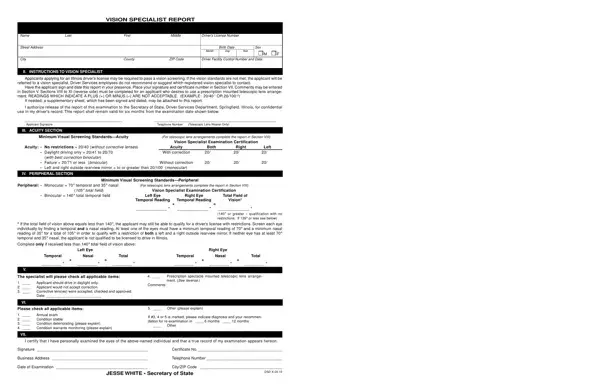

Form DSD X 20 at a glance
What it is: The Vision Specialist Report is an Illinois Secretary of State form reporting the applicant's examination.
Who signs: On the Provider's Signature line, stamped signatures are unacceptable.
A filled-in Form DSD X 20 example: a vision specialist completes the front of the report
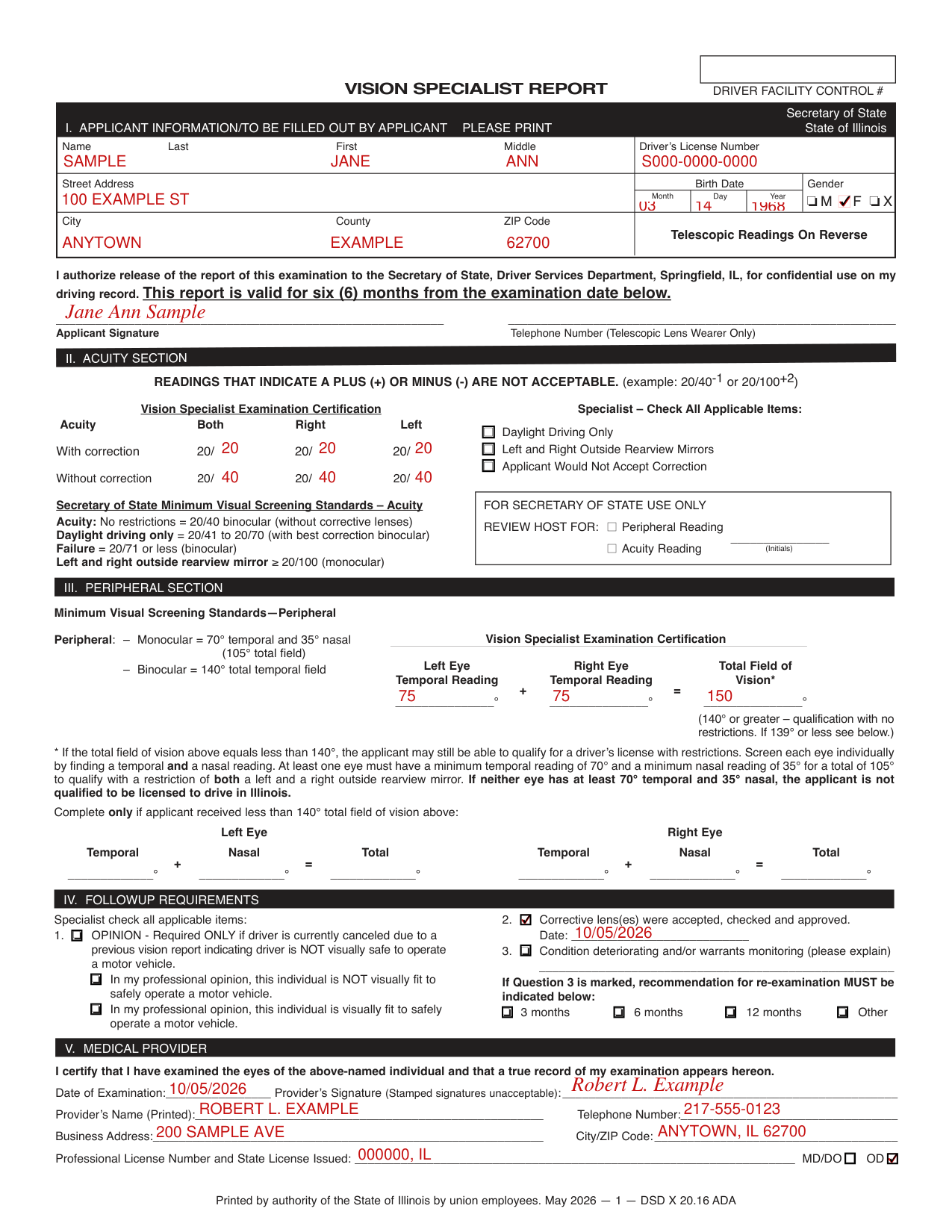
How to fill out Form DSD X 20, box by box
I. Applicant information
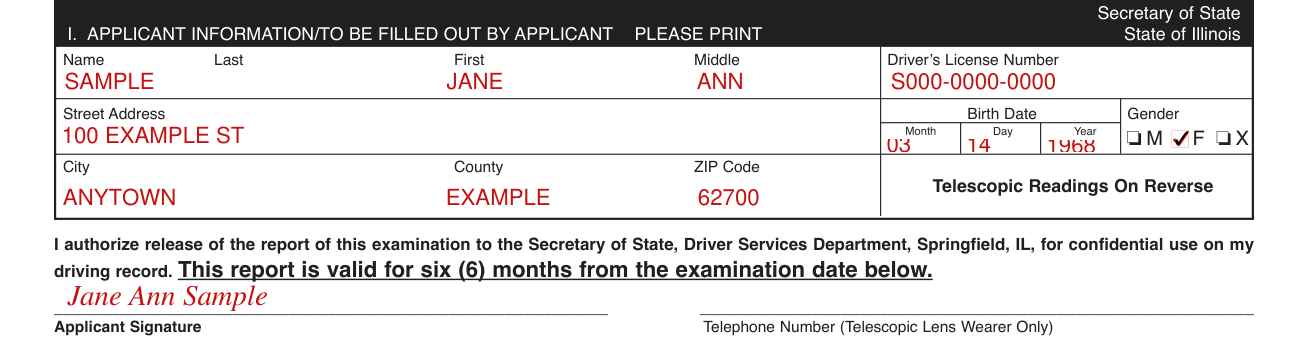
Applicant Information is to be filled out by the applicant; please print.
Enter the applicant's Name (Last, First, Middle), Driver's License Number, Street Address, City, County and ZIP Code.
Enter the Birth Date as Month, Day and Year, and mark the Gender box: M, F or X.
The applicant authorizes release of the report of this examination to the Secretary of State, Driver Services Department, Springfield, IL, for confidential use on the applicant's driving record.
This report is valid for six (6) months from the Date of Examination.
Sign on the Applicant Signature line, and enter the Telephone Number (Telescopic Lens Wearer Only).
II. Acuity section

In the Acuity Section, enter the readings With correction and Without correction for Both, Right and Left. Readings that indicate a plus (+) or minus (-) are not acceptable.
Specialist, check all applicable items: Daylight Driving Only, Left and Right Outside Rearview Mirrors, Applicant Would Not Accept Correction.
Secretary of State minimum standards for acuity: no restrictions is 20/40 binocular (without corrective lenses); daylight driving only is 20/41 to 20/70 (with best correction binocular); failure is 20/71 or less (binocular); left and right outside rearview mirror is ≥ 20/100 (monocular).
III. Peripheral section
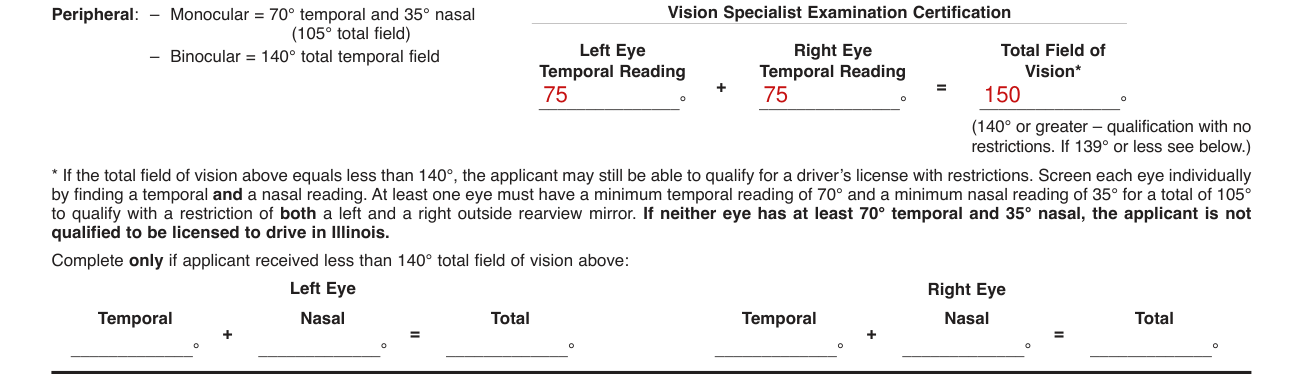
In the Peripheral Section, enter the Left Eye Temporal Reading, the Right Eye Temporal Reading and the Total Field of Vision.
Complete the Left Eye and Right Eye Temporal, Nasal and Total boxes only if the applicant received less than 140° total field of vision in the Total Field of Vision box.
IV. Followup requirements

In Followup Requirements, the specialist checks all applicable items. The opinion is required only if the driver is currently canceled due to a previous vision report indicating the driver is not visually safe to operate a motor vehicle.
The opinion boxes say: in the specialist's professional opinion, this individual is not visually fit to safely operate a motor vehicle, or is visually fit to safely operate a motor vehicle.
Mark box 2 when corrective lens(es) were accepted, checked and approved, and enter the Date.
Question 3 is marked when the condition is deteriorating and/or warrants monitoring; please explain.
If Question 3 is marked, a recommendation for re-examination MUST be indicated: 3 months, 6 months, 12 months or Other.
V. Medical provider

In Medical Provider, the provider certifies that the provider examined the eyes of the named individual of this form and that a true record of the examination appears hereon.
Enter the Date of Examination.
On the Provider's Signature line, stamped signatures are unacceptable.
Enter the Provider's Name (Printed), Telephone Number, Business Address, City/ZIP Code, and the Professional License Number and State License Issued; mark MD/DO or OD.
VI. Telescopic acuity section

In the Telescopic Acuity Section, all readings must be completed: enter the acuity Through carrier lenses, Through telescopic lenses and Without correction for Both, Right and Left.
Secretary of State minimum standards for telescopic acuity: central acuity through the telescopic lens must be ≥ 20/40; central acuity through the carrier must be ≥ 20/100; left and right outside rearview mirror ≥ 20/100 (monocular vision through telescopic lenses).
VII. Telescopic peripheral section
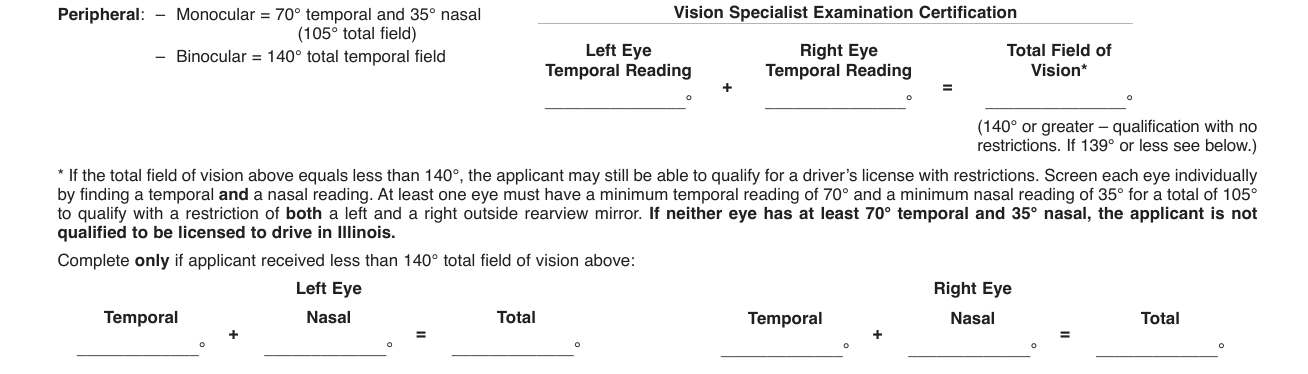
In the Telescopic Peripheral Section, enter the Left Eye Temporal Reading, the Right Eye Temporal Reading and the Total Field of Vision.
In the Telescopic Peripheral Section, complete the Left Eye and Right Eye Temporal, Nasal and Total boxes only if the applicant received less than 140° total field of vision in the Telescopic Peripheral Section.
VIII. Telescopic applicant issued and received lens arrangement
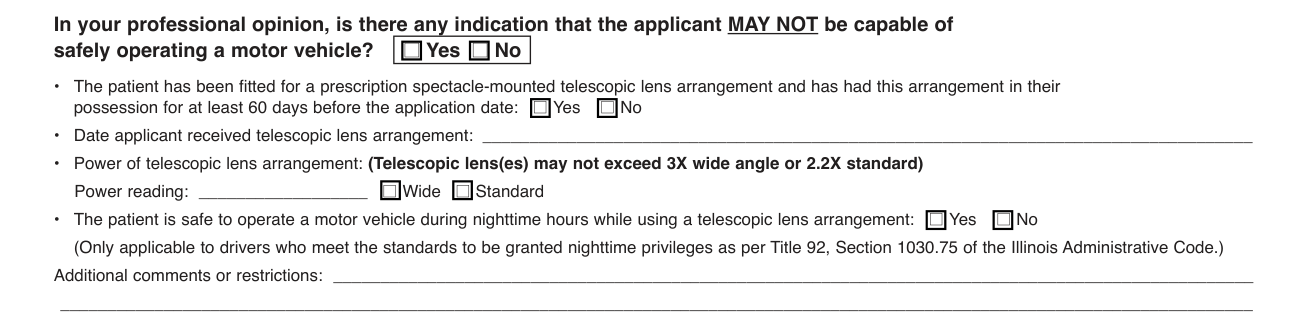
Mark Yes or No: in your professional opinion, is there any indication that the applicant may not be capable of safely operating a motor vehicle?
Mark Yes or No: the patient has been fitted for a prescription spectacle-mounted telescopic lens arrangement and has had this arrangement in their possession for at least 60 days before the application date.
Enter the date the applicant received the telescopic lens arrangement.
Enter the power reading of the telescopic lens arrangement and mark Wide or Standard; telescopic lens(es) may not exceed 3X wide angle or 2.2X standard.
Mark Yes or No: the patient is safe to operate a motor vehicle during nighttime hours while using a telescopic lens arrangement. This is only applicable to drivers who meet the standards to be granted nighttime privileges as per Title 92, Section 1030.75 of the Illinois Administrative Code.
Enter any additional comments or restrictions.
IX. Telescopic requirements

Mark Yes or No: the patient has completed all the requirements listed in Telescopic Requirements after the 60-day period of the new/current prescription.
More rules for Form DSD X 20
In the Peripheral Section and the Telescopic Peripheral Section, a Total Field of Vision of 140° or greater is qualification with no restrictions.
If the Total Field of Vision box equals less than 140°, the applicant may still be able to qualify for a driver's license with restrictions. Screen each eye individually by finding a temporal and a nasal reading. At least one eye must have a minimum temporal reading of 70° and a minimum nasal reading of 35° for a total of 105° to qualify with a restriction of both a left and a right outside rearview mirror. If neither eye has at least 70° temporal and 35° nasal, the applicant is not qualified to be licensed to drive in Illinois.
If your situation is different
The applicant wears prescription spectacle-mounted telescopic lenses
The reverse side is to be completed for Prescription Mounted Telescopic Lens Wearers ONLY.
Sections I, IV and V (front) and the following sections must be completed for prescription spectacle-mounted telescopic lens wearers.
Applicants who qualify to drive using a prescription telescopic lens arrangement are restricted to driving during daylight hours only, unless otherwise indicated, and are eligible for a Class “D” driver's license only.
Sources
[1] Form DSD X 20 (May 2026), Vision Specialist Report, Illinois Secretary of State (the Official source link on this page).