
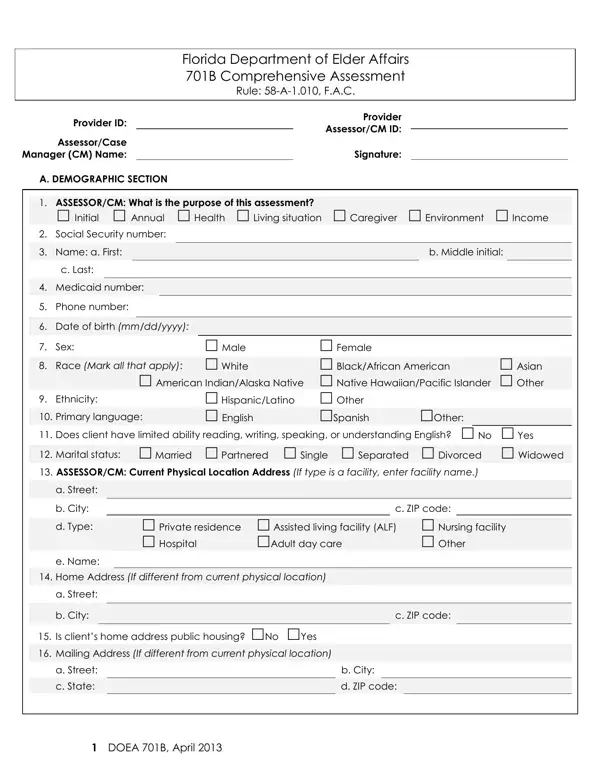
Florida DOEA Form 701B at a glance
What it is: Florida Department of Elder Affairs 701B Comprehensive Assessment, Rule: 58-A-1.010, F.A.C.
Who signs: The Assessor/Case Manager (CM) signs on the Signature line.
What to bring and attach to Florida DOEA Form 701B
If you have a printed list of meds managed by a facility, attach sheet.
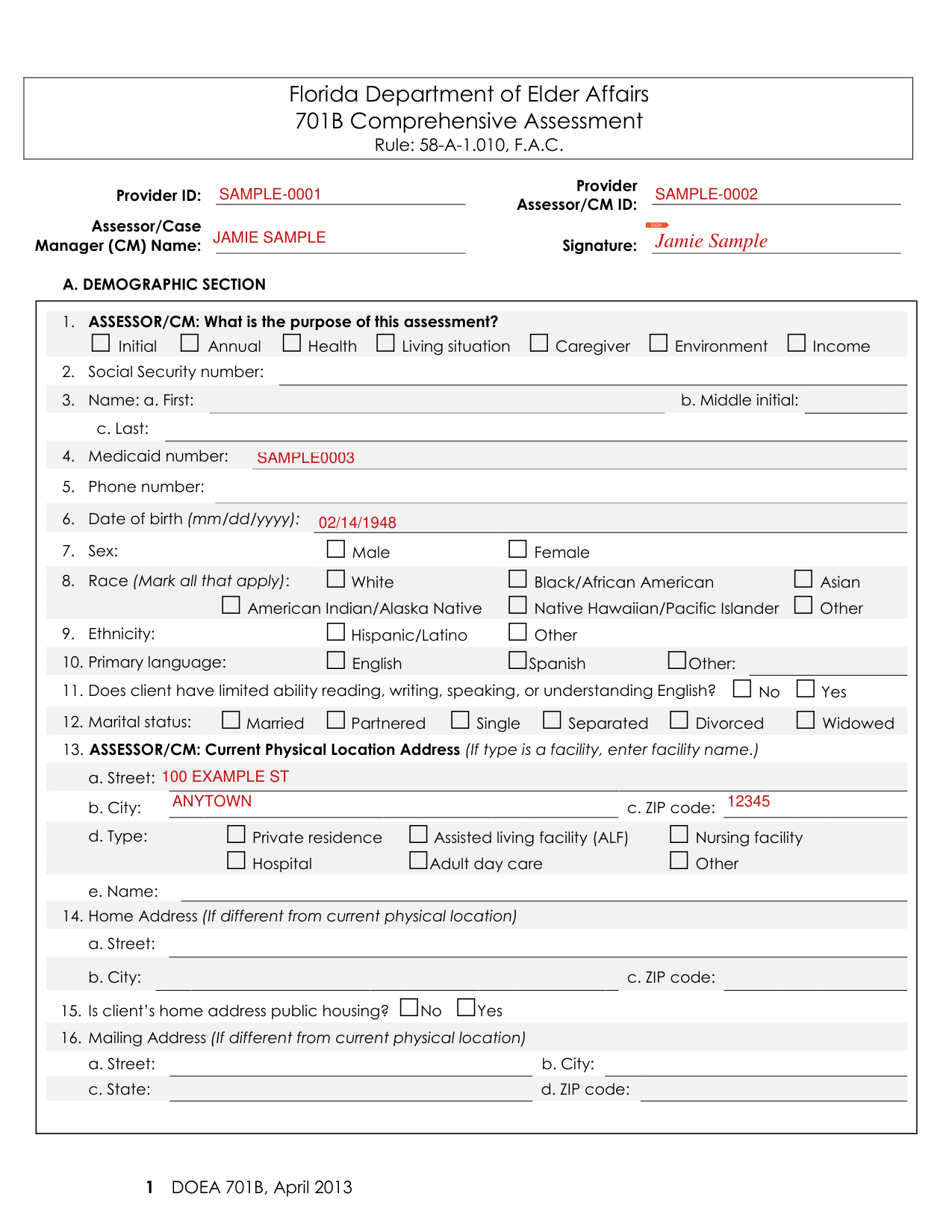
A filled-in Florida DOEA Form 701B example: an assessor enters the identifiers and an address
How to fill out Florida DOEA Form 701B, box by box
Provider ID, Assessor/Case Manager (CM) Name and Signature

Enter the Provider ID, the Provider Assessor/CM ID and the Assessor/Case Manager (CM) Name.
The Assessor/Case Manager (CM) signs on the Signature line.
Medicaid number and Date of birth

Enter the Medicaid number in 4 and the Date of birth (mm/dd/yyyy) in 6.
Current Physical Location Address

In 13, enter the Current Physical Location Address: a. Street, b. City, c. ZIP code. If type is a facility, enter facility name.
More rules for Florida DOEA Form 701B
In 14, enter the Home Address (If different from current physical location): a. Street, b. City, c. ZIP code.
In 16, enter the Mailing Address (If different from current physical location): a. Street, b. City, c. State, d. ZIP code.
In 33, is someone besides the client providing answers to questions? No (Skip to 34). Yes: Name, Relationship.
In 34, enter how many children under age 19 you live with and provide care for, besides your own children (if zero, skip to 35). In 35, enter how many disabled adults age 19 to 59 you live with and provide care for (if zero, skip to 36).
In 45, have you become concerned about your memory or had problems remembering important things? No (Skip to 47). Yes.
In 62, mark No, Yes or Blind (If blind, skip to 63). In 63, mark No, Yes or Deaf (If deaf, skip to 64).
In 74, indicate whether a problem occurred in the past by marking the first box and when a problem is current by marking the second box. Mark all that apply.
In the G. MENTAL HEALTH SECTION, if the client is not answering questions, skip to Question 81. If the client answered “Not at all” to a-i, skip to Question 81.
Thoughts of suicide or self-injury, hallucinations, or aggressive behaviors are potentially serious problems that should be reported immediately to a supervisor, primary care physician, emergency care, law enforcement, and/or Adult Protective Services, as appropriate.
In 82, indicate whether you noticed problem behaviors or any recurring problems have been reported to you by the client, caregiver, in-home worker, family, or staff, and note the frequency of occurrence in the last month. Provide details in the Notes & Summary section.
In 84, if information about the client's residence is reported to you, without your observation, check here and all that apply. If residence issues are directly observed by you, use the list to observe and check off the specific issue(s) with the potential for safety or accessibility problems.
If there are more medications to record, use the Notes & Summary section or a blank sheet of paper to write the information.
If you have more than ten physicians to record, use the Notes & Summary section or a blank sheet of paper to write the information.
In the L. CAREGIVER SECTION, if client has no caregiver, stop the assessment. If client has a caregiver, complete 115-136.
In 136, ask the caregiver to answer the following about the client. (An answer of “Yes, a change” indicates that there has been a change in the last year caused by thinking and memory problems.)
Your Social Security number is being collected pursuant to Title 42 Code of Federal Regulations, Section 435.910, to be used for screening and referral to programs or services that may be appropriate for you. The provision of your Social Security number is voluntary.
Sources
[1] Florida Department of Elder Affairs 701B Comprehensive Assessment (DOEA 701B, April 2013) (the Official source link on this page).