
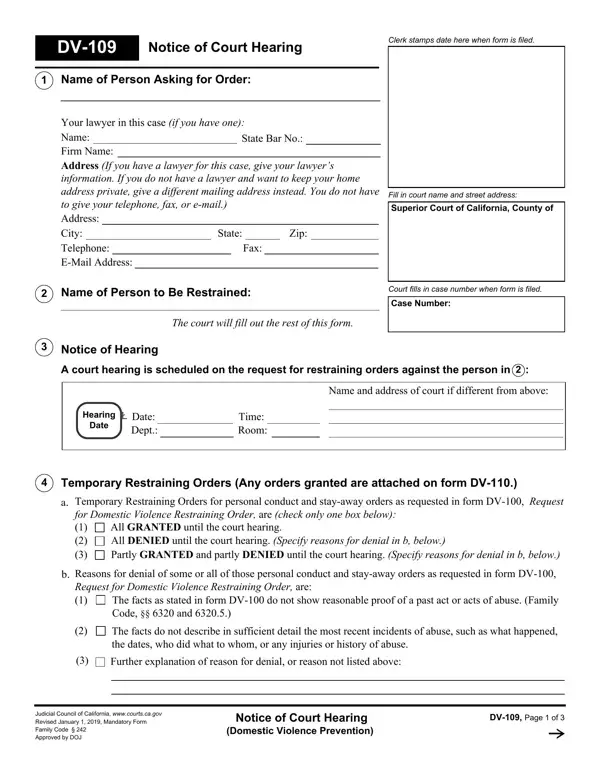
Form DV-109 at a glance
What it is: DV-109 is the Notice of Court Hearing (Domestic Violence Prevention).
The person asking for a restraining order must complete items 1 and 2. The court will complete the rest of this form.
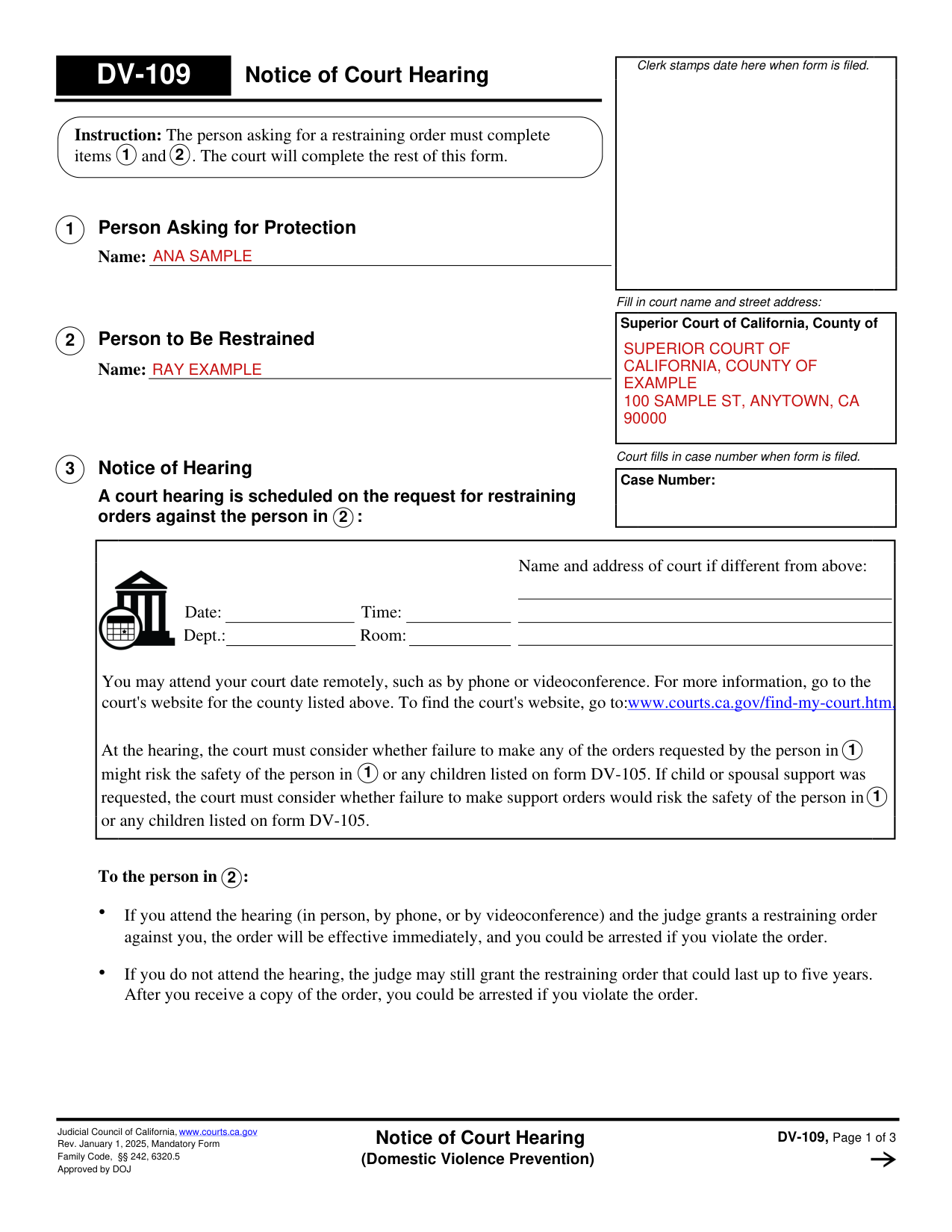
A filled-in Form DV-109 example: a person asks for a restraining order
How to fill out Form DV-109, box by box
Person Asking for Protection

Under Person Asking for Protection, enter the Name.
Fill in court name and street address

Fill in court name and street address under Superior Court of California, County of.
Person to Be Restrained

Under Person to Be Restrained, enter the Name.
More rules for Form DV-109
The court fills in the Case Number when the form is filed.
The clerk stamps the date when the form is filed.
A court hearing is scheduled on the request for restraining orders against the Person to Be Restrained, with the Date, Time, Dept. and Room.
You may attend your court date remotely, such as by phone or videoconference.
To the Person to Be Restrained: If you attend the hearing (in person, by phone, or by videoconference) and the judge grants a restraining order against you, the order will be effective immediately, and you could be arrested if you violate the order.
To the Person to Be Restrained: If you do not attend the hearing, the judge may still grant the restraining order that could last up to five years. After you receive a copy of the order, you could be arrested if you violate the order.
Any orders granted are attached on form DV-110. The court will complete Temporary Restraining Orders (any order requested under Family Code section 6320): (1) All granted until the court hearing; (2) All denied until the court hearing (Reasons for denial are given below in b); or (3) Partly granted and partly denied until the court hearing (Reasons for denial are given in b).
Reasons for denial of some or all of the orders requested on form DV-100: (1) The facts given in the request (form DV-100) do not show reasonable proof of a past act or acts of abuse. (Family Code sections 6300, 6320, and 6320.5.) (2) The facts given in the request do not give enough detail about the most recent incidents of abuse, including what happened, the dates, who did what to whom, or any injuries or history of abuse. (3) Other reasons for denial.
A request to keep minor's information confidential was made (see form DV-160) and granted; see form DV-165, Order on Request to Keep Minor's Information Confidential, served with this form.
The forms indicated are DV-100, Request for Domestic Violence Restraining Order (file-stamped); DV-110, Temporary Restraining Order (file-stamped), if granted; DV-120, Response to Request for Domestic Violence Restraining Order (blank form); DV-120-INFO, How Can I Respond to a Request for Domestic Violence Restraining Order?; DV-170, Notice of Order Protecting Information of Minor, and DV-165, Order on Request to Keep Minor's Information Confidential (file-stamped), if granted; and Other (specify).
To the Person Asking for Protection, at the hearing: The judge will decide if a restraining order is needed to keep you or your children safe. If the judge grants you a restraining order at the hearing, it can last up to five years.
You must attend the hearing if you want the judge to make any of the orders you requested on form DV-100.
Bring any evidence or witnesses you have.
Option to cancel hearing: If item a(2) or a(3) is checked, you have the option of canceling the hearing. If you cancel the hearing, your request for restraining order will not move forward. Any temporary orders made will expire on the day of the hearing. If you want to cancel the hearing, use form Waiver of Hearing on Denied Request for Temporary Restraining Order.
Before the hearing: You must have someone personally serve (give) the Person to Be Restrained a copy of all the papers listed in Service of Documents by the deadline listed there. You may ask to reschedule the hearing if you are unable to serve the Person to Be Restrained and need more time to serve the documents, or for other good reasons.
To the Person to Be Restrained, respond in writing (optional): You can respond in writing by completing form DV-120, Response to Request for Domestic Violence Restraining Order.
At the hearing: Whether or not you respond in writing, attend the hearing if you want the judge to hear from you before making an order. At the hearing, tell the judge why you agree or disagree with the orders requested.
If you are unable to attend your court hearing or need more time to prepare your case, you may ask the judge to reschedule your court date.
Request for Accommodations: Assistive listening systems, computer-assisted real-time captioning, or sign language interpreter services are available if you ask at least five days before the hearing.
Common questions about Form DV-109
Is there a deadline?
At least the number of days the court marks in Service of Documents (five, or another number the court fills in) before the hearing, someone age 18 or older, not you or anyone to be protected, must personally give (serve) a court file-stamped copy of this form (DV-109, Notice of Court Hearing) to the Person to Be Restrained.
Is there a penalty?
If the request was granted, the information described on the order (form DV-165) must be kept CONFIDENTIAL, and the disclosure or misuse of the information is punishable as a sanction, with a fine of up to $1,000 or other court penalties (checked November 8, 2026).
What am I certifying when I sign?
Clerk's Certificate (Clerk will fill out this part): "I certify that this Notice of Court Hearing is a true and correct copy of the original on file in the court."
Sources
[1] Form DV-109 (Rev. January 1, 2025), Notice of Court Hearing (Domestic Violence Prevention), Judicial Council of California (the Official source link on this page).