
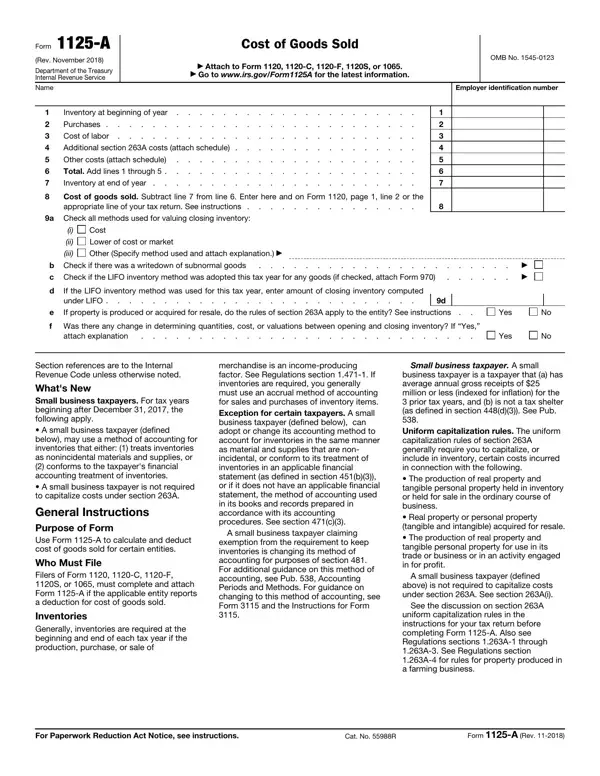

Form 1125-A at a glance
What it is: Use Form 1125-A to figure and deduct cost of goods sold for certain entities. Filers of Form 1120, 1120-C, 1120-F, 1120S, or 1065 must complete and attach Form 1125-A if the applicable entity reports a deduction for cost of goods sold.
Before completing Form 1125-A, see the discussion on section 263A uniform capitalization rules in the instructions for your tax return. Also see Regulations sections 1.263A-1 through 1.263A-3. See Regulations section 1.263A-4 for rules for property produced in a farming business and Pub. 225, Farmer's Tax Guide.
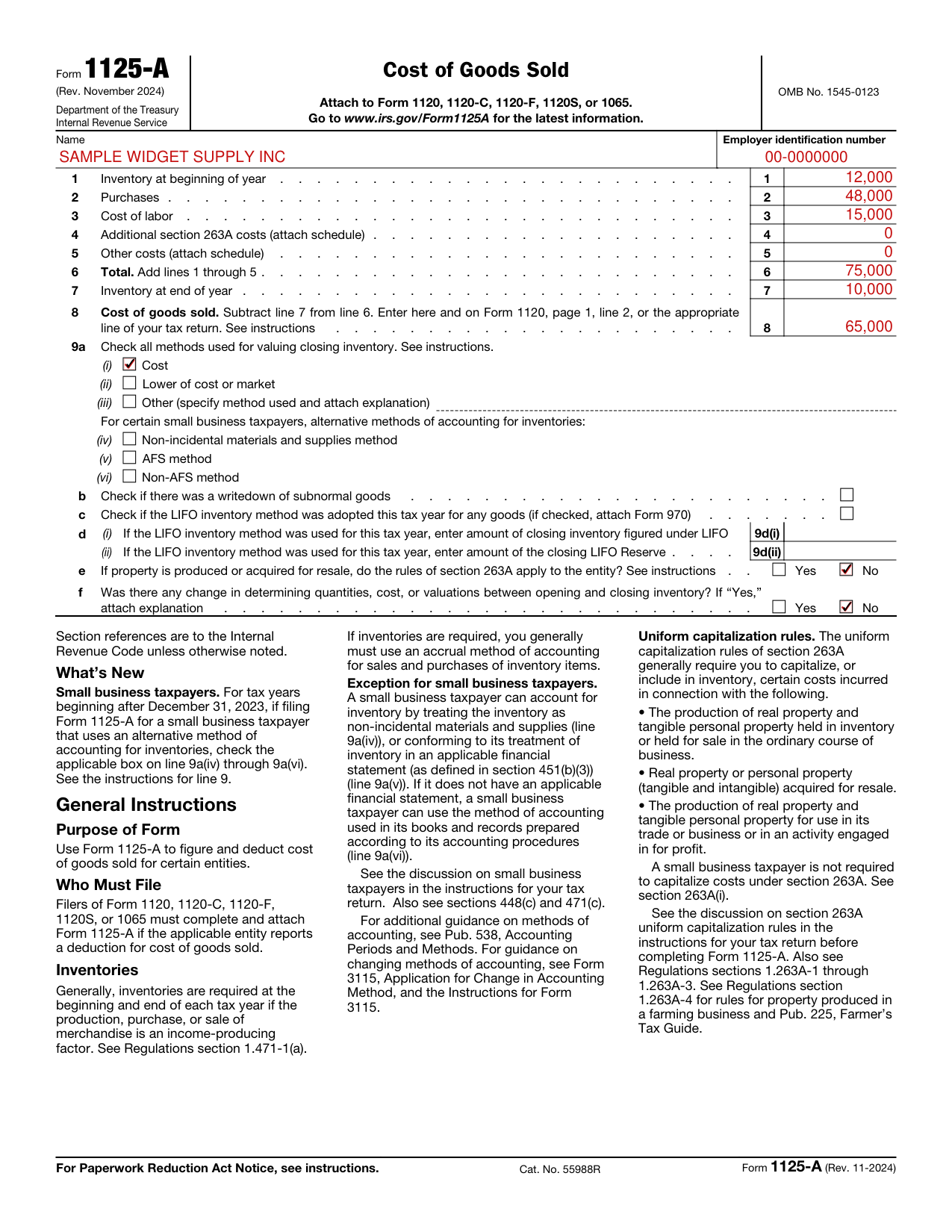
A filled-in Form 1125-A example: a corporation figures its cost of goods sold
How to fill out Form 1125-A, box by box
Tap a group of boxes to open it, and a picture to see it full size.
Name and Employer identification number

Fill in the Name and the Employer identification number.
Line 1 and Line 2

Line 1, Inventory at beginning of year (Form 1125-A (Rev. 11-2024), page 2): if you are changing your method of accounting for the current tax year, you must refigure last year's closing inventory using the new method of accounting. Enter the result on line 1.
If there is a difference between last year's closing inventory and the refigured amount, attach an explanation and take it into account when figuring any section 481(a) adjustment.
Line 2, Purchases: reduce purchases by items withdrawn for personal use.
For a partnership, the cost of these items should be shown on Schedule K and Schedule K-1 as distributions to partners.
Line 3, Line 4 and Line 5

Line 3, Cost of labor.
Line 4, Additional section 263A costs (attach schedule): if you elected a simplified method of accounting, enter on line 4 the balance of section 263A costs paid or incurred during the tax year not includible on lines 2, 3, and 5.
The uniform capitalization rules of section 263A generally require you to capitalize, or include in inventory, certain costs incurred in connection with the following: the production of real property and tangible personal property held in inventory or held for sale in the ordinary course of business; real property or personal property (tangible and intangible) acquired for resale; the production of real property and tangible personal property for use in its trade or business or in an activity engaged in for profit.
Line 5, Other costs (attach schedule): enter on line 5 any costs paid or incurred during the tax year not entered on lines 2 through 4. Attach a statement listing details of the costs.
Line 6, Line 7 and Line 8

Line 6, Total: add lines 1 through 5.
Line 7, Inventory at end of year: see Regulations sections 1.263A-1 through 1.263A-3 for details on figuring the amount of additional section 263A costs to be included in ending inventory.
Line 8, Cost of goods sold: subtract line 7 from line 6. Enter here and on Form 1120, page 1, line 2, or the appropriate line of your tax return. See instructions. The next line on the form, 9a: Check all methods used for valuing closing inventory.
Enter the amount from line 8 on your tax return as follows. Filers of Form 1120, 1120-C, 1120S, and 1065, enter cost of goods sold on page 1, line 2. Filers of Form 1120-F, enter cost of goods sold on Section II, line 2.
Line 9a
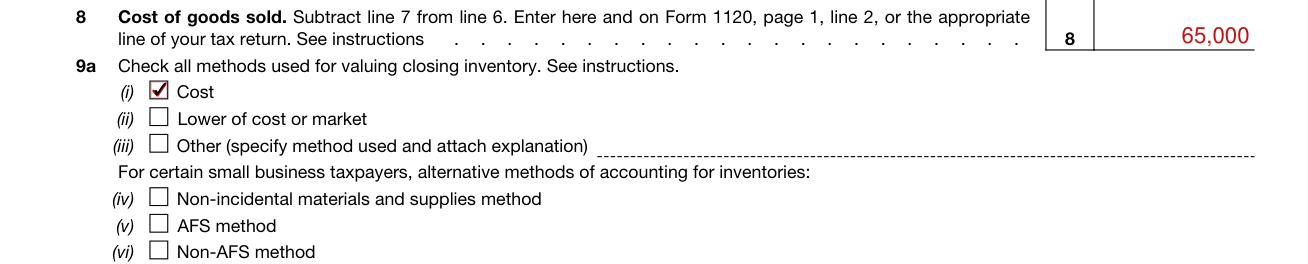
Line 9a, Inventory methods: (i) Cost, (ii) Lower of cost or market, (iii) Other (specify method used and attach explanation). For certain small business taxpayers, alternative methods of accounting for inventories: (iv) Non-incidental materials and supplies method, (v) AFS method, (vi) Non-AFS method. Complete line 9 as follows: check all applicable boxes on lines 9a(i) through 9a(iii) to indicate how the value of an inventory item is figured.
For certain small business taxpayers that have adopted or changed to an alternative accounting method that is an exception to the general inventory requirements described in the General Instructions, check a box on lines 9a(iv) through 9a(vi) in lieu of checking an applicable box on lines 9a(i) through 9a(iii).
See Regulations sections 1.471-1(b)(3) through (6) and your accounting procedures.
Inventories can be valued at cost, cost or market value (whichever is lower), or any other method approved by the IRS that conforms to the requirements of the applicable regulations.
Under lower of cost or market, the term “market” (for normal goods) means the current bid price prevailing on the inventory valuation date for the particular merchandise in the volume usually purchased by the filer.
For a manufacturer, market applies to the basic elements of cost-raw materials, labor, and burden.
If section 263A applies, the basic elements of cost must reflect the current bid price of all direct costs and all indirect costs properly allocable to goods on hand at the inventory date.
Common mistake: The methods on line 9a are methods of accounting. Any method, once established, cannot be changed in a later year without requesting a change in accounting method.
See the Instructions for Form 3115 for more information on requesting accounting method changes.
Line 9b, Lines 9c and 9d

Line 9b, Check if there was a writedown of subnormal goods: inventory may be valued below cost when the merchandise is unsalable at normal prices or unusable in the normal way because the goods are subnormal due to damage, imperfections, shopwear, change of style, odd or broken lots, or other similar causes, including second-hand goods taken in exchange.
The goods may be valued at the bona fide selling price, minus the direct cost of disposition (but not less than scrap value).
Bona fide selling price means actual offering of goods during a period ending not later than 30 days after inventory date.
Lines 9c and 9d, LIFO method: check the LIFO box on line 9c if the LIFO inventory method was adopted this tax year for any goods (if checked, attach Form 970).
If this is the first year the last-in, first-out (LIFO) inventory method was either adopted or extended to inventory goods not previously valued under the LIFO method provided in section 472, attach Form 970, Application To Use LIFO Inventory Method, or a statement with the information required by Form 970.
If the LIFO inventory method was used for this tax year, on line 9d(i) enter the amount of total closing inventories figured under section 472.
If you changed or extended your inventory method to LIFO and had to write up the opening inventory to cost in the year of election, report the effect of the write-up as other income, on your applicable return, proportionately over a 3-year period that begins with the year of the LIFO election.
If the LIFO inventory method was used for this tax year, on line 9d(ii) enter the closing LIFO Reserve. The closing LIFO Reserve is figured by subtracting the LIFO value of the inventory subject to a LIFO method that is on hand at the end of the tax year from the first-in, first-out (FIFO) value of that inventory.
If the closing LIFO Reserve amount is negative, place the amount on line 9d(ii) in parentheses.
Note (Form 1125-A (Rev. 11-2024), page 3): entities using the LIFO method that make an S corporation election or transfer LIFO inventory to an S corporation in a nonrecognition transaction may be subject to an additional tax attributable to the LIFO recapture amount. See the instructions for Form 1120, Schedule J, line 11, or the applicable line on your tax return.
Line 9e and Line 9f

Line 9e: if property is produced or acquired for resale and the rules of section 263A apply to the corporation, cooperative, partnership, or other applicable entity, check the “Yes” box on line 9e.
Line 9f: Was there any change in determining quantities, cost, or valuations between opening and closing inventory? If “Yes,” attach explanation.
More rules for Form 1125-A
Generally, inventories are required at the beginning and end of each tax year if the production, purchase, or sale of merchandise is an income-producing factor. See Regulations section 1.471-1(a).
Books or records relating to a form or its instructions must be retained as long as their contents may become material in the administration of any Internal Revenue law.
Situations: small business taxpayers, simplified methods, cooperatives
Small business taxpayers
If inventories are required, you generally must use an accrual method of accounting for sales and purchases of inventory items. Exception for small business taxpayers. A small business taxpayer can account for inventory by treating the inventory as non-incidental materials and supplies (line 9a(iv)), or conforming to its treatment of inventory in an applicable financial statement (as defined in section 451(b)(3)) (line 9a(v)). If it does not have an applicable financial statement, a small business taxpayer can use the method of accounting used in its books and records prepared according to its accounting procedures (line 9a(vi)).
A small business taxpayer is not required to capitalize costs under section 263A. See section 263A(i).
See the discussion on small business taxpayers in the instructions for your tax return. Also see sections 448(c) and 471(c).
If you elected the simplified production method or the modified simplified production method
If you elected the simplified production method or the modified simplified production method, additional section 263A costs are generally those costs, other than interest, that are not included in your section 471 costs but that are required to be capitalized under section 263A. For details, see Regulations section 1.263A-2(b).
If you elected the simplified resale method
If you elected the simplified resale method, additional section 263A costs are generally those costs incurred with respect to the following categories: off-site storage or warehousing; purchasing; handling, such as processing, assembling, repackaging, and transporting; and general and administrative costs (mixed service costs).
Cooperatives
Cooperatives are allowed to deduct certain per-unit retain allocations. Include these costs on line 5. Attach a statement listing details of per-unit retain allocations paid in: qualified per-unit retain certificates, money or other property (except nonqualified per-unit certificates), and nonqualified per-unit retain certificates redeemed this year.
Nonqualified per-unit retain certificates redeemed this year: include the amount paid in money or other property (except amounts already included as per-unit retain certificates) to patrons to redeem nonqualified per-unit retain certificates.
Common questions about Form 1125-A
Where do I file it?
Attach Form 1125-A to Form 1120, 1120-C, 1120-F, 1120S, or 1065. Go to www.irs.gov/Form1125A for the latest information.
Sources
[1] Form 1125-A (Rev. November 2024), Cost of Goods Sold, Internal Revenue Service (the Official source link on this page).