
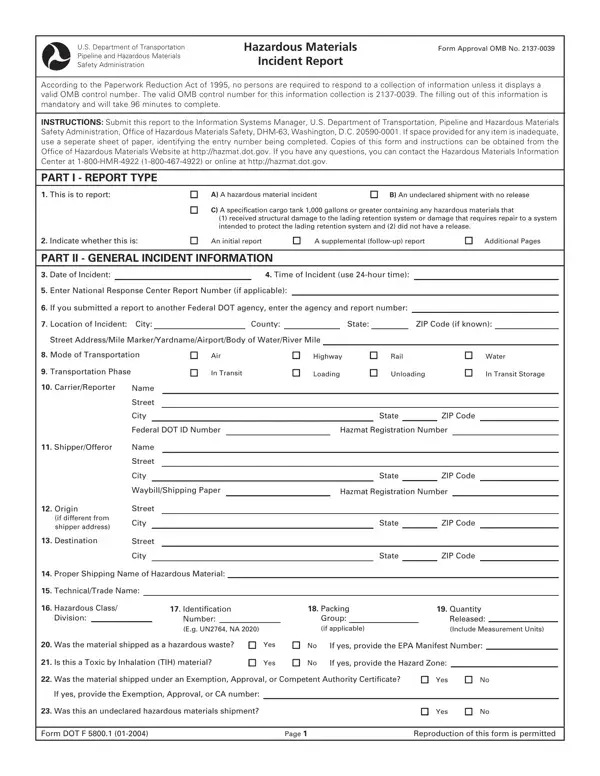

Form DOT F 5800.1 at a glance
What it is: Form DOT F 5800.1 is the Hazardous Materials Incident Report of the U.S. Department of Transportation Pipeline and Hazardous Materials Safety Administration.
Where and when to file: Submit this report to the Information Systems Manager, U.S. Department of Transportation, Pipeline and Hazardous Materials Safety Administration, Office of Hazardous Materials Safety, DHM-63, Washington, D.C. 20590-0001. If space provided for any item is inadequate, use a seperate sheet of paper, identifying the entry number being completed. Copies of this form and instructions can be obtained from the Office of Hazardous Materials Website at http://hazmat.dot.gov. If you have any questions, you can contact the Hazardous Materials Information Center at 1-800-HMR-4922 (1-800-467-4922) or online at http://hazmat.dot.gov.
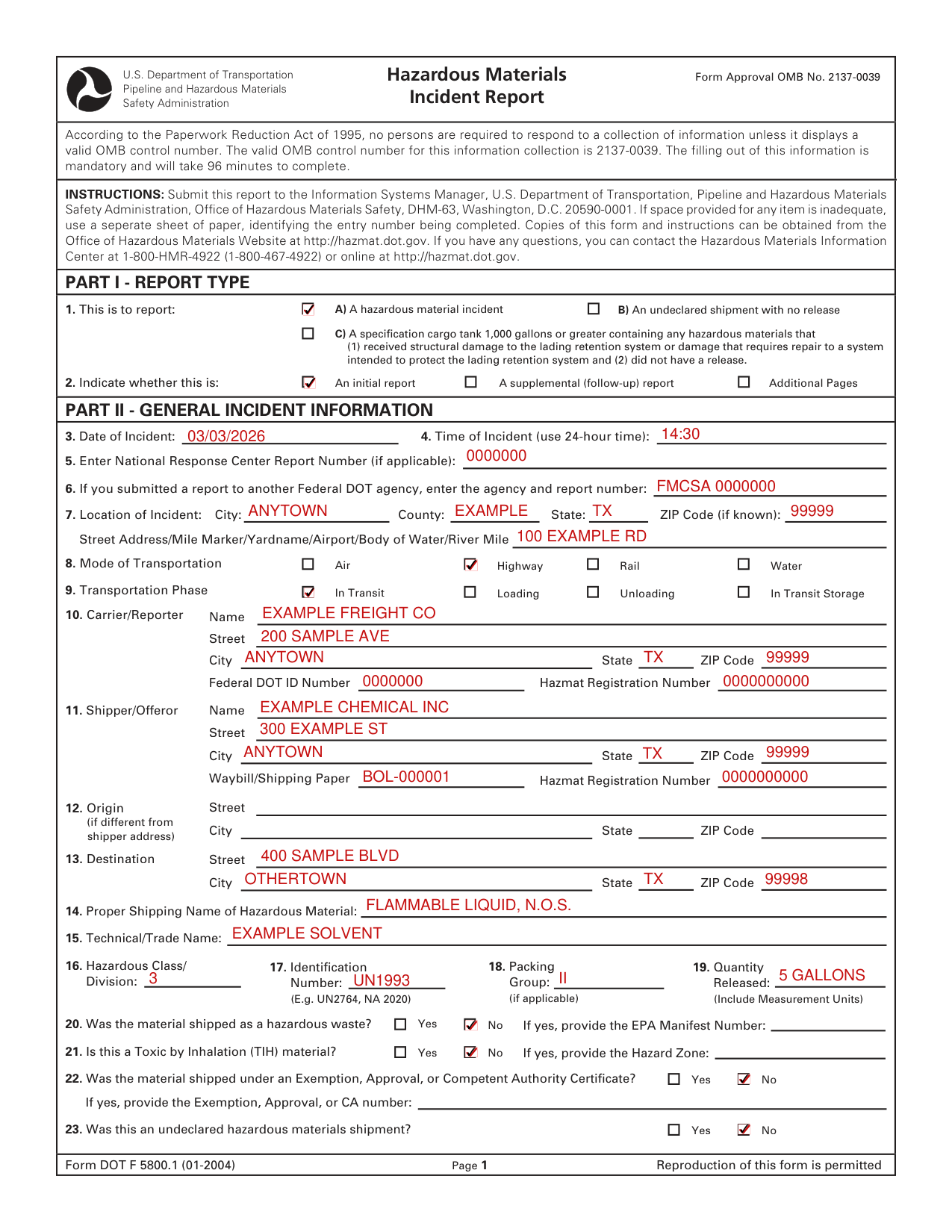
A filled-in Form DOT F 5800.1 example: a carrier reports a small highway release
How to fill out Form DOT F 5800.1, box by box
Part I, Report Type (boxes 1 and 2)

Box 1: This is to report A) A hazardous material incident, B) An undeclared shipment with no release, or C) A (1) specification cargo tank 1,000 gallons or greater containing any hazardous materials that received structural damage to the lading retention system or damage that requires repair to a system to protect the lading retention system and (2) did not have a release.
Box 2: Indicate whether this is an initial report or a supplemental (follow-up) report.
Date, time and location of the incident (boxes 3 to 7)

Box 3 is the Date of Incident and Box 4 is the Time of Incident (use 24-hour time).
Box 5: Enter National Response Center Report Number (if applicable).
Box 6: If you submitted a report to another Federal DOT agency, enter the agency and report number.
Box 7, Location of Incident: City, County, State, ZIP Code (if known), and Street Address/Mile Marker/Yardname/Airport/Body of Water/River Mile.
Mode of Transportation and Transportation Phase (boxes 8 and 9)

Box 8, Mode of Transportation: Air, Highway, Rail or Water.
Box 9, Transportation Phase: In Transit, Loading, Unloading or In Transit Storage.
Carrier/Reporter, Shipper/Offeror, Origin and Destination (boxes 10 to 13)
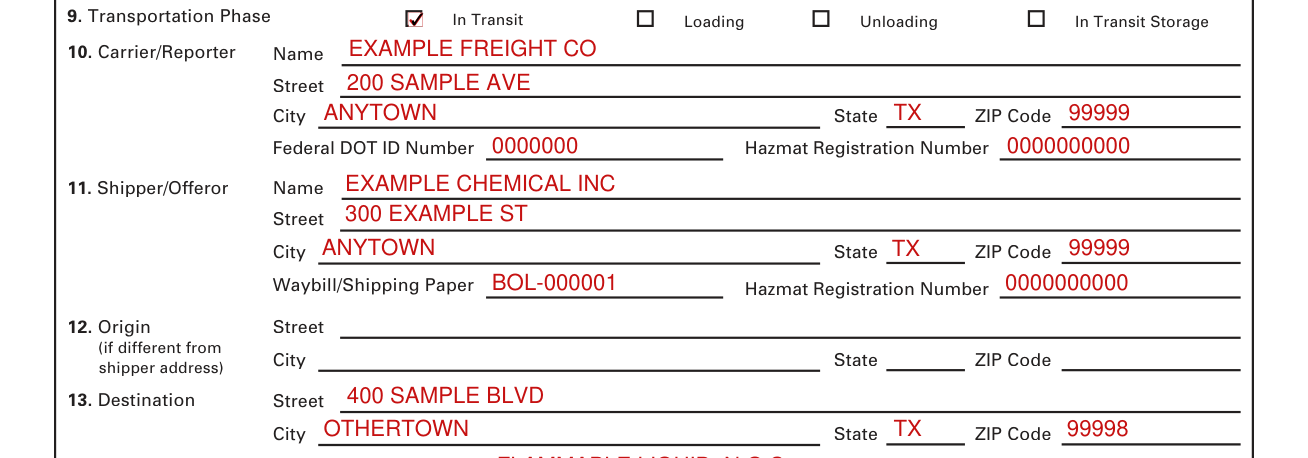
Box 10, Carrier/Reporter: Name, Street, City, State, ZIP Code, Federal DOT ID Number and Hazmat Registration Number.
Box 11, Shipper/Offeror: Name, Street, City, State, ZIP Code, Waybill/Shipping Paper and Hazmat Registration Number.
Box 12, Origin (if different from shipper address): Street, City, State and ZIP Code.
Box 13, Destination: Street, City, State and ZIP Code.
Shipping Name, Class, Identification Number and Quantity Released (boxes 14 to 19)

Box 14 is the Proper Shipping Name of Hazardous Material and Box 15 is the Technical/Trade Name.
Box 16: Hazardous Class/Division.
Box 17: Identification Number (E.g. UN2764, NA 2020).
Box 18: Packing Group (if applicable).
Box 19: Quantity Released (Include Measurement Units).
Hazardous waste, TIH, Exemption and undeclared shipment (boxes 20 to 23)
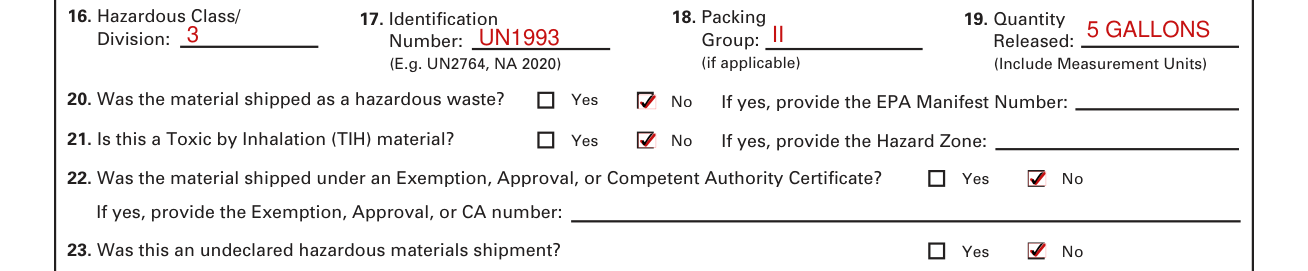
Box 20: Was the material shipped as a hazardous waste? Yes or No. If yes, provide the EPA Manifest Number.
Box 21: Is this a Toxic by Inhalation (TIH) material? If yes, provide the Hazard Zone.
Box 22: Was the material shipped under an Exemption, Approval, or Competent Authority Certificate? Yes or No. If yes, provide the Exemption, Approval, or CA number.
Box 23: Was this an undeclared hazardous materials shipment? Yes or No.
Part III, Packaging Type (box 24)

Box 24: Check Packaging Type (check only one - if more than one, list type of packaging, copy Part III, and complete for each type): Non-bulk, IBC, Cargo tank Motor Vehicle (CTMV), Tank Car, Cylinder, RAM, Portable Tank or Other.
What Failed, How Failed and Causes of Failure (box 25)

Box 25: See instructions and enter the appropriate failure codes found at the end of the instructions. Be sure to enter the codes from the list that corresponds to the particular packaging type checked in Box 24.
Enter the number of codes as appropriate to describe the incident. Enter the most important failure point in line 1. Each line has What Failed, How Failed and Causes of Failure.
If there are more than two failure points, provide in this format in part VI.
Packaging markings, capacity and construction (boxes 26 to 29)
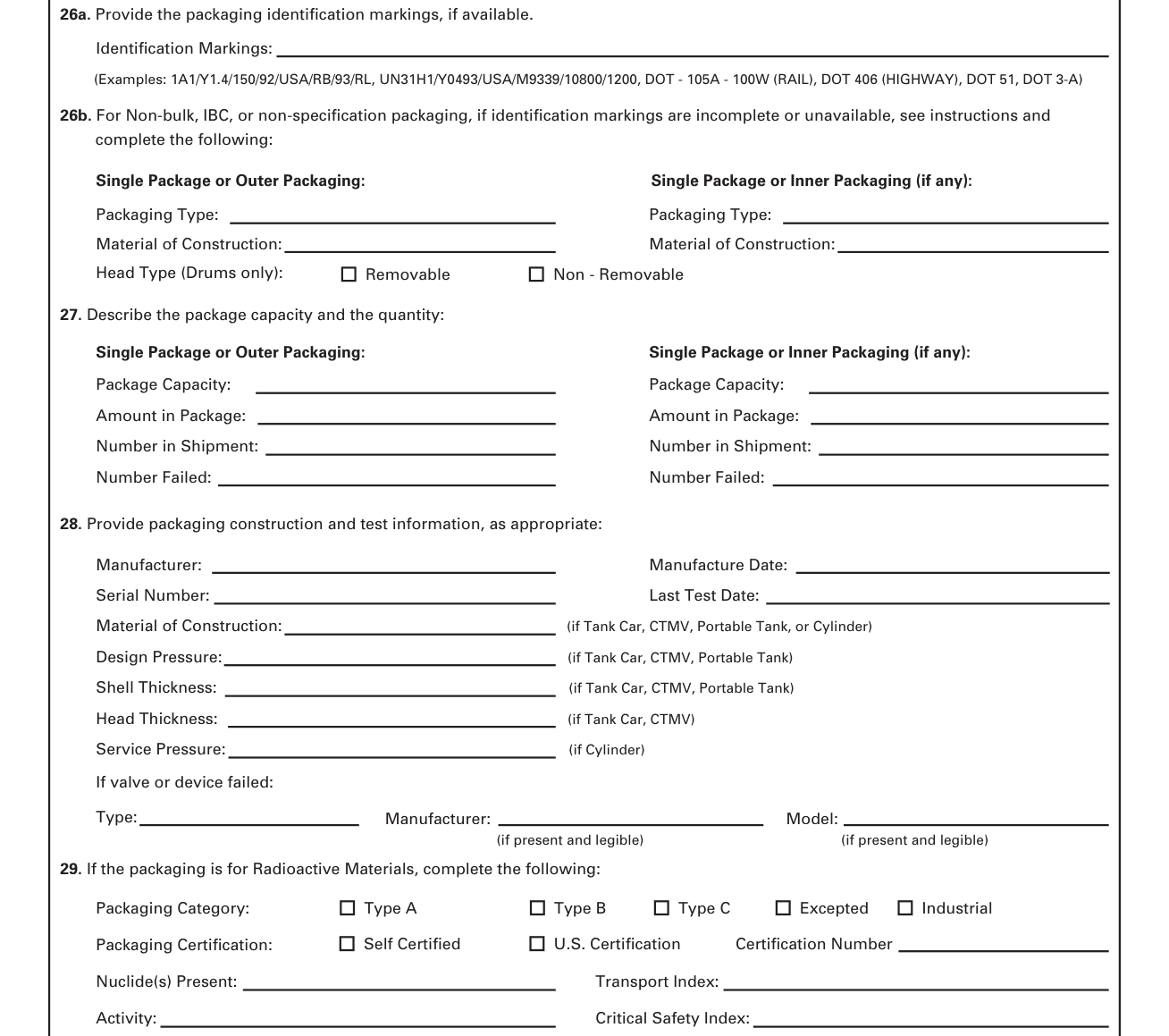
Box 26a: Provide the packaging identification markings, if available.
Box 26b: For Non-bulk, IBC, or non-specification packaging, if identification markings are incomplete or unavailable, see instructions and complete the following.
Box 27: Describe the package capacity and the quantity.
Box 28: Provide packaging construction and test information, as appropriate.
Box 29: If the packaging is for Radioactive Materials, complete Packaging Category (Type A, Type B, Type C, Industrial, Excepted), Packaging Certification (Self Certified, U.S. Certification), Certification Number, Nuclide(s) Present, Transport Index, Activity and Critical Safety Index.
Part IV, Consequences: result, emergency response and damages (boxes 30 to 32)
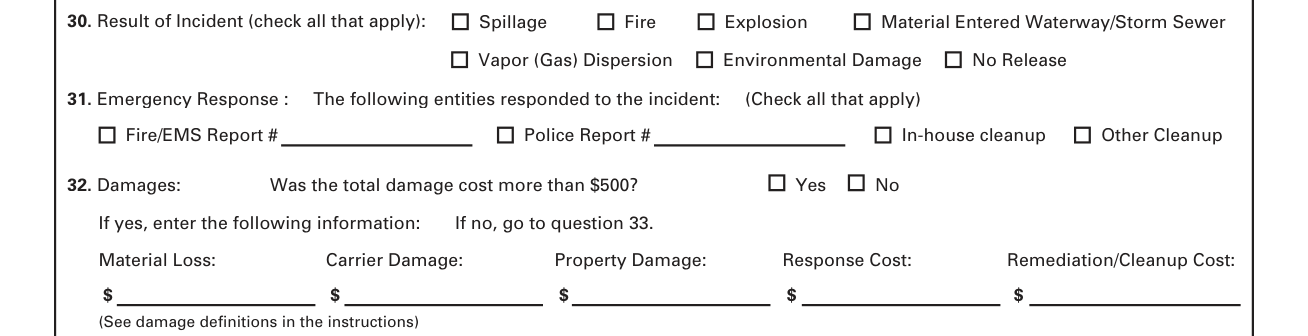
Part IV, Consequences. Box 30, Result of Incident (check all that apply): Spillage, Fire, Explosion, Material Entered Waterway/Storm Sewer, Vapor (Gas) Dispersion, Environmental Damage or No Release.
Box 31, Emergency Response: The following entities responded to the incident (Check all that apply): Fire/EMS Report #, Police Report #, In-house cleanup, Other Cleanup.
Box 32, Damages: Was the total damage cost more than $500? (checked November 1, 2026)
If yes, enter Material Loss, Carrier Damage, Property Damage, Response Cost, Remediation/Cleanup Cost. If no, go to question 33.
Fatalities, injuries and evacuation (boxes 33 to 35)
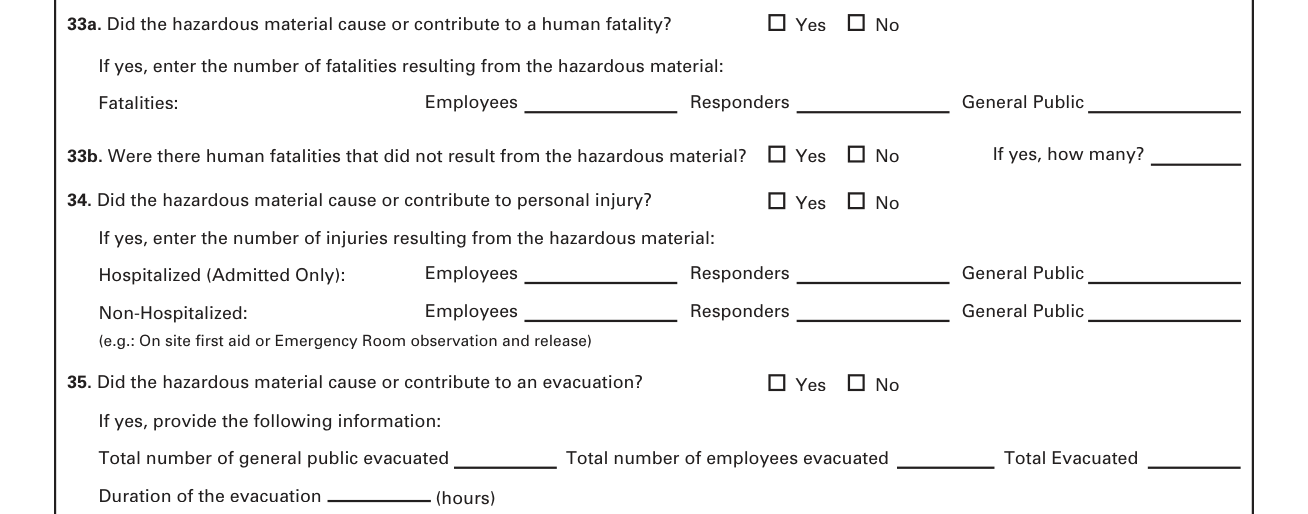
Box 33a: Did the hazardous material cause or contribute to a human fatality? If yes, enter the number of fatalities resulting from the hazardous material: Employees, Responders, General Public.
Box 33b: Were there human fatalities that did not result from the hazardous material? If yes, how many?
Box 34: Did the hazardous material cause or contribute to personal injury? Yes or No. If yes, enter the number of injuries resulting from the hazardous material: Hospitalized (Admitted Only) and Non-Hospitalized, each for Employees, Responders and General Public.
Box 35: Did the hazardous material cause or contribute to an evacuation? Yes or No. If yes, provide the Total number of general public evacuated, Total number of employees evacuated, Total Evacuated and Duration of the evacuation (hours).
Major transportation artery and crash or derailment (boxes 36 and 37)
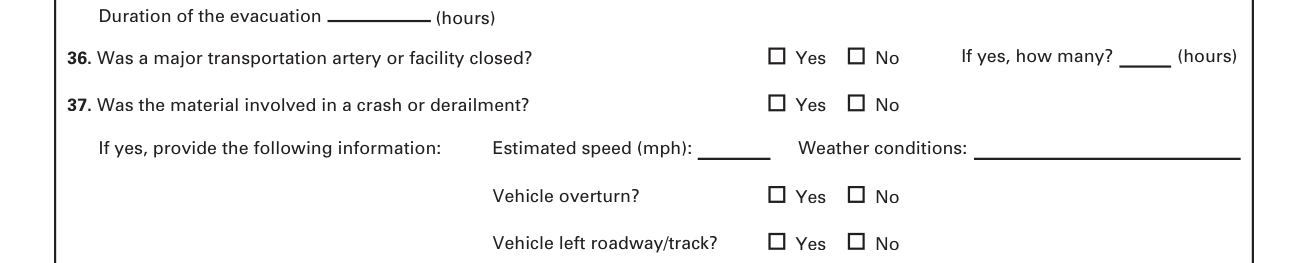
Box 36: Was a major transportation artery or facility closed? Yes or No. If yes, how many? (hours)
Box 37: Was the material involved in a crash or derailment? Yes or No. If yes, provide the Estimated speed (mph), Weather conditions, Vehicle overturn? and Vehicle left roadway/track?
Part V, Air Incident Information (boxes 38 to 40)
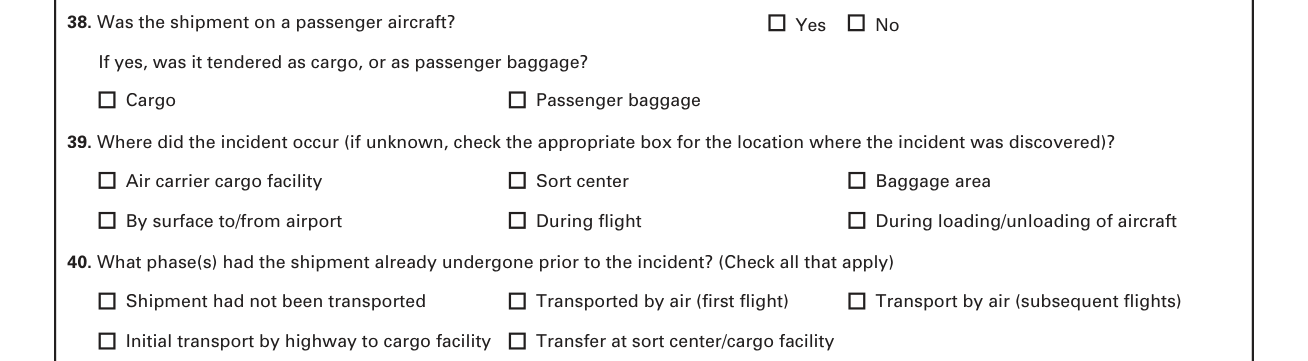
Part V is AIR INCIDENT INFORMATION (please refer to § 175.31 to report a discrepancy for air shipments).
Box 38: Was the shipment on a passenger aircraft? Yes or No. If yes, was it tendered as cargo, or as passenger baggage?
Box 39: Where did the incident occur (if unknown, check the appropriate box for the location where the incident was discovered)? Air carrier cargo facility, Baggage area, Sort center, By surface to/from airport, During loading/unloading of aircraft or During flight.
Box 40: What phase(s) had the shipment already undergone prior to the incident? (Check all that apply) Shipment had not been transported, Transport by air (subsequent flights), Transported by air (first flight), Initial transport by highway to cargo facility, Transfer at sort center/cargo facility.
Part VI, Part VII and Part VIII: description, recommendations and contact information
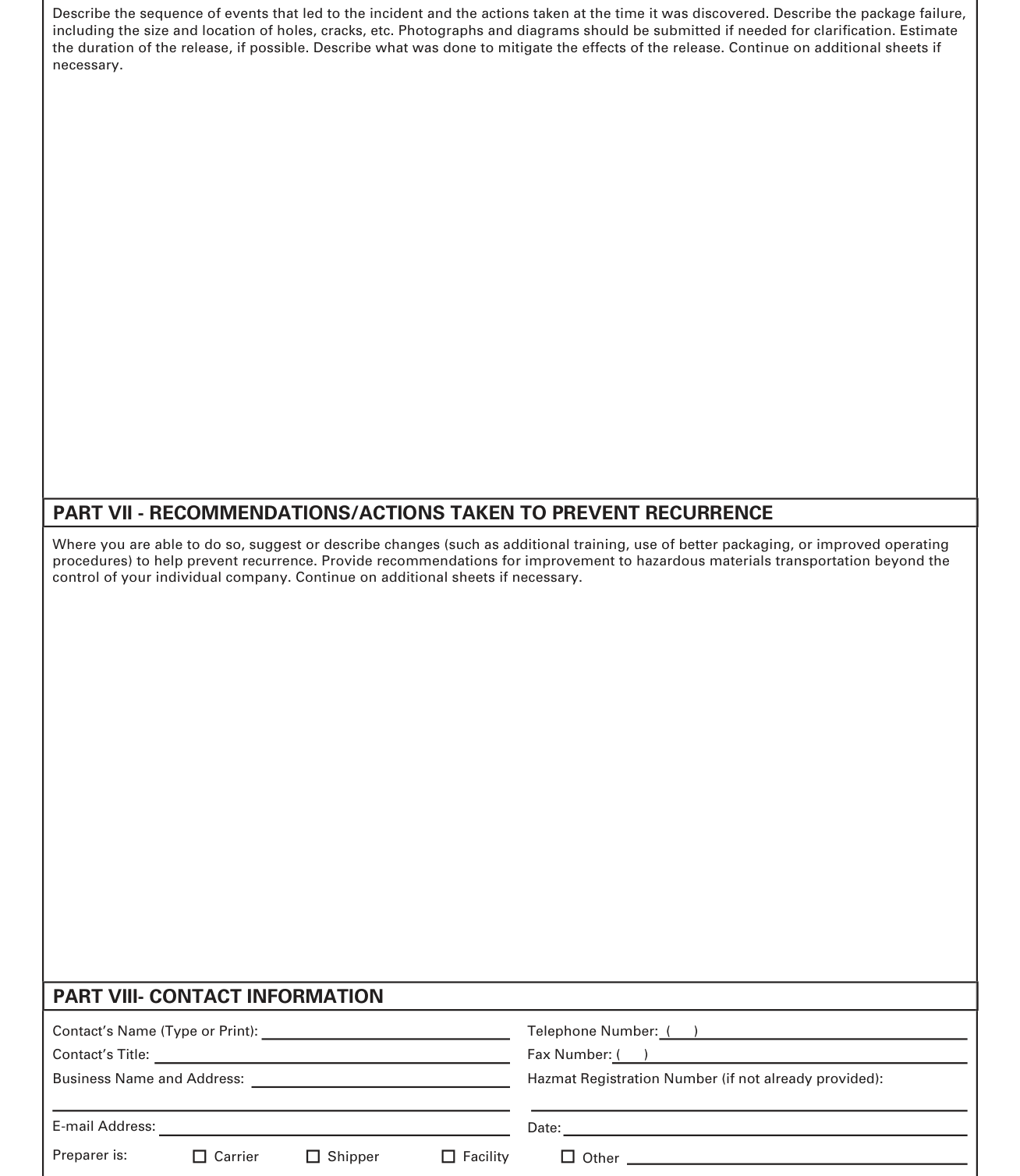
Part VI, Description of Events & Package Failure: Describe the sequence of events that led to the incident and the actions taken at the time it was discovered. Describe the package failure, including the size and location of holes, cracks, etc. Photographs and diagrams should be submitted if needed for clarification. Estimate the duration of the release, if possible. Describe what was done to mitigate the effects of the release. Continue on additional sheets if necessary.
Part VII, Recommendations/Actions Taken to Prevent Recurrence: Where you are able to do so, suggest or describe changes (such as additional training, use of better packaging, or improved operating procedures) to help prevent recurrence. Provide recommendations for improvement to hazardous materials transportation beyond the control of your individual company.
Part VIII, Contact Information: Contact's Name (Type or Print), Contact's Title, Telephone Number, Fax Number, Business Name and Address, E-mail Address, Hazmat Registration Number (if not already provided), Date, and Preparer is Carrier, Shipper, Facility or Other.
Sources
[1] Form DOT F 5800.1 (01-2004), Hazardous Materials Incident Report, Pipeline and Hazardous Materials Safety Administration, U.S. Department of Transportation (the Official source link on this page).