
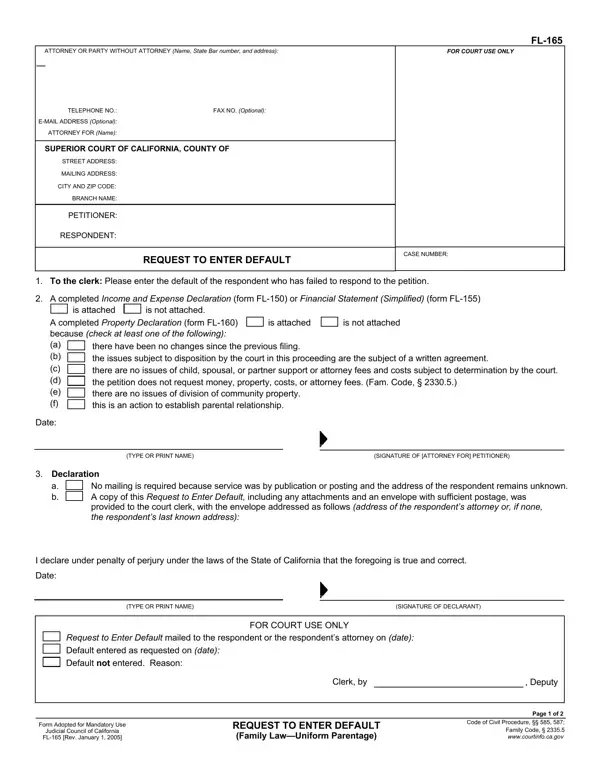
It is a Form Adopted for Mandatory Use by the Judicial Council of California.
Income and expenses: a completed Income and Expense Declaration (form FL-150) or Financial Statement (Simplified) (form FL-155) is attached or is not attached.
Property Declaration: if a completed Property Declaration (form FL-160) is not attached, check at least one of the boxes to indicate the reason.
No mailing: no mailing is required because service was by publication or posting and the address of the respondent remains unknown.
Nonmilitary status: declaration of nonmilitary status (required for a judgment).
Military status: if the respondent is in the military service, or their military status is unknown, the respondent is entitled to certain rights and protections.
| Question | Answer |
|---|---|
| Form Name | FL-165 |
| Form Length | 2 pages |
| Fillable? | Yes |
| Fillable fields | 142 |
| Avg. time to fill out | 24 min |
| Edition | July 1, 2025 |
| Issuing agency | Judicial Council of California |
| Who signs | The petitioner or attorney for petitioner, and the declarant |
| Matches the agency's file | Yes, checked October 1, 2026 |
| Other names | FL-165, FL165, FL 165, Form FL-165, California FL-165, Request to Enter Default |
| Official source | FL-165 (Rev July 1, 2025), Judicial Council of California |
Form Fl 165 isn’t the one you’re looking for?