
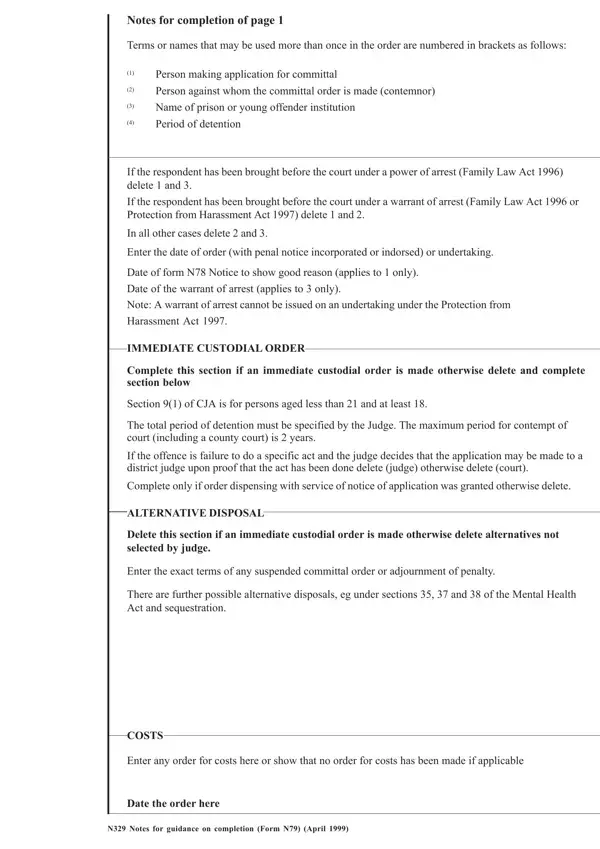
Form N79 at a glance
What it is: N79 is the Committal or other order upon proof of disobedience of a court order or breach of an undertaking (Family Law Act 1996) (Protection from Harassment Act 1997).
Who signs: If the judge is available he/she should be asked to approve and initial or sign the final (typed) version. If this is not possible the judge must be asked to initial or sign the final hand-written draft.
A filled-in Form N79 example: the heading and parties of an order
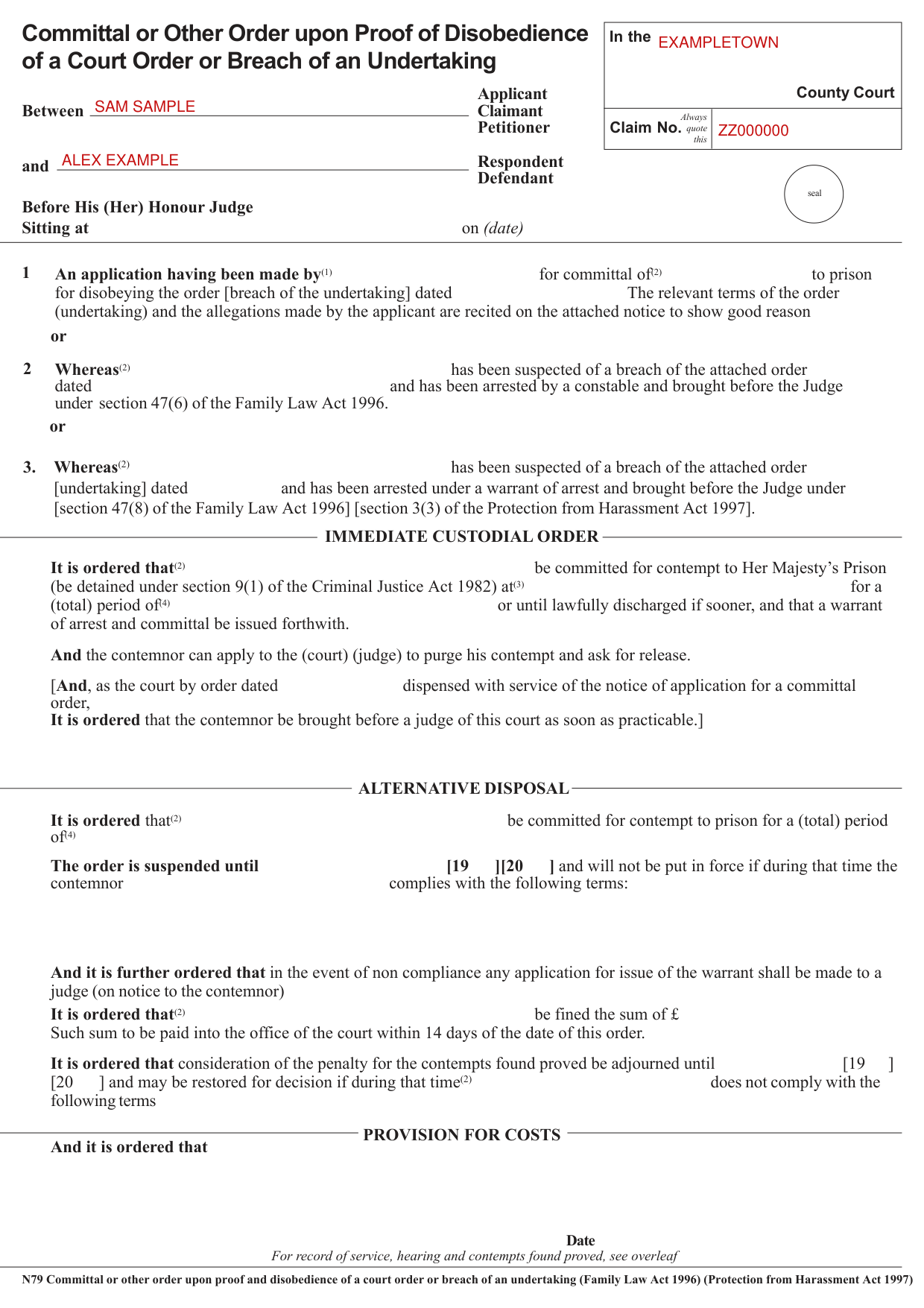
How to fill out Form N79, box by box
Claim number and court
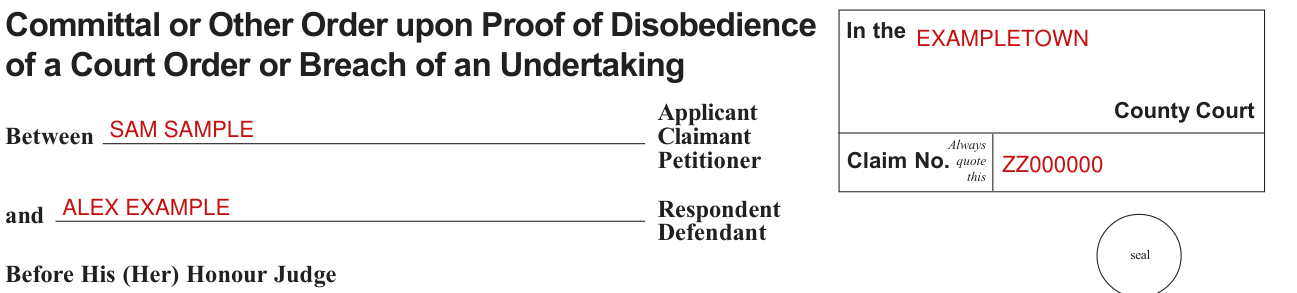
Always quote this Claim No.
When corresponding with the court, please address forms and letters to the Court Manager and quote the case number.
Immediate custodial order
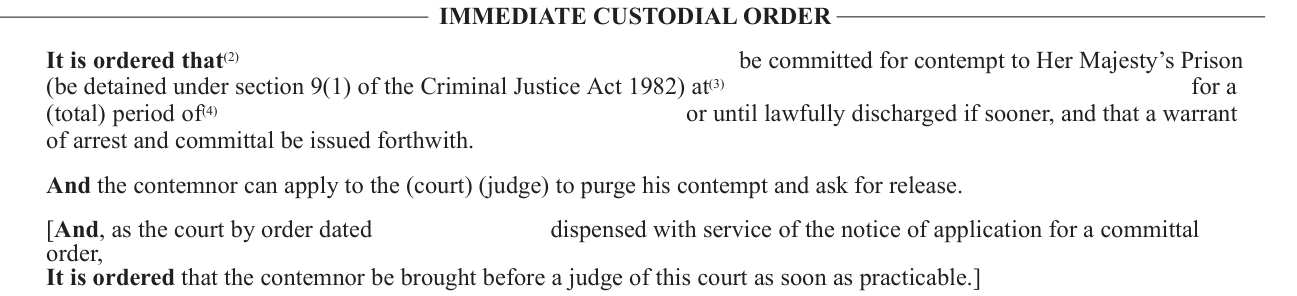
Complete this section if an immediate custodial order is made otherwise delete this section.
The total period of detention must be specified by the Judge. The maximum period for contempt of court (including a county court) is 2 years.
Section 9(1) of CJA is for persons aged less than 21 and at least 18.
If the offence is failure to do a specific act and the judge decides that the application may be made to a district judge upon proof that the act has been done delete (judge) otherwise delete (court).
Complete only if order dispensing with service of notice of application was granted otherwise delete.
Alternative disposal
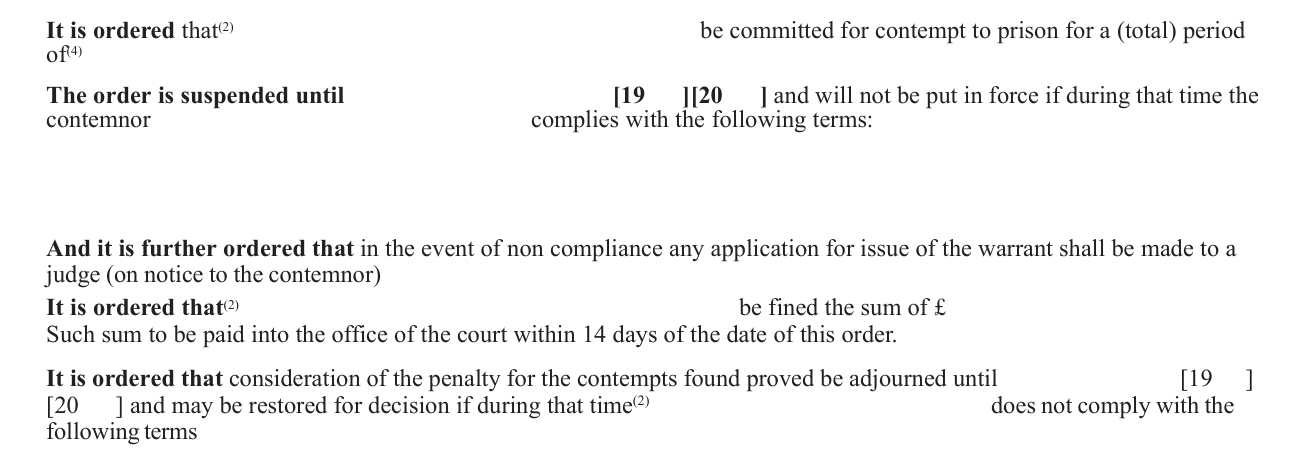
Delete this section if an immediate custodial order is made otherwise delete alternatives not selected by judge.
Enter the exact terms of any suspended committal order or adjournment of penalty.
There are further possible alternative disposals, eg under sections 35, 37 and 38 of the Mental Health Act and sequestration.
Costs and date

Enter any order for costs here or show that no order for costs has been made if applicable.
Date the order here.
More rules for Form N79
Enter the date of order (with penal notice incorporated or indorsed) or undertaking.
Date of form N78 Notice to show good reason (applies to 1 only). Date of the warrant of arrest (applies to 3 only). Note: A warrant of arrest cannot be issued on an undertaking under the Protection from Harassment Act 1997.
If the respondent has been brought before the court under a power of arrest (Family Law Act 1996) delete 1 and 3. If the respondent has been brought before the court under a warrant of arrest (Family Law Act 1996 or Protection from Harassment Act 1997) delete 1 and 2. In all other cases delete 2 and 3.
There is unlikely to be any affidavit evidence offered where the respondent has been brought to court under a power of arrest.
If necessary annex additional page and continue list on it.
Where a suspended committal order is made, the applicant is responsible for service.
Where there is suspended committal order or penalty is adjourned on terms, personal service is advisable.
Where the respondent is brought before the court under a power of arrest delete record of service of form N78.
If an additional page is not used delete the words (and as set out in the attached schedule).
If separate penalties are imposed for each contempt found proved these are to be recorded in the right-hand column showing whether or not periods of detention are to run consecutively or concurrently.
Oral evidence: Only those witnesses sworn and examined. Contempts found proved: List and give exact details of only those allegations of contempt which the judge has found proved.
Terms or names that may be used more than once in the order are numbered in brackets as follows: (1) Person making application for committal, (2) Person against whom the committal order is made (contemnor), (3) Name of prison or young offender institution, (4) Period of detention.
Sources
[1] Form N79, Committal or other order upon proof of disobedience of a court order or breach of an undertaking (the served file; no issuer file found) (the Official source link on this page).