

Fire Alarm System Record of Completion at a glance
What it is: The Fire Alarm System Record of Completion is Figure 4.5.2.1, Record of Completion, in the 2002 Edition of NFPA 72.
Who signs: The installation contractor/supplier, the alarm service company and the central station each add (signed), (title) and (date).
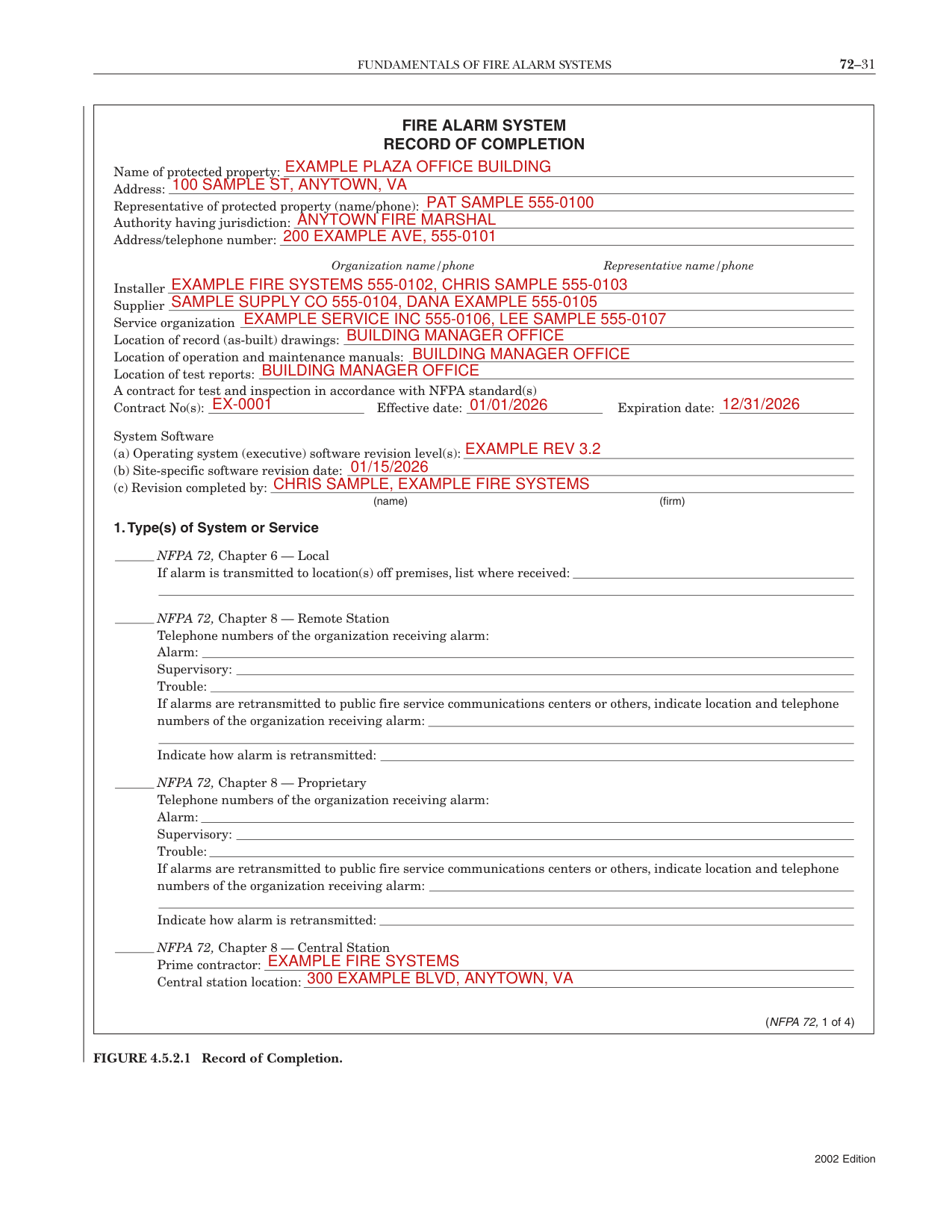
A filled-in Fire Alarm System Record of Completion example: a central station system in one building
How to fill out Fire Alarm System Record of Completion, box by box
Name of protected property and authority having jurisdiction

Enter the Name of protected property, its Address, the Representative of protected property (name/phone), the Authority having jurisdiction and its Address/telephone number.
Installer, Supplier, Service organization and contract

For the Installer, the Supplier and the Service organization, enter the Organization name/phone and the Representative name/phone. Enter the Location of record (as-built) drawings, the Location of operation and maintenance manuals and the Location of test reports. For A contract for test and inspection in accordance with NFPA standard(s), enter the Contract No(s), the Effective date and the Expiration date.
System Software

Under System Software, enter (a) Operating system (executive) software revision level(s), (b) Site-specific software revision date and (c) Revision completed by (name) (firm).
NFPA 72, Chapter 6 - Local

Under NFPA 72, Chapter 6 - Local, if alarm is transmitted to location(s) off premises, list where received.
NFPA 72, Chapter 8 - Remote Station

Under NFPA 72, Chapter 8 - Remote Station, enter the Telephone numbers of the organization receiving alarm: Alarm, Supervisory and Trouble. If alarms are retransmitted to public fire service communications centers or others, indicate location and telephone numbers of the organization receiving alarm, and indicate how alarm is retransmitted.
NFPA 72, Chapter 8 - Proprietary
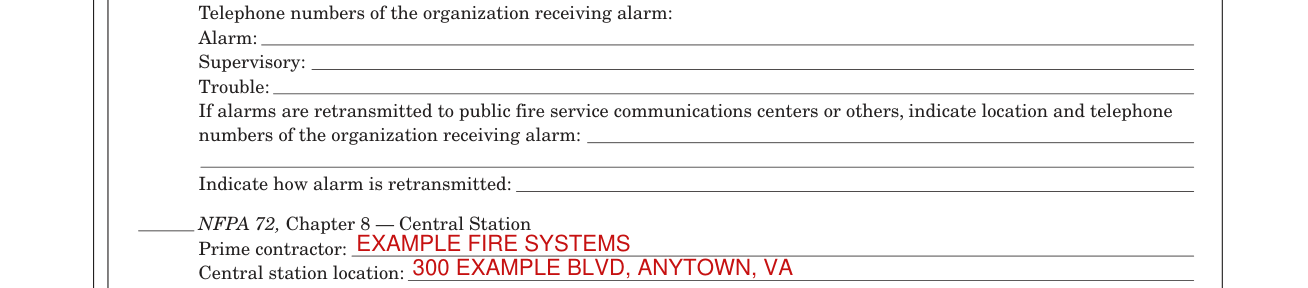
Under NFPA 72, Chapter 8 - Proprietary, enter the Telephone numbers of the organization receiving alarm: Alarm, Supervisory and Trouble; if alarms are retransmitted to public fire service communications centers or others, indicate how alarm is retransmitted.
NFPA 72, Chapter 8 - Central Station

Under NFPA 72, Chapter 8 - Central Station, enter the Prime contractor and the Central station location.
More rules for Fire Alarm System Record of Completion
Means of transmission of signals from the protected premises to the central station: McCulloh, Multiplex, One-way radio, Digital alarm communicator, Two-way radio or Others.
Enter the Means of transmission of alarms to the public fire service communications center, and the System location.
Under NFPA 72, Chapter 9 - Auxillary, indicate type of connection: Local energy, Shunt or Parallel telephone, and enter the Location of telephone number for receipt of signals.
Fill out 2. Record of System Installation after installation is complete and wiring is checked for opens, shorts, ground faults, and improper branching, but prior to conducting operational acceptance tests.
In 2. Record of System Installation, this system has been installed in accordance with the NFPA standards, was inspected by on , includes the devices shown in 5 and 6, and has been in service since .
In 2. Record of System Installation, circle all that apply: NFPA 72, Chapters, NFPA 70, National Electrical Code, Article 760, Manufacturer's instructions, or Other (specify).
In 2. Record of System Installation, fill in Signed, Date and Organization.
In 3. Record of System Operation, Documentation in accordance with Inspection Testing Form, Figure 10.6.2.3, is attached. All operational features and functions of this system were tested by date and found to be operating properly in accordance with the requirements of NFPA 72, Chapters, NFPA 70, National Electrical Code, Article 760, Manufacturer's instructions or Other (specify): circle all that apply.
Under 4. Signaling Line Circuits, enter the Quantity, Style and Class of signaling line circuits connected to system (see NFPA 72, Table 6.6.1).
Under 5. Alarm-Initiating Devices and Circuits, enter the Quantity, Style and Class of initiating device circuits (see NFPA 72, Table 6.5).
Under MANUAL, (a) Manual stations: Noncoded, Transmitters, Coded or Addressable, and (b) Combination manual fire alarm and guard's tour coded stations.
Under AUTOMATIC, Coverage: Complete, Partial, Selective or Nonrequired.
Under AUTOMATIC: (a) Smoke detectors: Ion, Photo or Addressable; (b) Duct detectors: Ion, Photo or Addressable; (c) Heat detectors: FT, RR, FT/RR, RC or Addressable; (d) Sprinkler waterflow indicators: Transmitters, Noncoded, Coded or Addressable; (e) The alarm verification feature is disabled or enabled, changed from seconds to seconds; (f) Other (list).
Under 6. Supervisory Signal-Initiating Devices and Circuits, use blanks to indicate quantity of devices. Under GUARD'S TOUR, (a) Coded stations, (b) Noncoded stations, (c) Compulsory guard's tour system comprised of transmitter stations and intermediate stations. Combination devices are recorded under 5(b), Manual, and 6(a), Guard's Tour.
Under SPRINKLER SYSTEM, check if provided: (a) Valve supervisory switches, (b) Building temperature points, (c) Site water temperature points, (d) Site water supply level points. Electric fire pump: (e) Fire pump power, (f) Fire pump running, (g) Phase reversal. Engine-driven fire pump: (h) Selector in auto position, (i) Engine or control panel trouble, (j) Fire pump running.
Under ENGINE-DRIVEN GENERATOR: (a) Selector in auto position, (b) Control panel trouble, (c) Transfer switches, (d) Engine running, and Other supervisory function(s) (specify).
Under 7. Annunciator(s), enter the Number, Type and Location.
Under 8. Alarm Notification Appliances and Circuits, NFPA 72, Chapter 6 - Emergency Voice/Alarm Service: enter the Quantity of voice/alarm channels as Single or Multiple. Enter the Quantity of speakers installed, the Quantity of speaker zones, the Quantity of telephones or telephone jacks included in system, and the Quantity and the class of notification appliance circuits connected to system (see NFPA 72, Table 6.7).
Under 8. Alarm Notification Appliances and Circuits, enter Quantity, Style and Class, and the Types and quantities of notification appliances installed: (a) Bells, (b) Speakers, (c) Horns, (d) Chimes and (e) Other, each With Visible, and (f) Visible appliances without audible.
Under 9. System Power Supplies, (a) Fire Alarm Control Panel: Nominal voltage, Current rating, Overcurrent protection Type, Current rating and Location. (b) Secondary (standby): Storage battery Amp-hour rating and Calculated capacity to drive system, in hours; Engine-driven generator dedicated to fire alarm system, Location of fuel storage. (c) Emergency system used as backup to primary power supply: Emergency system described in NFPA 70, Article 700.
Under 10. Comments, enter the Frequency of routine tests and inspections, if other than in accordance with the referenced NFPA standard(s), and the System deviations from the referenced NFPA standard(s).
Upon completion of the system(s) satisfactory test(s) witnessed (if required by the authority having jurisdiction): (signed) representative of the authority having jurisdiction, with title and date.
Common questions about Fire Alarm System Record of Completion
Who signs it?
The installation contractor/supplier, the alarm service company and the central station each add (signed), (title) and (date).
Sources
[1] Fire Alarm System Record of Completion, Figure 4.5.2.1, NFPA 72, 2002 Edition (the Official source link on this page).
