
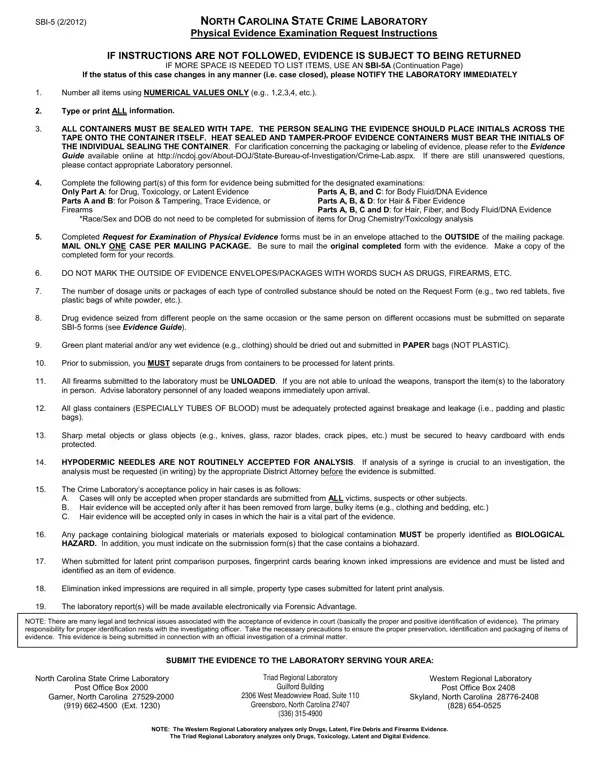
Form SBI-5 at a glance
What it is: Form SBI-5 (2/2012) is the North Carolina State Crime Laboratory Physical Evidence Examination Request. This evidence is being submitted in connection with an official investigation of a criminal matter.
Where and when to file: Submit the evidence to the laboratory serving your area: North Carolina State Crime Laboratory Post Office Box 2000 Garner, North Carolina 27529-2000 (919) 662-4500 (Ext. 1230).
A filled-in Form SBI-5 example: a deputy submits one item of evidence
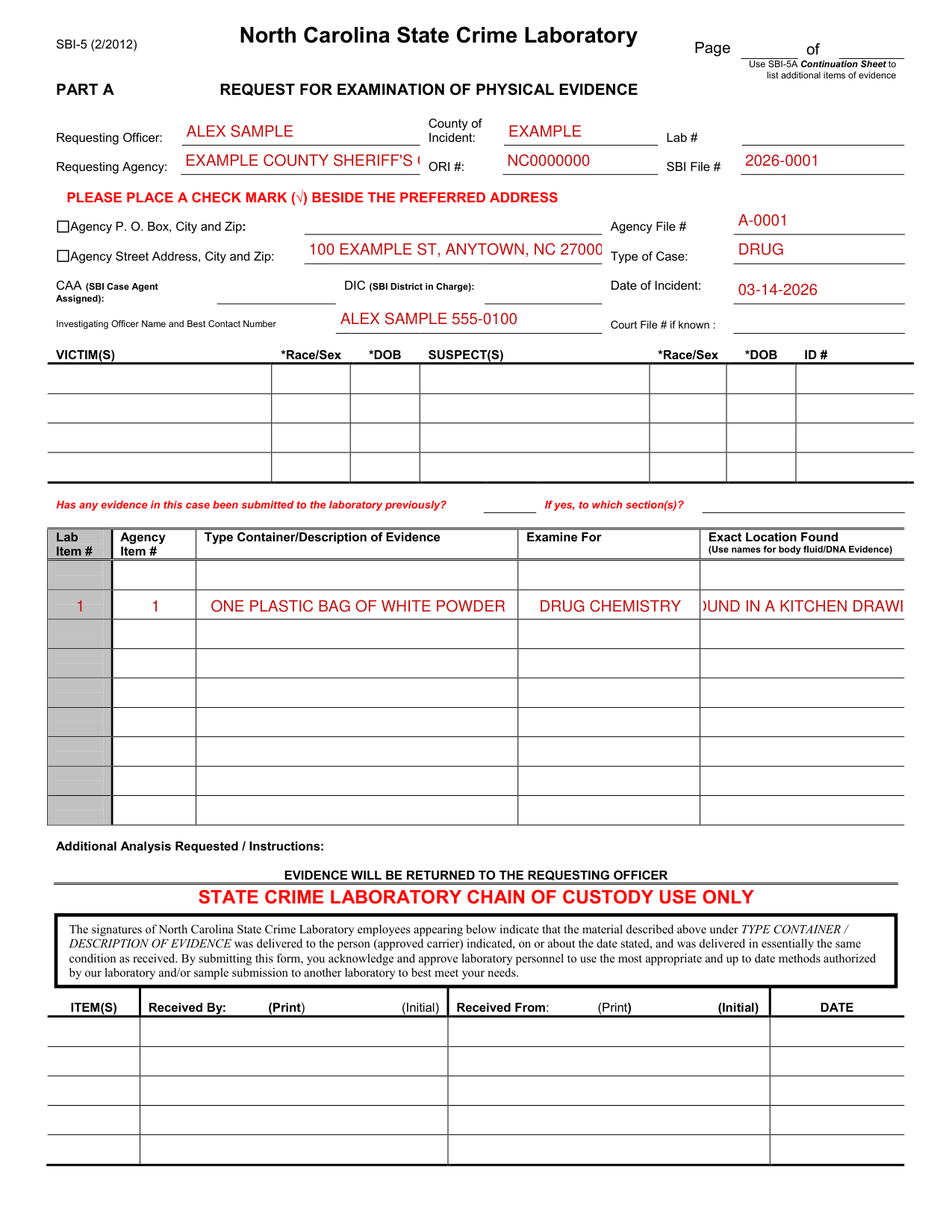
How to fill out Form SBI-5, box by box
Part A: requesting officer, agency and incident
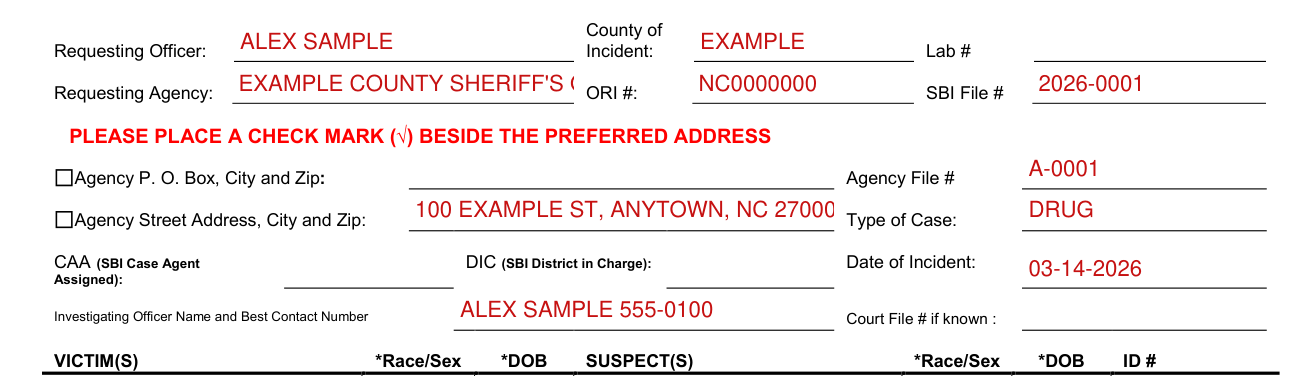
Under Part A, Request for Examination of Physical Evidence, enter the Requesting Officer, the Requesting Agency and the County of Incident.
Enter the ORI #, the SBI File # and the Agency File #.
Enter the Type of Case, the CAA (SBI Case Agent Assigned), the DIC (SBI District in Charge) and the Date of Incident.
Enter the Investigating Officer Name and Best Contact Number, and the Court File # if known.
List all the VICTIM(S) and the SUSPECT(S) with *Race/Sex, *DOB and ID #. *Race/Sex and DOB do not need to be completed for submission of items for Drug Chemistry/Toxicology analysis.
The preferred address

Place a check mark (√) beside the preferred address: Agency P. O. Box, City and Zip or Agency Street Address, City and Zip.
Evidence submitted to the laboratory previously

Has any evidence in this case been submitted to the laboratory previously? If yes, to which section(s)?
The items of evidence
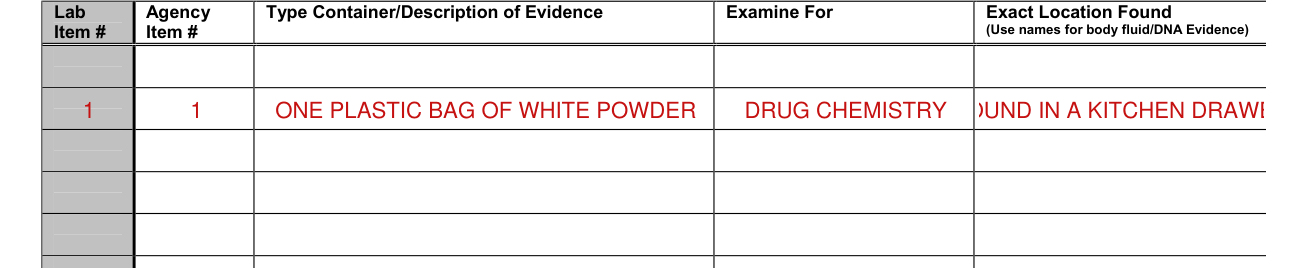
For each item of evidence, enter the Lab Item #, the Agency Item #, the Type Container/Description of Evidence, Examine For and Exact Location Found (Use names for body fluid/DNA Evidence).
Number all items using numerical values only (e.g., 1,2,3,4, etc.).
If more space is needed to list items, use an SBI-5A (Continuation Page).
Part B: description of the incident
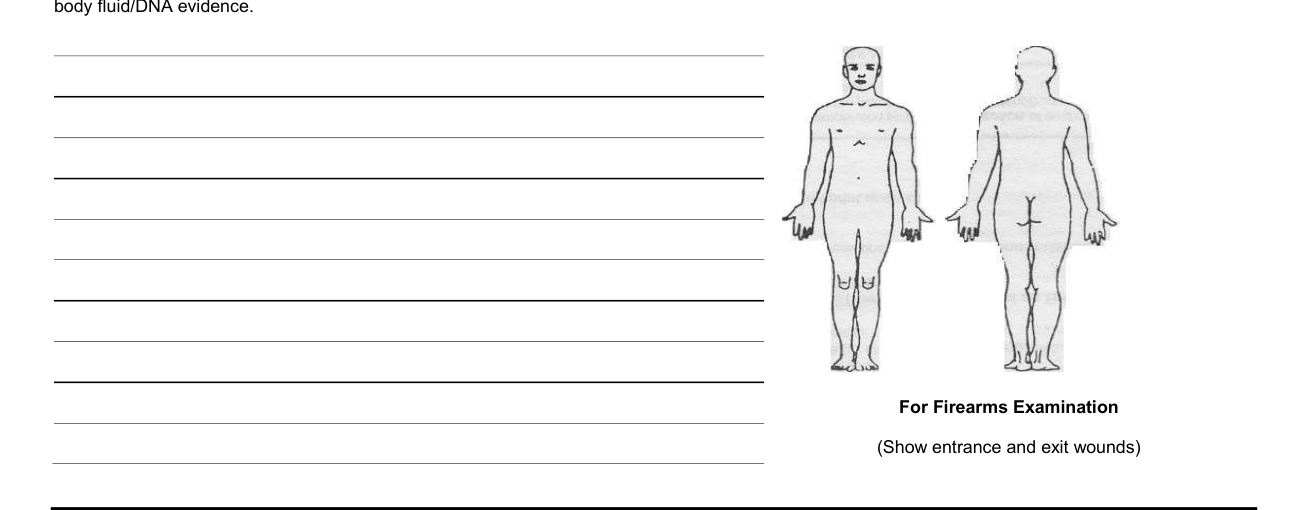
Part B: Description of the incident (brief summary of the events). Be sure to provide details as to who may have been bleeding in cases involving body fluid/DNA evidence.
Complete Part B or attach a copy of the investigative report.
For Firearms Examination (Show entrance and exit wounds).
More rules for Form SBI-5
If instructions are not followed, evidence is subject to being returned.
If the status of this case changes in any manner (i.e. case closed), notify the laboratory immediately.
Type or print all information.
Other cases and parts of the form
Which parts of the form to complete
Complete only Part A for Drug, Toxicology, or Latent Evidence.
Complete Parts A and B for Poison & Tampering, Trace Evidence, or Firearms.
Complete Parts A, B, and C for Body Fluid/DNA Evidence.
Complete Parts A, B, & D for Hair & Fiber Evidence.
Complete Parts A, B, C and D for Hair, Fiber, and Body Fluid/DNA Evidence.
Body fluid/DNA evidence
Part C (For body fluid/DNA cases): Have samples from all possible bleeders or body fluid donors been included? Yes No Have any of the persons been transfused in the last 30 days? Yes No
In sexual offense cases answer the following: 1. Was the alleged assailant known to the victim? 2. Did the victim have sex with someone within 72 hours prior to the incident? (if no, skip to question 5) 3. Is a known DNA sample from the consenting sex partner available at this time? 4. Do you plan to submit this sample? 5. Has/have the suspect(s) made any statement that the act was consensual?
No DNA testing will be conducted on evidence samples unless known DNA samples from all victims and suspects are submitted. In sexual offense cases, a known DNA sample must also be submitted from any consensual sexual partners of the victim within 72 hours of the incident, if DNA typing is requested.
Hair and fiber evidence
Part D (For hair, fiber and other particle analysis cases): Incident Occurred (Check all that apply): Suspect's Residence, Victim's Residence, Suspect's Vehicle, Victim's Vehicle, or Other Location (describe).
Have the suspect(s) and victim(s) lived at the same residence or shared a common environment? If this is a rape case, has consent or common environment been involved? If yes, hair samples should not be submitted for examination. Be sure to indicate the race of the victim(s) and suspect(s) listed in Part A.
Please retain all hair and fiber evidence until either (1) the hair samples from all suspects and victims are obtained for hair analysis, OR (2) all fiber standards (carpeting, upholstery, and clothing of suspect/victim) are obtained for fiber analysis. You must submit the necessary standards before analysis can be performed.
The Crime Laboratory's acceptance policy in hair cases A. Cases will only be accepted when proper standards are submitted from ALL victims, suspects or other subjects. B. Hair evidence will be accepted only after it has been removed from large, bulky items (e.g., clothing and bedding, etc.) C. Hair evidence will be accepted only in cases in which the hair is a vital part of the evidence.
Mailing the evidence
Completed Request for Examination of Physical Evidence forms must be in an envelope attached to the OUTSIDE of the mailing package.
Mail only one case per mailing package.
Mail the original completed form with the evidence. Make a copy of the completed form for your records.
Triad Regional Laboratory: Guilford Building 2306 West Meadowview Road, Suite 110 Greensboro, North Carolina 27407 (336) 315-4900.
Western Regional Laboratory: Post Office Box 2408 Skyland, North Carolina 28776-2408 (828) 654-0525. NOTE: The Western Regional Laboratory analyzes only Drugs, Latent, Fire Debris and Firearms Evidence. The Triad Regional Laboratory analyzes only Drugs, Toxicology, Latent and Digital Evidence.
Sealing and packaging
All containers must be sealed with tape. The person sealing the evidence should place initials across the tape onto the container itself.
Heat sealed and tamper-proof evidence containers must bear the initials of the individual sealing the container.
Do not mark the outside of evidence envelopes/packages with words such as drugs, firearms, etc.
All glass containers (ESPECIALLY TUBES OF BLOOD) must be adequately protected against breakage and leakage (i.e., padding and plastic bags).
Sharp metal objects or glass objects (e.g., knives, glass, razor blades, crack pipes, etc.) must be secured to heavy cardboard with ends protected.
Any package containing biological materials or materials exposed to biological contamination must be properly identified as BIOLOGICAL HAZARD. In addition, you must indicate on the submission form(s) that the case contains a biohazard.
For clarification concerning the packaging or labeling of evidence, refer to the Evidence Guide available online at http://ncdoj.gov/About-DOJ/State-Bureau-of-Investigation/Crime-Lab.aspx. If there are still unanswered questions, contact appropriate Laboratory personnel.
Drug evidence
The number of dosage units or packages of each type of controlled substance should be noted on the Request Form (e.g., two red tablets, five plastic bags of white powder, etc.).
Drug evidence seized from different people on the same occasion or the same person on different occasions must be submitted on separate SBI-5 forms.
Green plant material and/or any wet evidence (e.g., clothing) should be dried out and submitted in PAPER bags (NOT PLASTIC).
Prior to submission, you MUST separate drugs from containers to be processed for latent prints. When submitted for latent print comparison purposes, fingerprint cards bearing known inked impressions are evidence and must be listed and identified as an item of evidence. Elimination inked impressions are required in all simple, property type cases submitted for latent print analysis.
Firearms and hypodermic needles
All firearms submitted to the laboratory must be UNLOADED. If you are not able to unload the weapons, transport the item(s) to the laboratory in person.
Hypodermic needles are not routinely accepted for analysis. If analysis of a syringe is crucial to an investigation, the analysis must be requested (in writing) by the appropriate District Attorney before the evidence is submitted.
Reports
The laboratory report(s) will be made available electronically via Forensic Advantage.
Common questions about Form SBI-5
What am I certifying when I sign?
By submitting this form, you acknowledge and approve laboratory personnel to use the most appropriate and up to date methods authorized by the laboratory and/or sample submission to another laboratory to best meet your needs.
Sources
[1] Form SBI-5 (2/2012), Physical Evidence Examination Request, North Carolina State Crime Laboratory (the Official source link on this page).