

Notice to Homeowner at a glance
What it is: Notice to Homeowner, Assumption of HUD / FHA Insured Mortgages, Release of Personal Liability: you are legally obligated to make the monthly payments required by your mortgage (deed of trust) and promissory note.
Who signs: You must sign and date this notice as indicated, return one copy to your lender as proof of notification and keep one copy for your records.
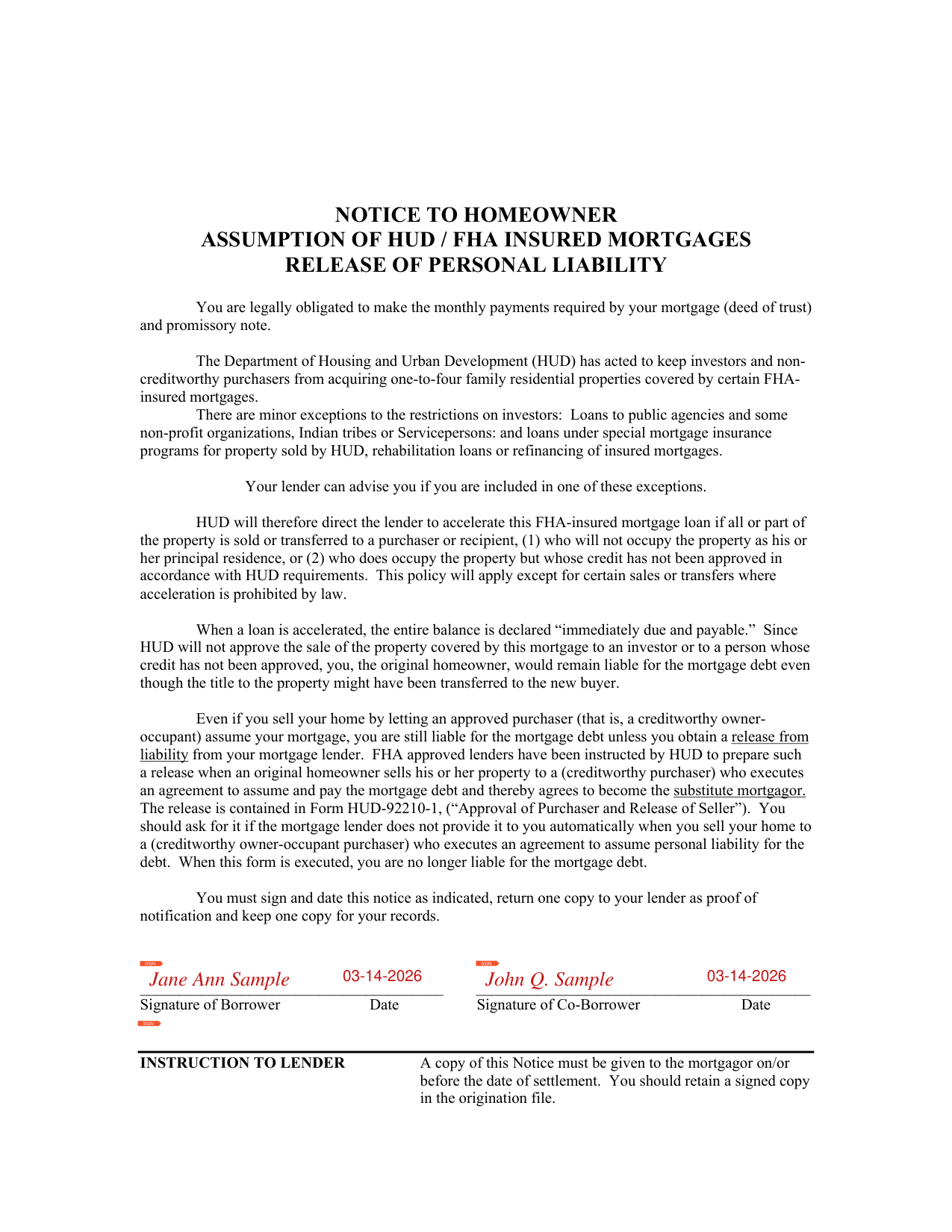
A filled-in Notice to Homeowner example: a borrower and co-borrower sign the notice
How to fill out Notice to Homeowner, box by box
Signature of Borrower and Signature of Co-Borrower

Borrower: sign on the line over Signature of Borrower and fill in the Date. If there is a Co-Borrower, the Co-Borrower signs on the line over Signature of Co-Borrower and fills in the Date.
More rules for Notice to Homeowner
There are minor exceptions to the restrictions on investors: Loans to public agencies and some non-profit organizations, Indian tribes or Servicepersons: and loans under special mortgage insurance programs for property sold by HUD, rehabilitation loans or refinancing of insured mortgages. Your lender can advise you if you are included in one of these exceptions.
If your situation is different
A buyer who will not occupy the property, or whose credit has not been approved
HUD will therefore direct the lender to accelerate this FHA-insured mortgage loan if all or part of the property is sold or transferred to a purchaser or recipient, (1) who will not occupy the property as his or her principal residence, or (2) who does occupy the property but whose credit has not been approved in accordance with HUD requirements, except for certain sales or transfers where acceleration is prohibited by law. When a loan is accelerated, the entire balance is declared “immediately due and payable.” Since HUD will not approve the sale of the property covered by this mortgage to an investor or to a person whose credit has not been approved, you, the original homeowner, would remain liable for the mortgage debt even though the title to the property might have been transferred to the new buyer.
An approved purchaser assumes your mortgage
Even if you sell your home by letting an approved purchaser (that is, a creditworthy owner-occupant) assume your mortgage, you are still liable for the mortgage debt unless you obtain a release from liability from your mortgage lender. FHA approved lenders have been instructed by HUD to prepare such a release when an original homeowner sells his or her property to a (creditworthy purchaser) who executes an agreement to assume and pay the mortgage debt and thereby agrees to become the substitute mortgagor. The release is contained in Form HUD-92210-1, (“Approval of Purchaser and Release of Seller”). You should ask for it if the mortgage lender does not provide it to you automatically when you sell your home to a (creditworthy owner-occupant purchaser) who executes an agreement to assume personal liability for the debt. When this form is executed, you are no longer liable for the mortgage debt.
Sources
[1] Notice to Homeowner, Assumption of HUD / FHA Insured Mortgages, Release of Personal Liability (served file) (the Official source link on this page).
