

Form JD-CV-40 at a glance
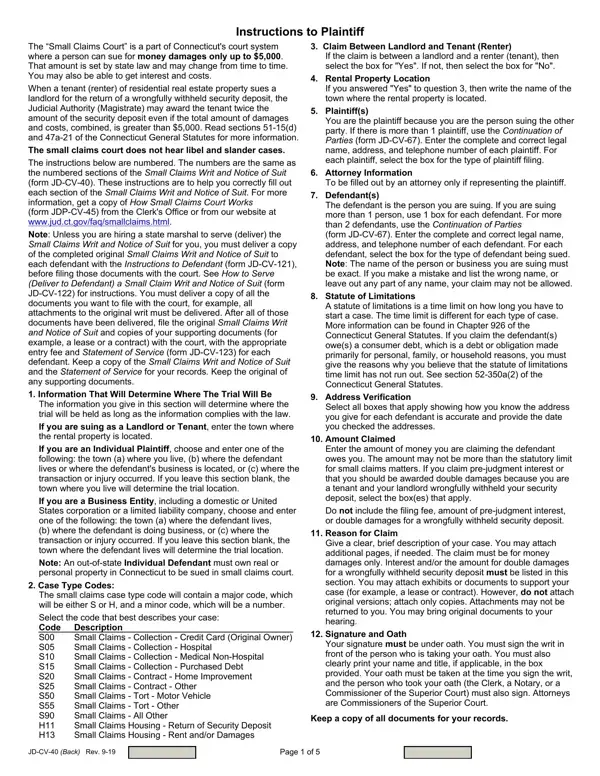
What it is: JD-CV-40, the Small Claims Writ and Notice of Suit of the State of Connecticut Superior Court Small Claims Session.
Who signs: You must sign the form in front of the person who is taking your oath. The person taking your oath must also sign.
Small Claims Court is where a person can sue for money damages only up to $5,000 (checked November 12, 2026). In the case of a home improvement contract, money damages are limited up to $15,000 (checked November 12, 2026). You may also ask for interest and costs.
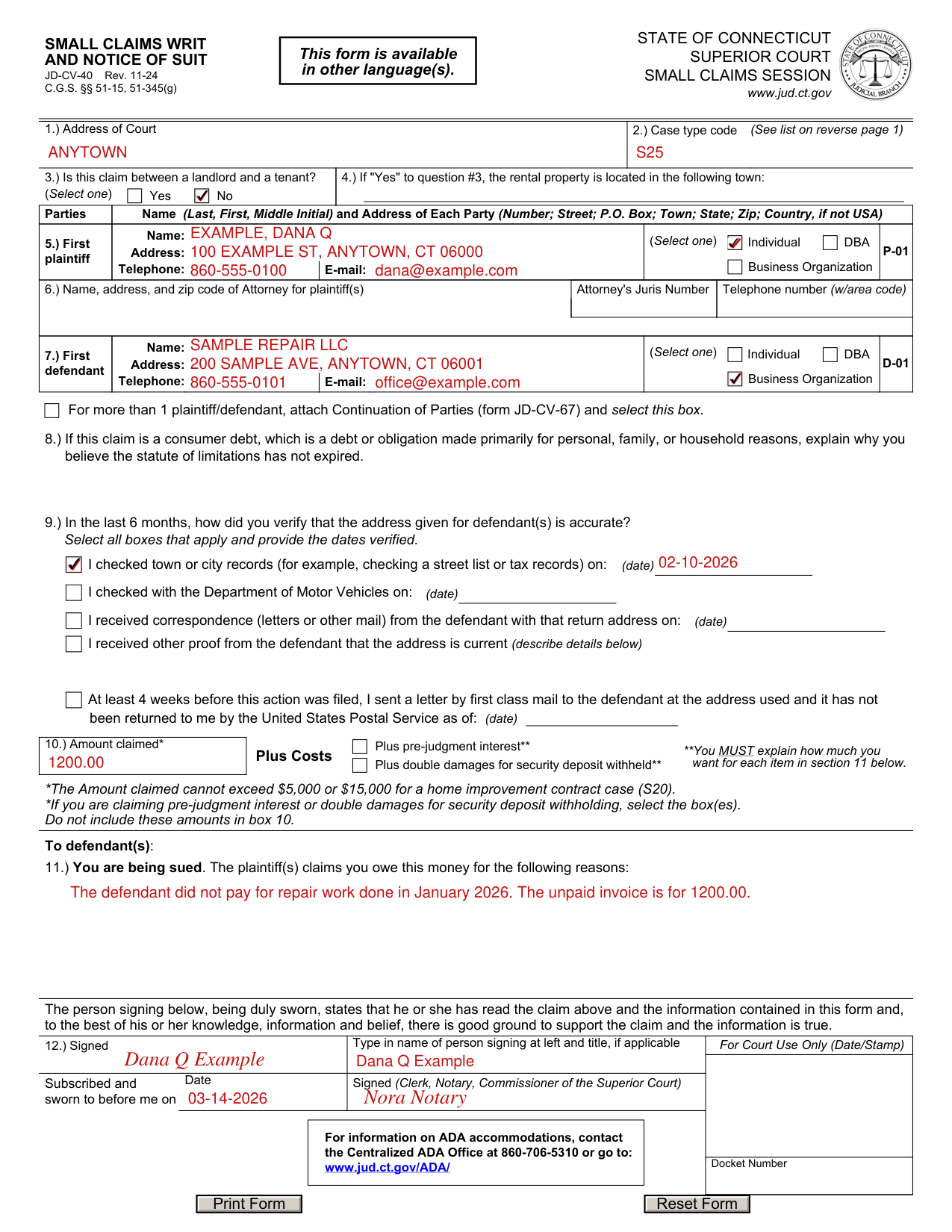
A filled-in Form JD-CV-40 example: an individual sues a business for unpaid work
How to fill out Form JD-CV-40, box by box
Address of court and case type code

Landlord or Tenant: Enter the town where the rental property is located.
Individual: Enter one of the following: the town (a) where you live, (b) where the defendant lives or where the defendant's business is located, or (c) where the transaction or injury occurred.
Business Entity (including a domestic or foreign business organization): Enter one of the following: the town (a) where the defendant lives, (b) where the defendant is doing business, or (c) where the transaction or injury occurred.
An out-of-state individual defendant must own real or personal property in Connecticut to be sued in small claims court.
Select one code that best describes your case: S00 Collection - Credit Card (Original Owner), S05 Collection - Hospital, S10 Collection - Medical Non-Hospital, S15 Collection - Purchased Debt, S20 Contract - Home Improvement, S25 Contract - Other, S50 Tort - Motor Vehicle, S55 Tort - Other, S90 All Other, H11 Housing - Return of Security Deposit, H13 Housing - Rent and/or Damages.
Landlord or tenant and rental property town

Select appropriate box.
If this is a landlord/tenant dispute, then write in which town the rental property is located.
Plaintiff, defendant and attorney
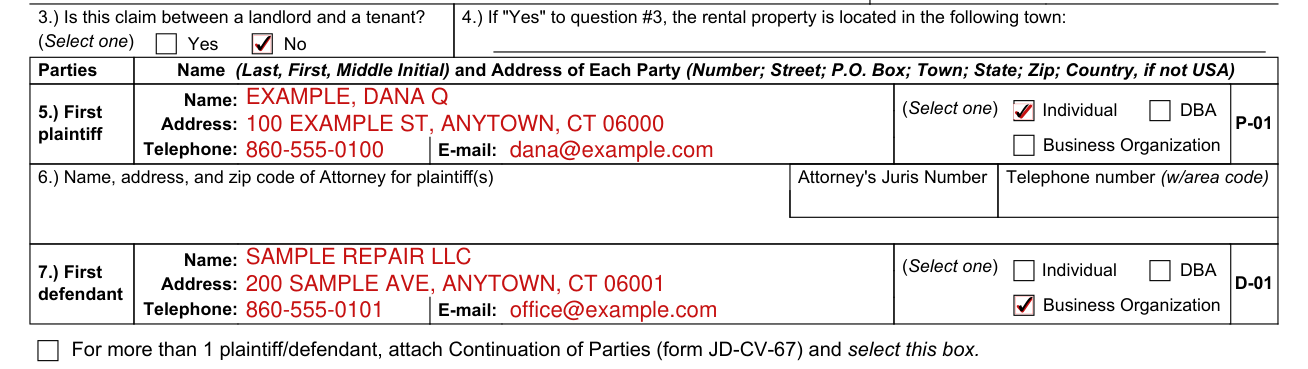
You are the plaintiff because you are suing the defendant. If there is more than one plaintiff, use the Continuation of Parties (form JD-CV-67). Enter the complete and correct legal name, address, telephone number, and e-mail address each plaintiff. For each plaintiff, select the box for the type of plaintiff.
If you are an attorney complete this section.
The defendant is the person you are suing. Use one box for each defendant. For more than two defendants, use the Continuation of Parties (form JD-CV-67). Enter the complete and correct legal name, address, telephone number, and e-mail address for each defendant. For each defendant, select the box for the type of defendant.
For more than 1 plaintiff/defendant, attach Continuation of Parties (form JD-CV-67) and select this box.
Statute of limitations

There is a time limit for starting a case. The time limit is different for each type of case. See General Statutes §§ 52-573 through 52-598a.
If this claim is a consumer debt, which is a debt or obligation made primarily for personal, family, or household reasons, explain why you believe the statute of limitations has not expired.
Address verification
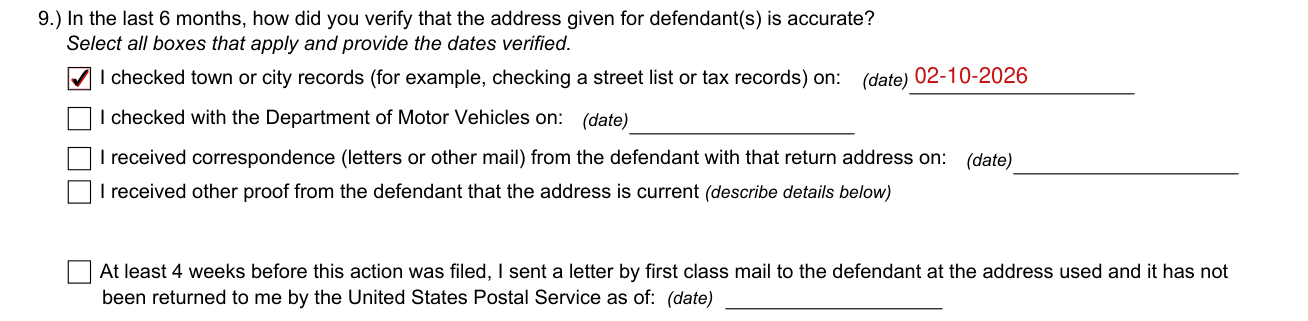
Select the box(es) that made you confident you are using the correct address for the defendant(s).
In the last 6 months, how did you verify that the address given for defendant(s) is accurate? Select all boxes that apply and provide the dates verified.
I checked town or city records (for example, checking a street list or tax records) on: (date)
I checked with the Department of Motor Vehicles on: (date)
I received correspondence (letters or other mail) from the defendant with that return address on: (date)
I received other proof from the defendant that the address is current, and describe the details.
At least 4 weeks before this action was filed, I sent a letter by first class mail to the defendant at the address used and it has not been returned to me by the United States Postal Service as of: (date)
Amount claimed, interest and double damages

Enter the amount of money you claim the defendant owes you. Do not include the filing fee. The amount must be within the limits noted for the Amount claimed. If you claim pre-judgment interest or double damages because your landlord wrongfully withheld your security deposit, select the box(es) that apply.
Plus double damages for security deposit withheld and plus pre-judgment interest: if you are claiming pre-judgment interest or double damages for security deposit withholding, select the box(es). The Amount claimed cannot exceed $5,000 or $15,000 for a home improvement contract case (S20) (checked November 12, 2026).
Do not include these amounts in box 10. You MUST explain how much you want for each item in section 11 below.
When a residential tenant sues a landlord for the return of a withheld security deposit, the court may award the tenant twice the amount of the security deposit even if the total amount of damages and costs, combined, is greater than $5,000 (checked November 12, 2026).
Reason for claim
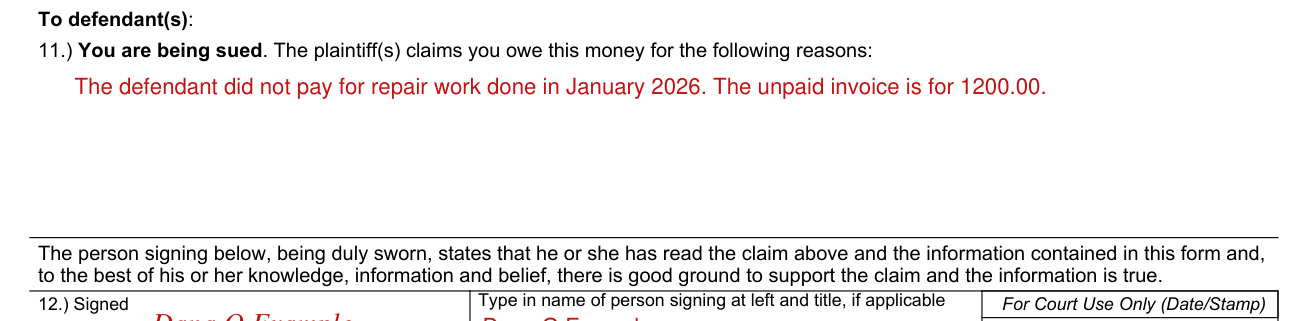
Clearly describe your case. You may attach additional pages. Explain your claim for money damages, interest, and/or double damages for a wrongfully withheld security deposit. You may attach copies (not originals) of documents to support your case (for example, a lease or contract). Attachments may not be returned to you. Bring original documents to your hearing.
Signed and sworn

The person signing, being duly sworn, states that he or she has read the claim and the information contained in this form and, to the best of his or her knowledge, information and belief, there is good ground to support the claim and the information is true.
More rules for Form JD-CV-40
The numbered sections of these instructions correspond to the numbered sections of the form. For more information, see How Small Claims Court Works (JDP-CV-45) at the Clerk's Office or at www.jud.ct.gov/faq/smallclaims.html.
Keep a copy of everything.
Common questions about Form JD-CV-40
Where do I file it?
After completing the form, serve (deliver) it to each defendant. Whether you hire a state marshal to serve the form, or you perform the service yourself, a copy of the completed form and the Instructions to Defendant (form JD-CV-121) must be delivered to each defendant before filing those documents with the court. See How to Serve (Deliver to Defendant) a Small Claim Writ and Notice of Suit (form JD-CV-122) for instructions. After all documents have been served, file the original of this form, copies of your supporting documents, and Statement of Service (form JD-CV-123) for each defendant with the court. Pay the appropriate entry fee. Keep all originals of supporting documents. If the defendant is an individual and does not file an answer, you must file a military affidavit before the case can be reviewed for a default judgment. See https://www.jud.ct.gov/faq/smallclaims.html#17 for more information.
When is this form not the right one?
The Small Claims Court does not hear libel and slander cases.
Sources
[1] Form JD-CV-40 (Rev. 11-24), Small Claims Writ and Notice of Suit, State of Connecticut Judicial Branch (the Official source link on this page).