
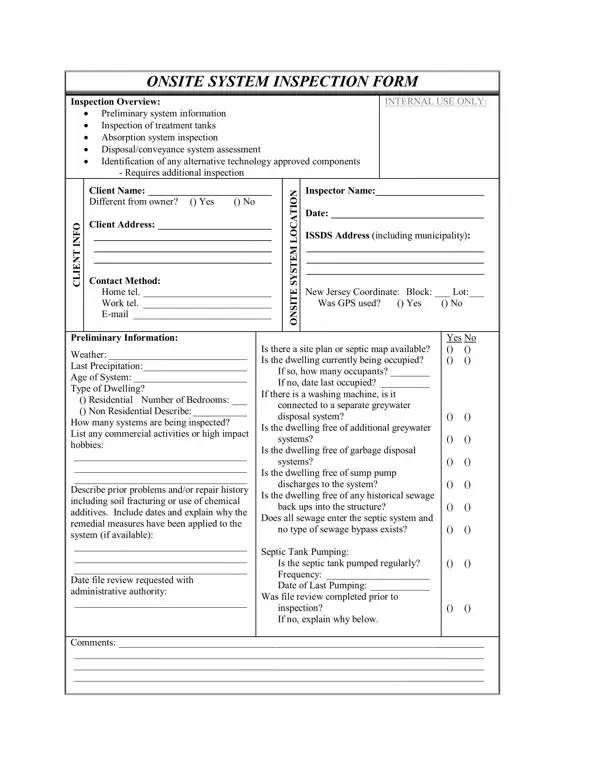

Onsite System Inspection Form at a glance
What it is: The Onsite System Inspection Form is an inspection overview: preliminary system information, inspection of treatment tanks, absorption system inspection, disposal/conveyance system assessment and identification of any alternative technology approved components, which requires additional inspection.
Who signs: The Customer signs and the Inspector signs, based on information provided by the owner(s) or their agent.
A filled-in Onsite System Inspection Form example: a homeowner orders an inspection
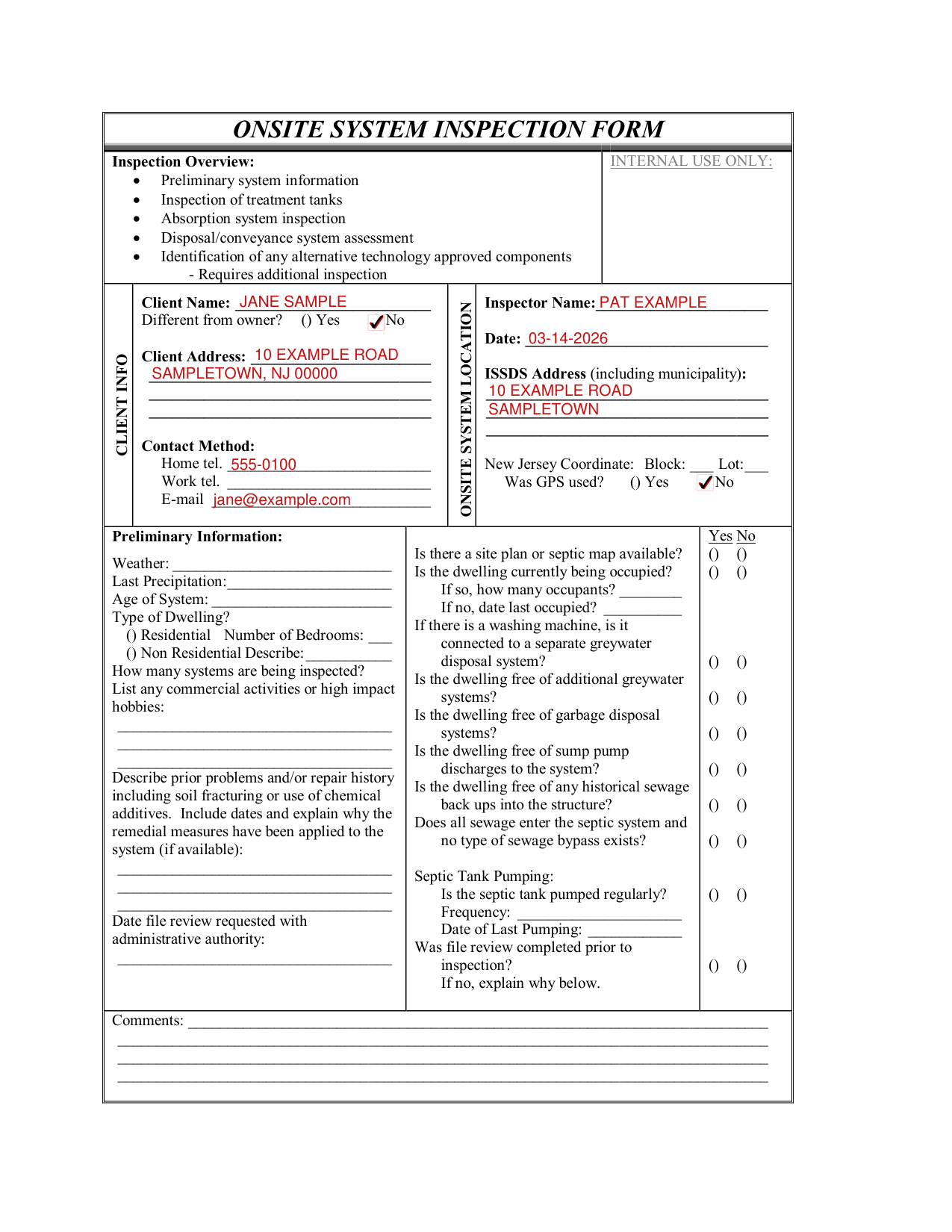
How to fill out Onsite System Inspection Form, box by box
Client Name, Client Address and Contact Method
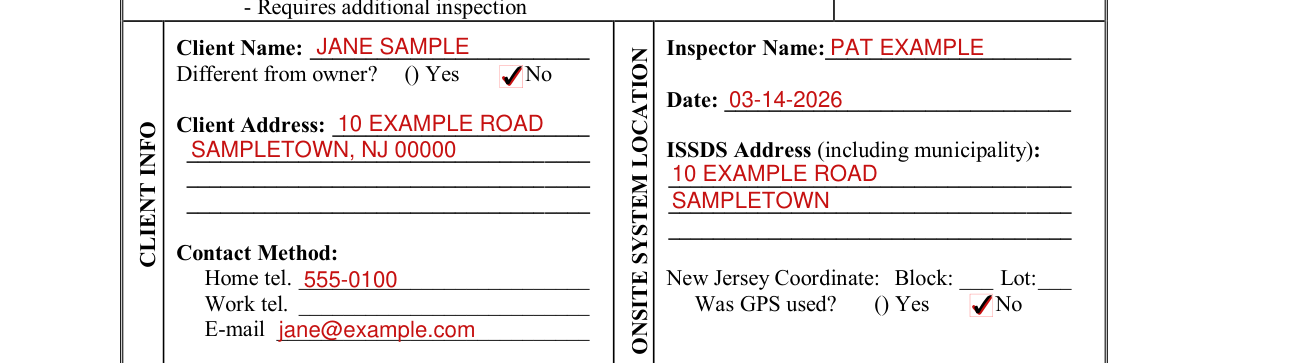
Enter the Client Name, mark Yes or No under Different from owner?, and enter the Client Address and the Contact Method: Home tel., Work tel. and E-mail.
Inspector Name, Date and ISSDS Address
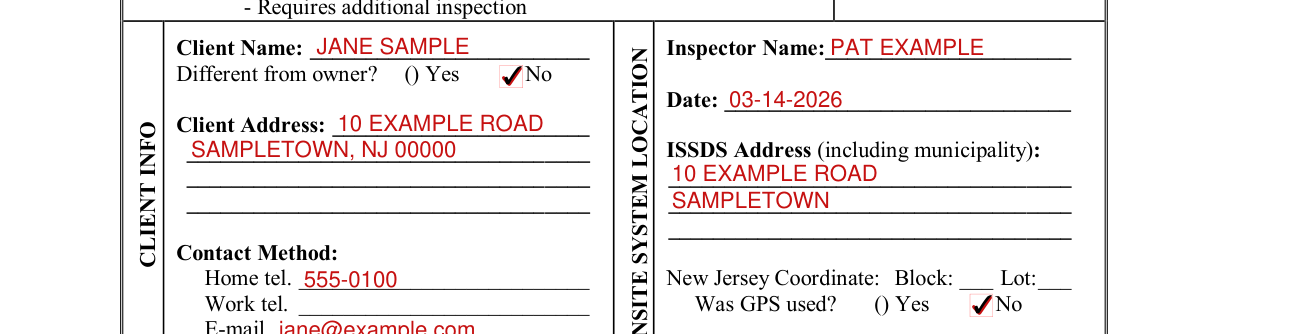
Enter the Inspector Name, the Date and the ISSDS Address (including municipality), then the New Jersey Coordinate for Block and Lot, and mark Yes or No for Was GPS used?
Preliminary Information
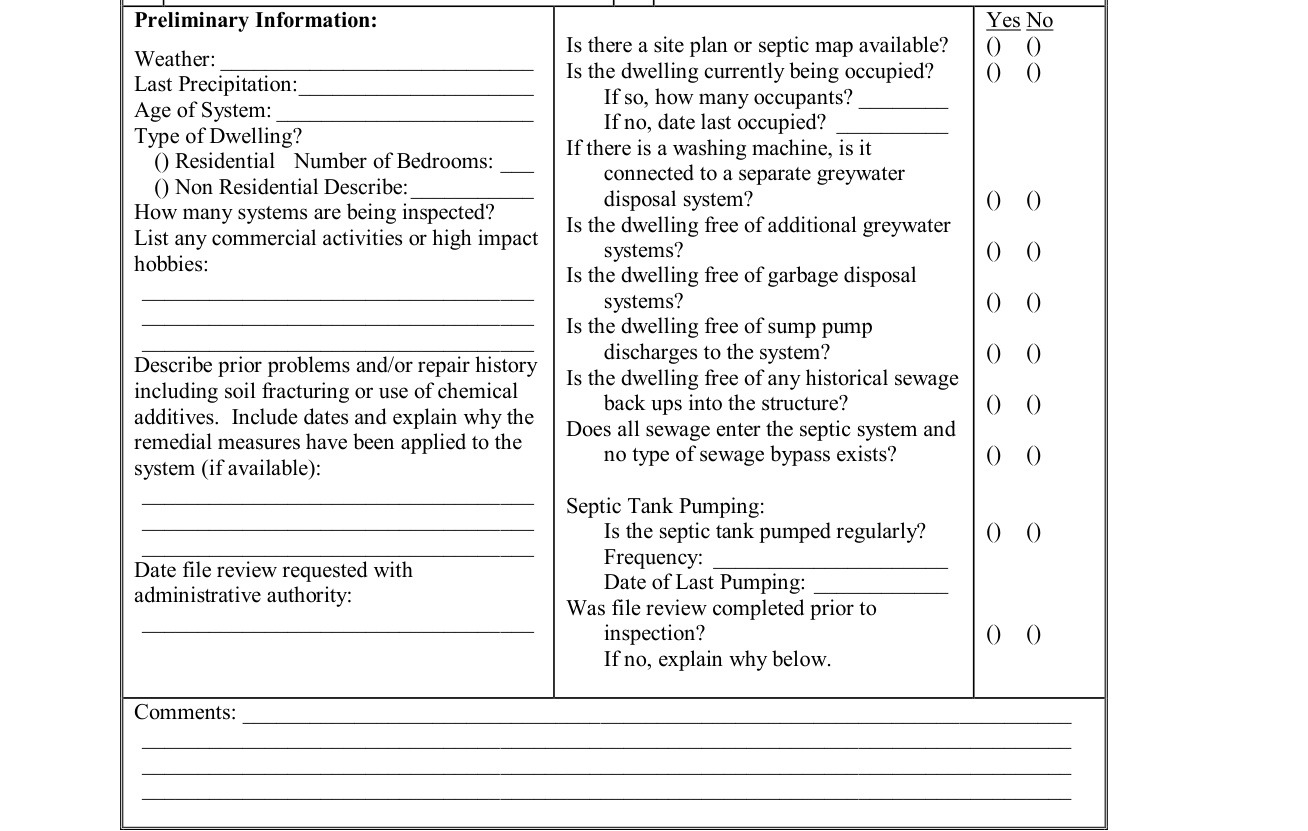
Enter the Weather, the Last Precipitation and the Age of System.
Under Type of Dwelling, mark Residential and enter the Number of Bedrooms, or mark Non Residential and enter a description under Describe.
Enter how many systems are being inspected and list any commercial activities or high impact hobbies.
Describe prior problems and/or repair history including soil fracturing or use of chemical additives, with the dates and why the remedial measures have been applied to the system (if available).
Enter the date file review requested with the administrative authority.
Mark Yes or No for each of these: Is there a site plan or septic map available? Is the dwelling currently being occupied? If so, how many occupants? If no, date last occupied? If there is a washing machine, is it connected to a separate greywater disposal system? Is the dwelling free of additional greywater systems? Is the dwelling free of garbage disposal systems? Is the dwelling free of sump pump discharges to the system? Is the dwelling free of any historical sewage back ups into the structure? Does all sewage enter the septic system and no type of sewage bypass exists? Under Septic Tank Pumping: Is the septic tank pumped regularly? Enter the Frequency and the Date of Last Pumping. Was file review completed prior to inspection? “If no, explain why below.”
Treatment Tank
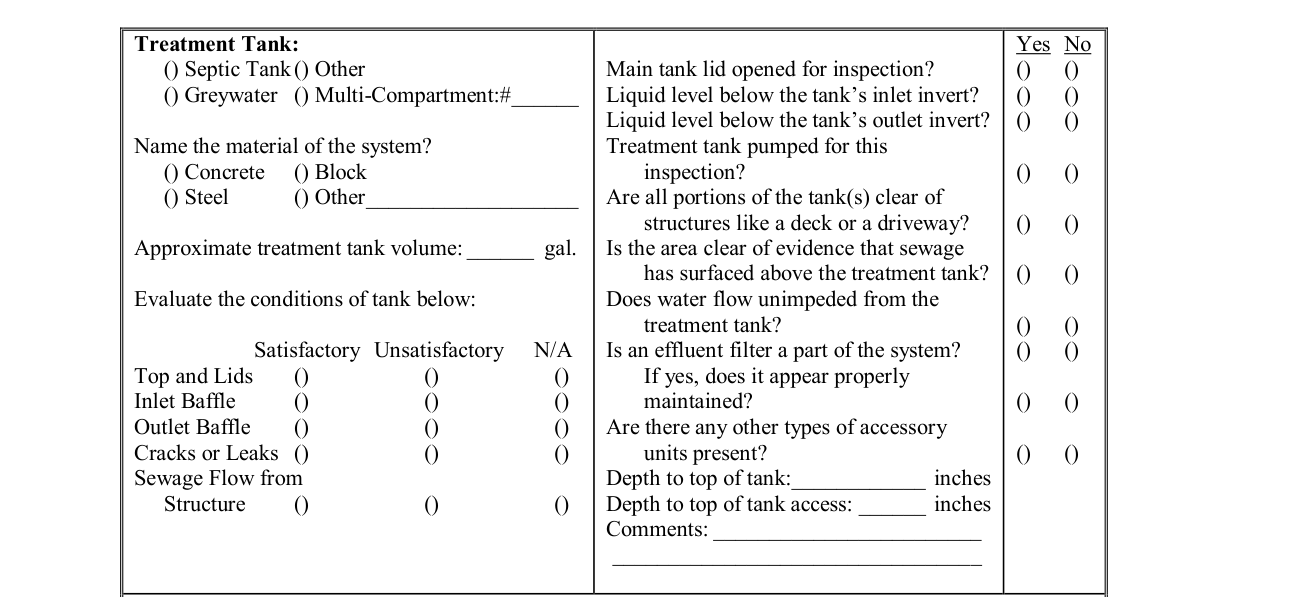
Under Treatment Tank, mark Septic Tank, Other, Greywater or Multi-Compartment and enter the number, name the material of the system as Concrete, Block, Steel or Other, and enter the approximate treatment tank volume in gal.
Evaluate the conditions of the tank as Satisfactory, Unsatisfactory or N/A for Top and Lids, Inlet Baffle, Outlet Baffle, Cracks or Leaks and Sewage Flow from Structure.
Mark Yes or No for each of these: Main tank lid opened for inspection? “Liquid level below the tank's inlet invert?” “Liquid level below the tank's outlet invert?” Treatment tank pumped for this inspection? Are all portions of the tank(s) clear of structures like a deck or a driveway? “Is the area clear of evidence that sewage has surfaced above the treatment tank?” Does water flow unimpeded from the treatment tank? Is an effluent filter a part of the system? If yes, does it appear properly maintained? Are there any other types of accessory units present? Enter the Depth to top of tank in inches and the Depth to top of tank access in inches.
Absorption Area
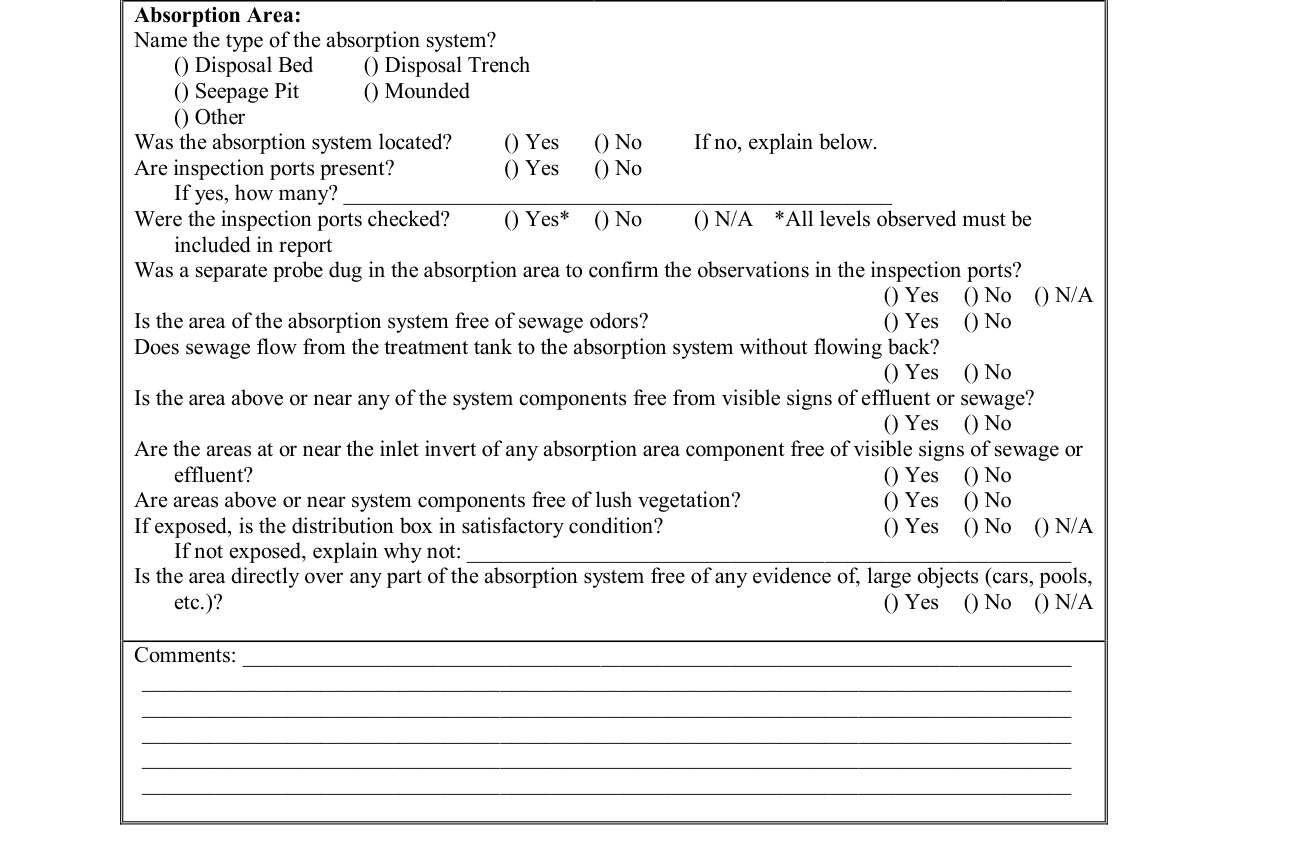
Under Absorption Area, name the type of the absorption system as Disposal Bed, Disposal Trench, Seepage Pit, Mounded or Other. Was the absorption system located? Mark Yes or No. “If no, explain below.”
Are inspection ports present? Mark Yes or No. If yes, how many? Were the inspection ports checked? Mark Yes*, No or N/A (*All levels observed must be included in report). Was a separate probe dug in the absorption area to confirm the observations in the inspection ports? Mark Yes, No or N/A. Mark Yes or No for each of these: Is the area of the absorption system free of sewage odors? Does sewage flow from the treatment tank to the absorption system without flowing back? “Is the area above or near any of the system components free from visible signs of effluent or sewage?” Are the areas at or near the inlet invert of any absorption area component free of visible signs of sewage or effluent? “Are areas above or near system components free of lush vegetation?” If exposed, is the distribution box in satisfactory condition? Mark Yes, No or N/A. If not exposed, explain why not. Is the area directly over any part of the absorption system free of any evidence of, large objects (cars, pools, etc.)? Mark Yes, No or N/A.
Dosing or Pump Tank
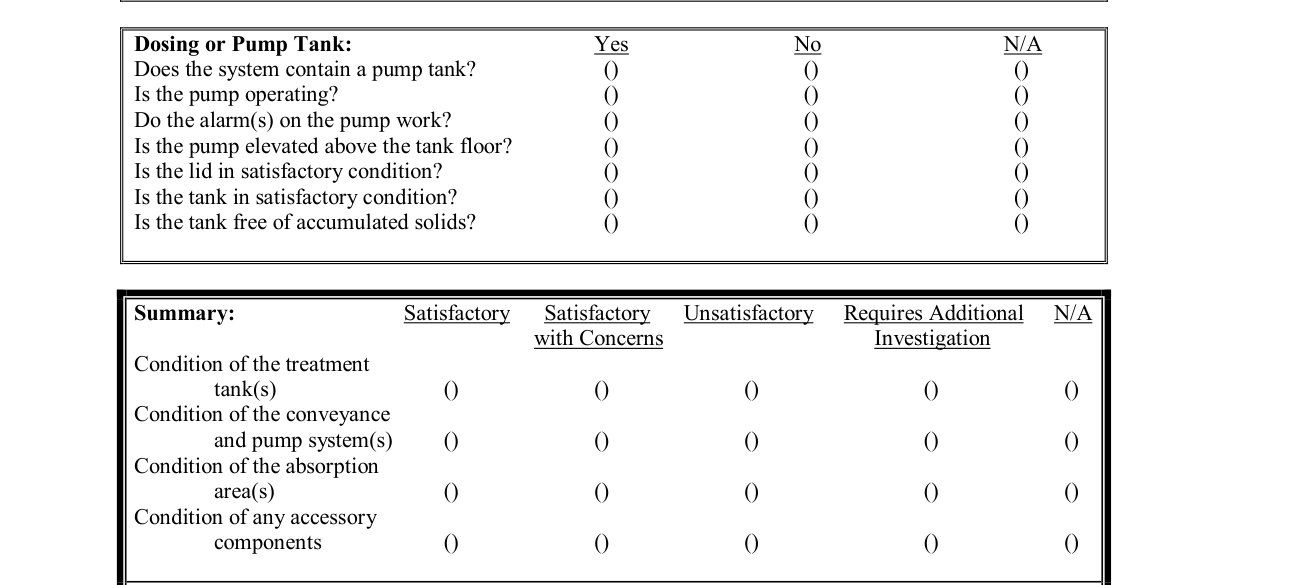
Sketch the approximate system location in the space provided. Under Dosing or Pump Tank, mark Yes, No or N/A for each: Does the system contain a pump tank? Is the pump operating? Do the alarm(s) on the pump work? “Is the pump elevated above the tank floor?” Is the lid in satisfactory condition? Is the tank in satisfactory condition? Is the tank free of accumulated solids?
Summary

Under Summary, mark each condition as Satisfactory, Satisfactory with Concerns, Unsatisfactory, Requires Additional Investigation or N/A for the treatment tank(s), the conveyance and pump system(s), the absorption area(s) and any accessory components.
Health Department Reporting
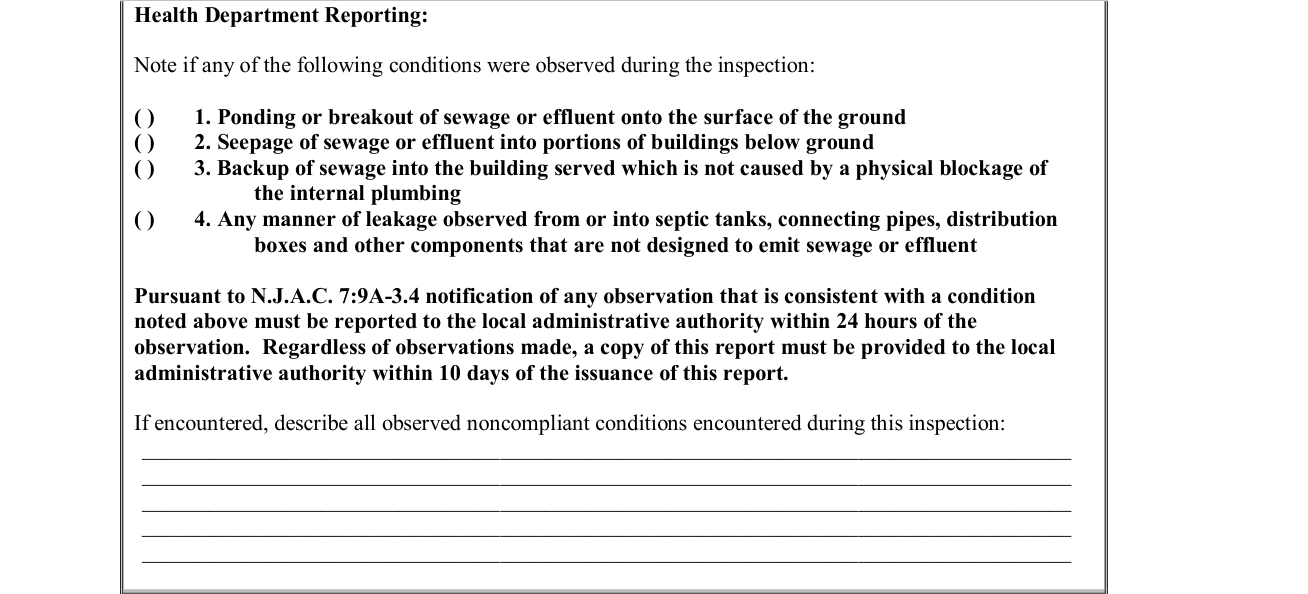
Under Health Department Reporting, note if any of the following conditions were observed during the inspection: 1. Ponding or breakout of sewage or effluent onto the surface of the ground; 2. “Seepage of sewage or effluent into portions of buildings below ground”; 3. Backup of sewage into the building served which is not caused by a physical blockage of the internal plumbing; 4. Any manner of leakage observed from or into septic tanks, connecting pipes, distribution boxes and other components that are not designed to emit sewage or effluent.
Under 7:9A-3.4, “notification of any observation that is consistent with a condition noted above must be reported to the local administrative authority within 24 hours of the observation.”
Regardless of observations made, a copy of this report must be provided to the local administrative authority within 10 days of the issuance of this report.
If encountered, describe all observed noncompliant conditions encountered during this inspection.
Customer Authorization

By the Customer Authorization the customer authorizes “The Company” to enter the listed property for the purpose of performing a sub-surface sewage disposal system inspection, to expose parts of the system if required, to determine location and condition, and to provide this form to all parties as required.
Under Customer Authorization: I understand that “The Company” relies on information supplied by the owner(s) of the listed property or their agent and the local administrative authority in the evaluation of the sub-surface disposal system.
The Customer signs on the Customer signature line and enters a Printed name, and the Inspector signs on the Inspector's signature line with a Printed name. Based on today's observations and the information provided by the owner(s) or their agent, “The Company” submits this sub-surface sewage disposal system inspection form.
More rules for Onsite System Inspection Form
The inspection is based on the current condition of the onsite sewage disposal system, and “The Company” has not been retained to warrant, guarantee, or certify the proper functioning of the system for any period of time.
Sources
[1] Onsite System Inspection Form (the served file; no issuer file found) (the Official source link on this page).