
Score Sheet Scale PDF Details

The Score Sheet Early Childhood Environment Rating Scale–Revised, a comprehensive tool crafted by Thelma Harms, Richard M. Clifford, and Debby Cryer, is meticulously designed to evaluate the quality of early childhood environments. This detailed form encompasses several areas essential for fostering an enriching early education setting, including space and furnishings, personal care routines, language-reasoning activities, and interactions among various parties within the educational ecosystem. Information regarding the observer, the center or school being evaluated, and specific classroom details such as the number of children, their ages, and any identified disabilities, is methodically collected to ensure a well-rounded assessment. Moreover, the scale evaluates critical aspects spanning from the physical environment to the nuanced interactions between staff and children, aiming for a holistic view of the learning atmosphere. With sections dedicated to evaluating program structure, involvement with parents and staff, and provisions for children with disabilities, the score sheet reflects an in-depth analysis of the educational quality, tailored to promote the developmental needs and welfare of the children it serves.

QuestionAnswer
Form NameScore Sheet Scale
Form Length7 pages
Fillable?No
Fillable fields0
Avg. time to fill out1 min 45 sec
Other namesecers r book download, ecers r book pdf, ecers rating scale pdf, score sheet scale

How to Fill Out Score Sheet, Early Childhood Environment Rating Scale-Revised

Score Sheet, Early Childhood Environment Rating Scale-Revised at a glance

What it is: Score Sheet, Early Childhood Environment Rating Scale-Revised, by Thelma Harms, Richard M. Clifford, and Debby Cryer.

A filled-in Score Sheet, Early Childhood Environment Rating Scale-Revised example: an observer totals the seven subscales
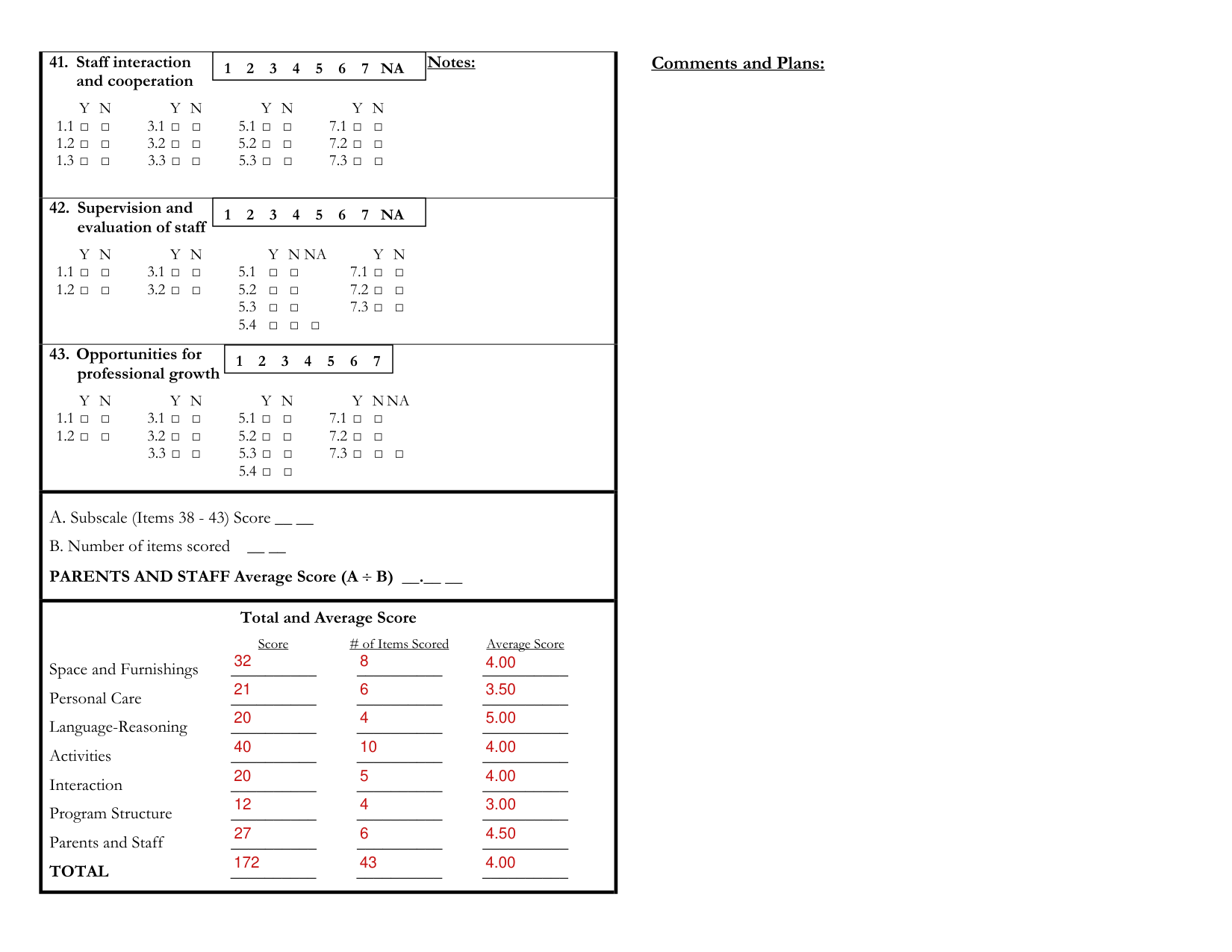
Score Sheet, Early Childhood Environment Rating Scale-Revised example filled out, example: an observer totals the seven subscales
Jordan Sample, an observer, copies the subscale results onto the score sheet. Every item in all seven subscales was scored, so each count equals the printed item range. The picture shows page 6 only, and its names and figures are sample values. Each Average Score is the Score divided by the items scored, and TOTAL adds up the seven rows. No child in the room has an identified disability, so the Type(s) of disability boxes stay empty.

How to fill out Score Sheet, Early Childhood Environment Rating Scale-Revised, box by box

Observer, Center/School, Room and Teacher(s)
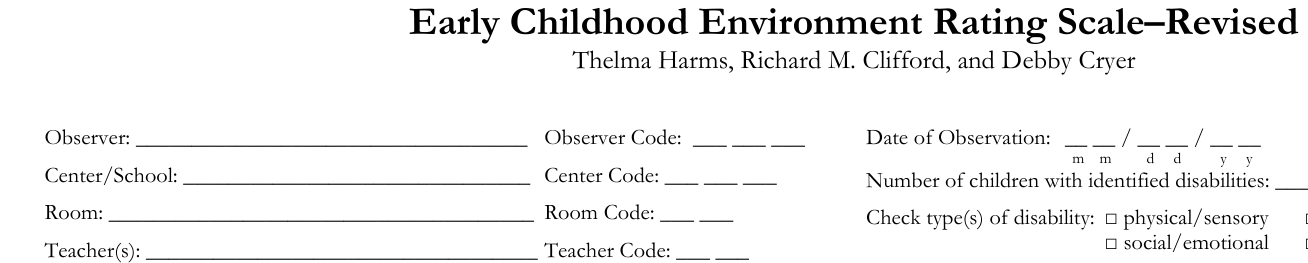
Score Sheet, Early Childhood Environment Rating Scale-Revised example filled out, observer, Center/School, Room and Teacher(s)

Write the Observer and the Observer Code.

Write the Center/School and the Center Code.

Write the Room and the Room Code.

Write the Teacher(s) and the Teacher Code.

Type(s) of disability

Score Sheet, Early Childhood Environment Rating Scale-Revised example filled out, type(s) of disability

Write the Date of Observation and the Number of children with identified disabilities, then check the type(s) of disability: physical/sensory, cognitive/language, social/emotional or other. Write the Birthdates of children enrolled, youngest and oldest,, and the Time observation began.

Total and Average Score
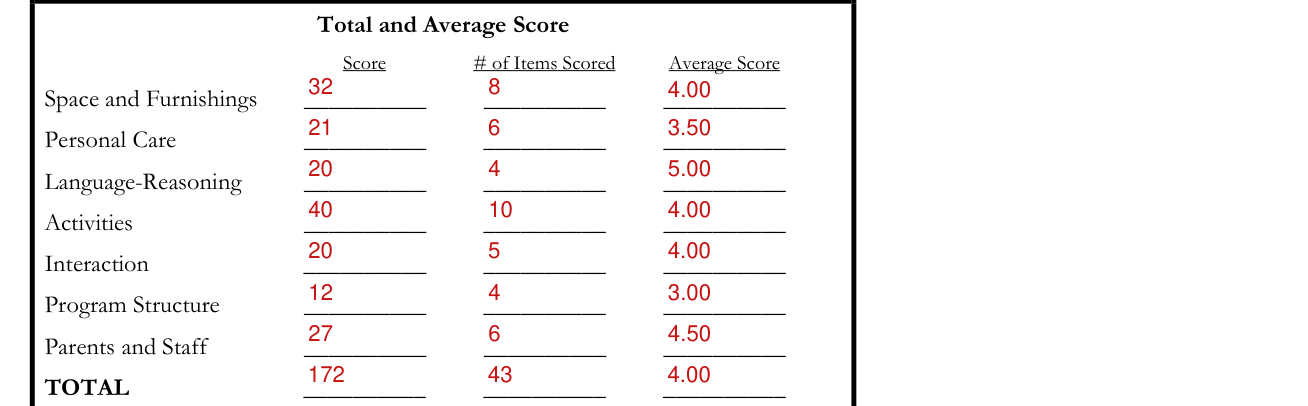
Score Sheet, Early Childhood Environment Rating Scale-Revised example filled out, total and Average Score

In Total and Average Score, fill each row with its Score, # of Items Scored and Average Score: Space and Furnishings, Personal Care, Language-Reasoning, Activities, Interaction, Program Structure, Parents and Staff and the TOTAL.

More rules for Score Sheet, Early Childhood Environment Rating Scale-Revised

Under 1. Indoor space, mark Y or N at 1.1, 3.1, 5.1 and 7.1 and the other lines it prints, and write Notes.

For each subscale, write A. Subscale Score, B. Number of items scored and the Average Score (A ÷ B): SPACE AND FURNISHINGS (Items 1 - 8), PERSONAL CARE ROUTINES (Items 9 - 14), LANGUAGE-REASONING (Items 15 - 18), ACTIVITIES (Items 19 - 28), INTERACTION (Items 29 - 33), PROGRAM STRUCTURE (Items 34 - 37) and PARENTS AND STAFF (Items 38 - 43).

Write Comments and Plans.

If your situation is different

Number of staff present and children enrolled in class

Write the Number of staff present, the Number of children enrolled in class, the Highest number center allows in class at one time and the Highest number of children present during observation.

Sources

[1] Score Sheet, Early Childhood Environment Rating Scale-Revised (the served file; no issuer file found).

Please rate Score Sheet Scale

1 Votes
If you believe this page is infringing on your copyright, please familiarize yourself with and follow our DMCA notice and takedown process - click here to proceed .