
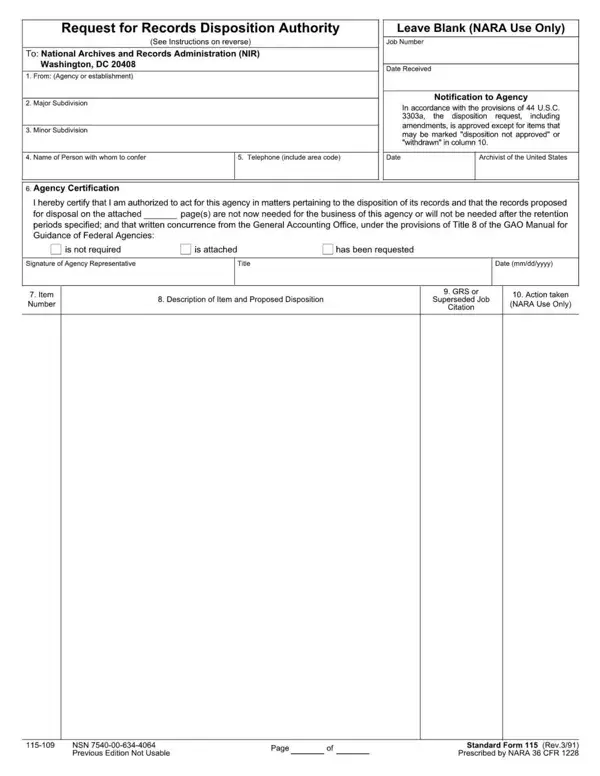
Standard Form 115 at a glance
What it is: Standard Form 115, Request for Records Disposition Authority, obtains authority for the disposition of records.
Who signs: Signature of Agency Representative, Title and Date (mm/dd/yyyy).
Entry 1 should show the name of the Executive Branch department or independent agency, Legislative Branch agency, or the Administrative Office of the U.S. Courts for the Judicial Branch that is submitting the request.
What to bring and attach to Standard Form 115
The SF 115 may be accompanied by Standard Form 115A, Continuation Sheet, by schedule items entered on blank stationery formatted similar to the SF 115A, or by pages formatted to conform to the agency's published records disposition schedule.
GAO's written approval must either accompany each SF 115 requiring Comptroller General concurrence or be requested prior, to the submission of the SF 115 to NARA.
A filled-in Standard Form 115 example: a records officer schedules one series of records
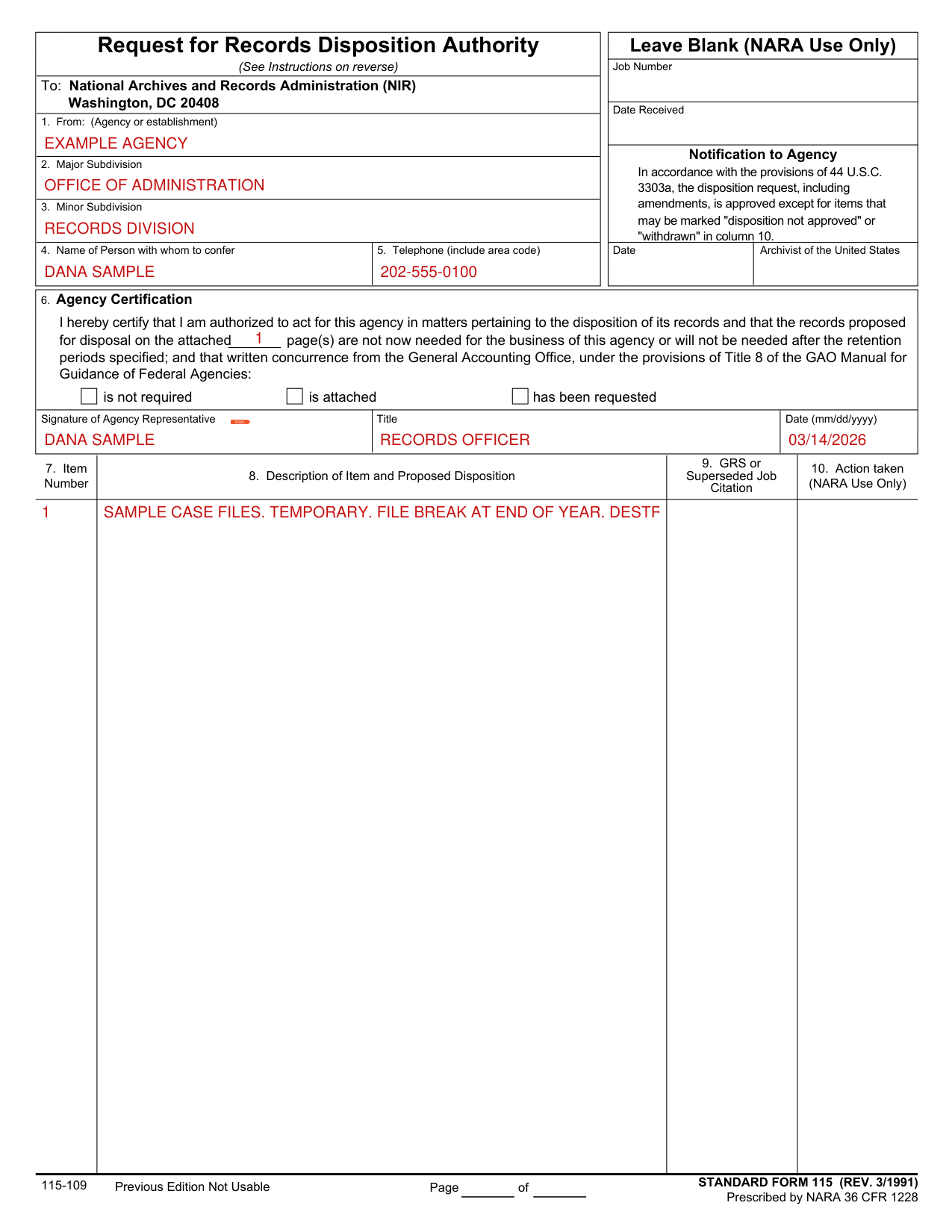
How to fill out Standard Form 115, box by box
Entries 2 and 3: major and minor subdivisions

Entries 2 and 3 should show the major and minor organizational subdivisions that create or maintain the records described on the form. If more than one subdivision maintains records described in the submission, the various office names should be specified in entry 8.
Entries 4 and 5: person to be contacted and telephone number

Entries 4 and 5 should provide the name and telephone number of the person to be contacted for information.
6. Agency Certification
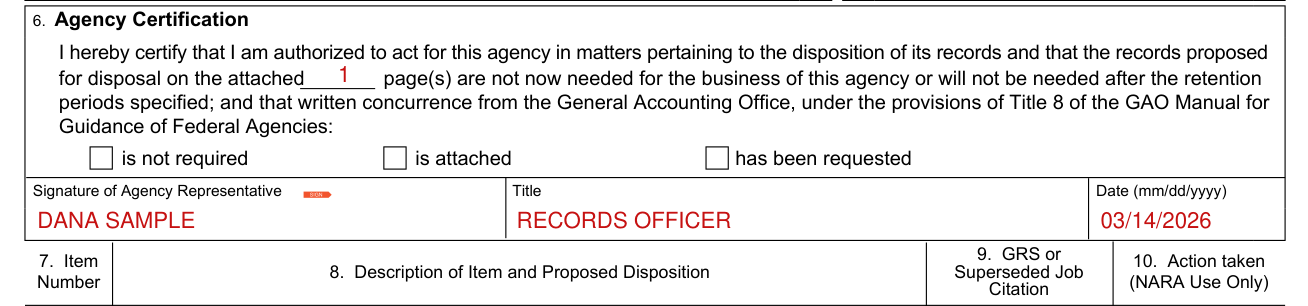
Entry 6 must be signed and dated by the agency official authorized to certify that the retention periods for records proposed for disposal are adequate to meet the agency's needs, and that GAO requirements have been met (check appropriate box).
Unsigned SF 115s will be returned to the agency.
Entry 7, 8 and 9: item numbers, the records and previous job numbers
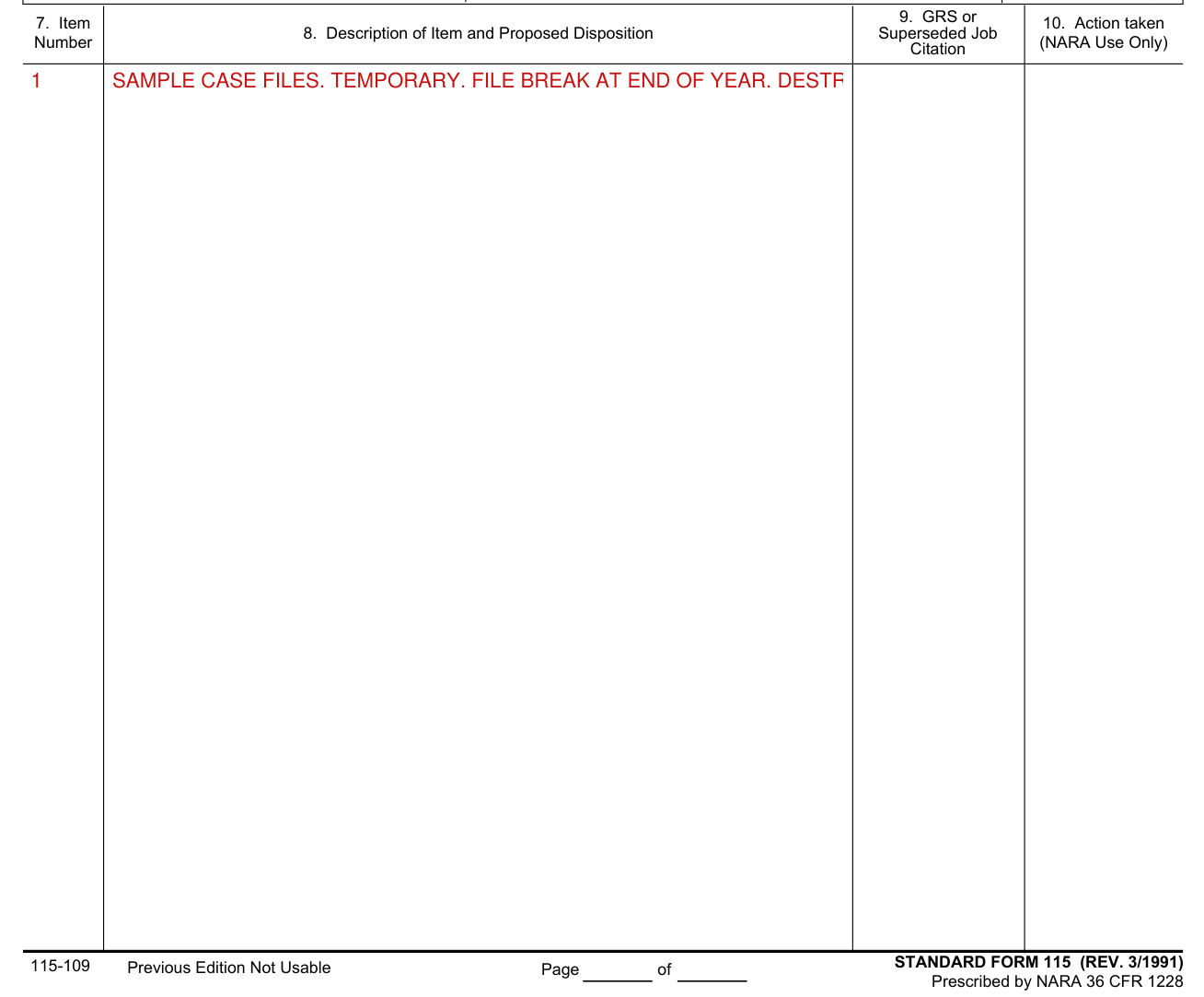
Entry 7 should contain the item numbers of the records identified on the form in sequence, beginning with "1." Lower case letters and numbers may be used to designate subdivisions of an item (1a, 1b, 1b(1), 1b(2), etc.). Agency file numbers should not be entered in this column but may be included in entry 8.
Entry 8 should describe the records to be scheduled. Follow these steps in describing the records: (a) Include centered headings for groups of items to indicate the office of origin if all records described on the form are not those of the same office, or if they are records created by another office or agency such as, for example, records inherited from a defunct agency.
(b) Identify separate collections of nontextual records, such as photographs, sound recordings, maps, architectural drawings, or magnetic tapes or disks, as separate and distinct items. If such records are interspersed with textual records, as in case files, their presence should be noted in the description of the textual file.
(c) Describe completely and accurately each series of records proposed for disposal or transfer to the National Archives. See 36 CFR 1228 for more detailed requirements. Failure to comply with the provisions of that regulation will result in the return of the SF 115 for corrective action.
(d) Provide clear disposition instructions for each item and subitem. These instructions should include file breaks; the time after which records will be retired to Federal records centers, if applicable; for temporary records, the time after which they may be destroyed; and for archival (permanent) records, the time after which they will be transferred to the legal custody of the National Archives.
(e) If immediate disposal or transfer to the National Archives is proposed for non-recurring records, indicate the volume and inclusive dates of the records and the Federal records center accession and box numbers, if applicable.
(f) If future or continuing disposition authority is requested, state the retention period in terms of years, months, etc. or in terms of future actions or events. Ensure that any future action or event that must precede final disposition is objective and definite.
(g) If records are converted to electronic form, schedule both the original records and the electronic media, unless covered by the General Records Schedules.
(h) If permanent or unscheduled records are converted to microform, the disposition for both the original and microform copies must be approved on an SF115. The SF 115 covering the microform must contain the certifications required by 36 CFR 1230.
Entry 9 must include the previous NARA disposition job and item numbers; General Records Schedule and item numbers, if applicable; and agency directive or manual and item numbers, if applicable, as required by 36 CFR 1228. If such information is missing from column 9, the SF 115 will be returned without action. Leave column 9 blank only if the records are being scheduled for the first time.
More rules for Standard Form 115
Entry 10 is for NARA use only and should be left blank.
NARA will later return one copy as notification of the items approved for disposal or archival (permanent) retention. This copy will also indicate any items withdrawn or disapproved.
Common questions about Standard Form 115
Where do I file it?
Submit two signed copies to the National Archives and Records Administration (NIR), Washington DC 20408, and retain one copy as your suspense copy.
Sources
[1] Standard Form 115 (REV. 3/1991), Request for Records Disposition Authority, National Archives and Records Administration (the Official source link on this page).