
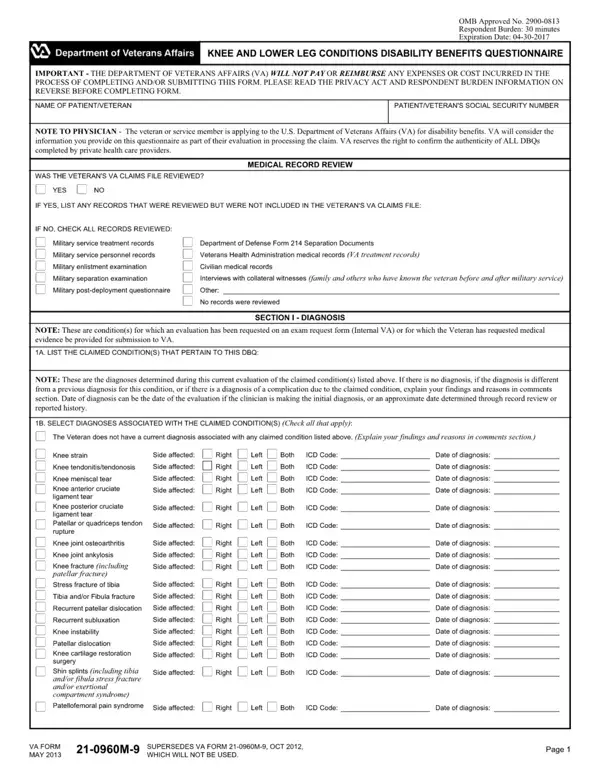

Knee and Lower Leg Disability Benefits Questionnaire (VA) at a glance
What it is: The Knee and Lower Leg Disability Benefits Questionnaire is intended to be completed by the Veteran's healthcare provider; VA may obtain additional medical information, including an examination, if necessary.
Who signs: 16A. Examiner's signature.
A filled-in Knee and Lower Leg Disability Benefits Questionnaire (VA) example: a Veteran-requested questionnaire
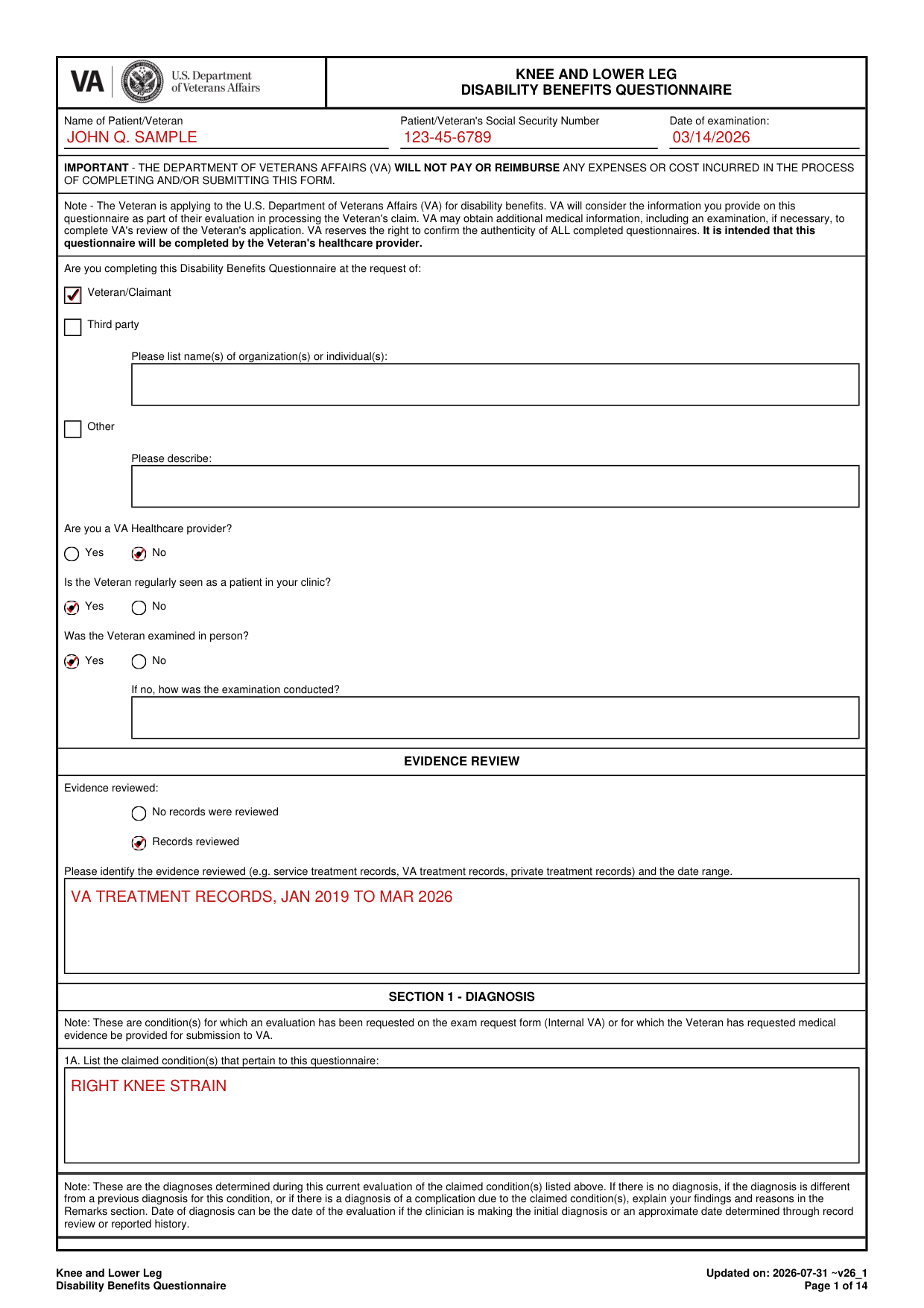
How to fill out Knee and Lower Leg Disability Benefits Questionnaire (VA), box by box
Who requested the questionnaire
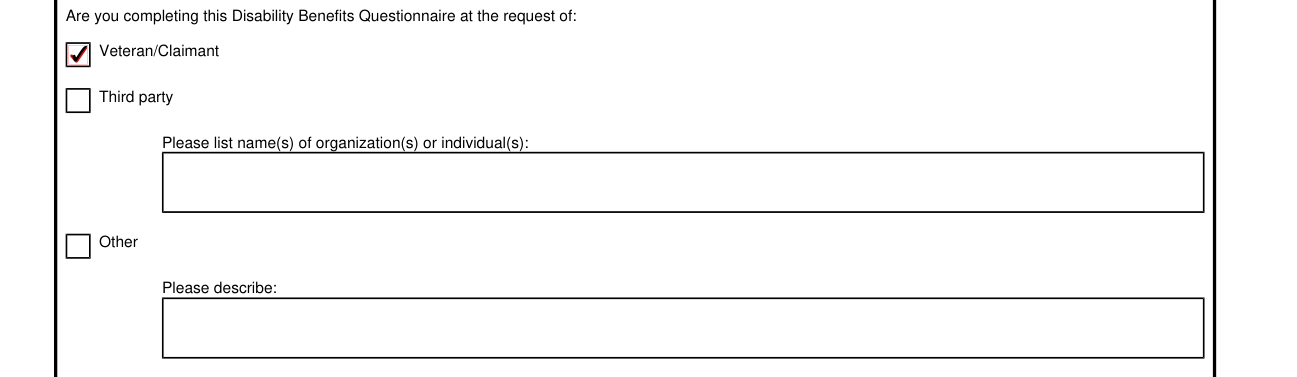
Are you completing this Disability Benefits Questionnaire at the request of: Veteran/Claimant, Third party (list name(s) of organization(s) or individual(s)) or Other (describe)?
Examination and evidence review
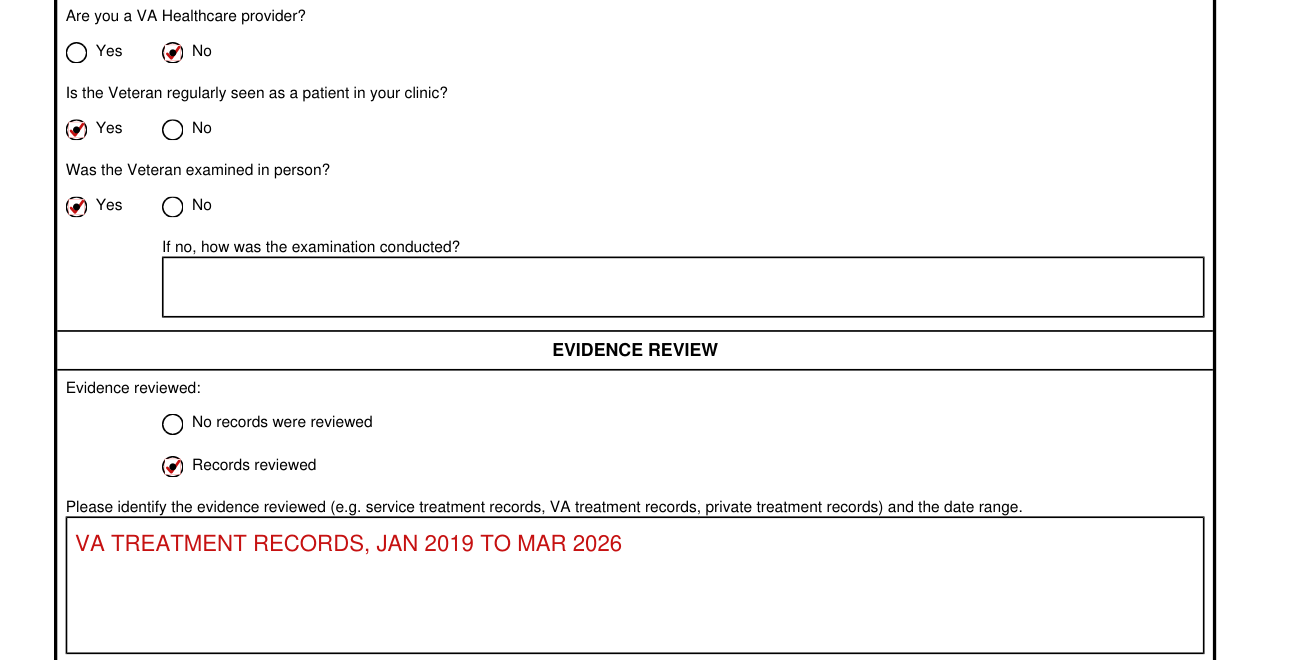
Are you a VA Healthcare provider? Is the Veteran regularly seen as a patient in your clinic? Was the Veteran examined in person? If no, how was the examination conducted?
Evidence reviewed: No records were reviewed, or Records reviewed. Identify the evidence reviewed (e.g. service treatment records, VA treatment records, private treatment records) and the date range.
Examiner's signature, name and title
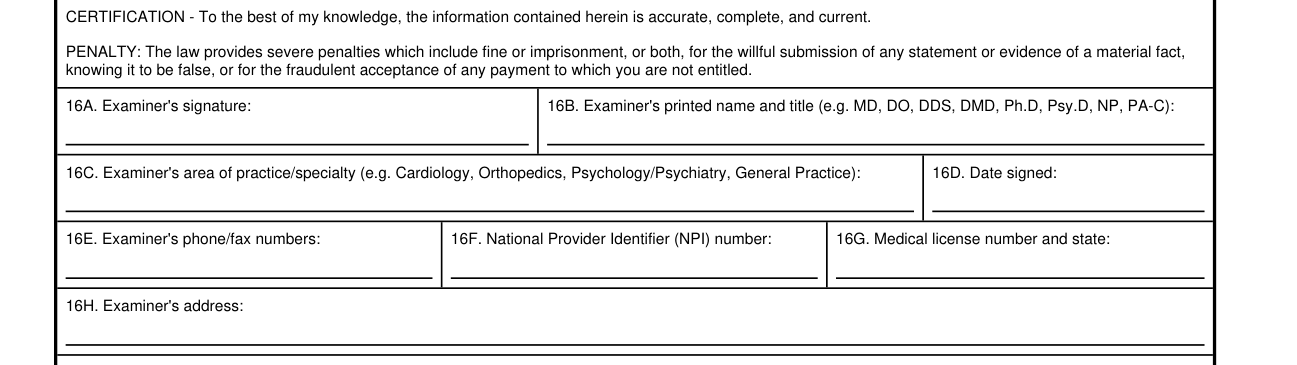
In Section 16: 16B. Examiner's printed name and title (e.g. MD, DO, DDS, DMD, Ph.D, Psy.D, NP, PA-C), 16C. Examiner's area of practice/specialty (e.g. Cardiology, Orthopedics, Psychology/Psychiatry, General Practice), 16D. Date signed, 16E. Examiner's phone/fax numbers, 16F. National Provider Identifier (NPI) number, 16G. Medical license number and state, 16H. Examiner's address.
More rules for Knee and Lower Leg Disability Benefits Questionnaire (VA)
In 1A, list the claimed condition(s) that pertain to this questionnaire: these are condition(s) for which an evaluation has been requested on the exam request form (Internal VA) or for which the Veteran has requested medical evidence be provided for submission to VA.
In 1B, select diagnoses associated with the claimed condition(s) (check all that apply).
The diagnoses are the diagnoses determined during this current evaluation of the claimed condition(s). If there is no diagnosis, if the diagnosis is different from a previous diagnosis for this condition, or if there is a diagnosis of a complication due to the claimed condition(s), explain your findings and reasons in the Remarks section. Date of diagnosis can be the date of the evaluation if the clinician is making the initial diagnosis or an approximate date determined through record review or reported history.
If testing cannot be performed or is medically contraindicated (such as it may cause the Veteran severe pain or the risk of further injury), an explanation must be given.
If this is the unclaimed joint, is it: Damaged or Undamaged? If undamaged, range of motion testing must be conducted.
Ankylosis is the immobilization of a joint due to disease, injury, or surgical procedure.
If ankylosed, is there involvement of Muscle Group XIII? If yes, complete the Muscle Injuries questionnaire.
Does the Veteran have any scars or other disfigurement (of the skin) related to any conditions or to the treatment of any conditions listed in the diagnosis section? If yes, also complete the appropriate dermatological questionnaire.
Under DIAGNOSTIC TESTING, testing listed is not indicated for every condition. The diagnosis of degenerative arthritis (osteoarthritis) or post-traumatic arthritis must be confirmed by imaging studies. Once such arthritis has been documented, even if in the past, no further imaging studies are required by VA, even if arthritis has worsened.
For any joint condition, examiners should address pain on both passive and active motion, and on both weight-bearing and non-weight bearing. Examiners should also test the contralateral joint (unless medically contraindicated).
When pain is associated with movement, the examiner must give a statement on whether pain could significantly limit functional ability during flare-ups and/or after repeated use over time in terms of additional loss of range of motion.
The examiner should provide the estimated range of motion based on a review of all procurable information - to include the Veteran's statement on examination, case-specific evidence (to include medical treatment records when applicable and lay evidence), and the examiner's medical expertise. If, after evaluation of the procurable and assembled data, the examiner determines that it is not feasible to provide this estimate, the examiner should explain why an estimate cannot be provided.
A surgical procedure that does not involve repair of one or more patellofemoral components that contribute to the underlying instability shall not qualify as surgical repair for patellar instability (including but not limited to, arthroscopy to remove loose bodies and joint aspiration).
The intention of this section is to permit the examiner to quantify the level of remaining function; it is not intended to inquire whether the Veteran should undergo an amputation with fitting of a prosthesis. For example, if the functions of grasping (hand) or propulsion (foot) are as limited as if the Veteran had an amputation and prosthesis, the examiner should check "yes" and describe the diminished functioning.
Provide the impact of only the diagnosed condition(s), without consideration of the impact of other medical conditions or factors, such as age.
If shin splints is diagnosed with compartment syndrome complete the Muscles questionnaire in lieu of this questionnaire.
Common questions about Knee and Lower Leg Disability Benefits Questionnaire (VA)
Are there fees?
VA will not pay or reimburse any expenses or cost incurred in the process of completing and/or submitting this form.
Is there a penalty?
PENALTY: The law provides severe penalties which include fine or imprisonment, or both, for the willful submission of any statement or evidence of a material fact, knowing it to be false, or for the fraudulent acceptance of any payment to which you are not entitled.
What am I certifying when I sign?
CERTIFICATION - To the best of my knowledge, the information contained herein is accurate, complete, and current.
Sources
[1] Knee and Lower Leg Disability Benefits Questionnaire, U.S. Department of Veterans Affairs (the Official source link on this page).