
The Idaho motor vehicle power of attorney form lets one person (the principal) name another (the agent) to handle title and registration matters for a vehicle. It is a practical choice when the owner cannot be there in person because of travel, illness or other commitments. You can create the document online or download the PDF.
Last Updated: October 2026. This guide is reviewed and updated regularly to reflect current law. If you notice an error or outdated information, please contact us.
Build Your Document
Answer a few simple questions to make your document in minutes
Save and Print
Save progress and finish on any device, download and print anytime
Sign and Use
Your valid, lawyer-approved document is ready
A motor vehicle power of attorney lets you hand your vehicle paperwork to someone you trust. You name an agent, describe the vehicle and sign the document. The agent then acts for you on the vehicle matters the document lists.
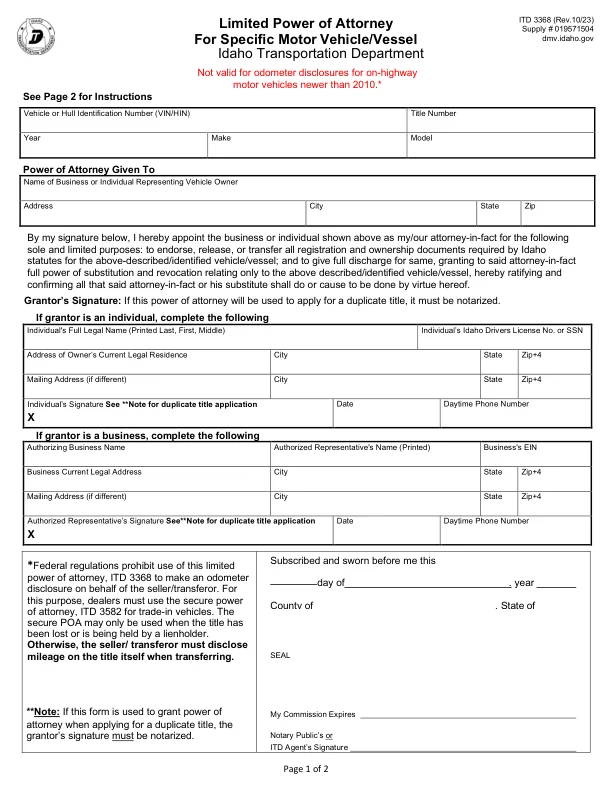
Idaho Form ITD-3368, also known as the power of attorney form, is specifically designed for vehicle transactions in Idaho.[1] It is the PDF this page hands out: the Idaho Transportation Department’s Limited Power of Attorney For Specific Motor Vehicle/Vessel, ITD 3368 (Rev.10/23). Page 1 is the form and page 2 holds the instructions for using it. This document requires detailed information about:
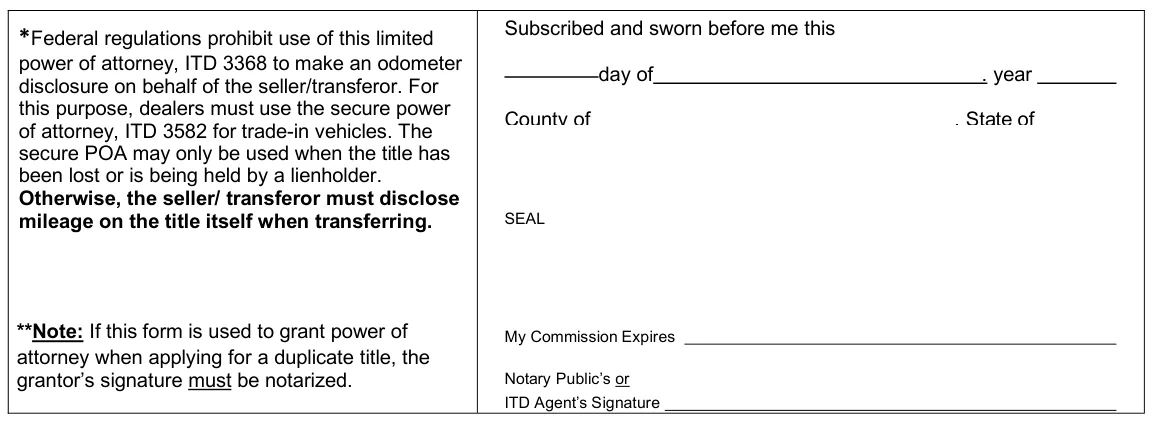
If the mailing address differs from the legal residence, provide this alternate address in the designated section, including city, state, and ZIP+4.[1] The bottom of page 1 has a block for a notary public or ITD agent. The form says the grantor’s signature must be notarized if the form is used to grant power of attorney when applying for a duplicate title.[1]
The FormsPal template behind Create My Document is a different document. It includes an acknowledgment for a notary public or other officer.
| Document Name | Idaho Motor Vehicle Power of Attorney Form |
| State Form Name | Idaho Form ITD-3368, Limited Power of Attorney For Specific Motor Vehicle/Vessel (Rev.10/23) |
| Relevant Link | Idaho Transportation Department |
| Avg. Time to Fill Out | 15 minutes |
| # of Fillable Fields | 35 |
| Available Formats | Adobe PDF |
These steps follow the Idaho Transportation Department’s Limited Power of Attorney For Specific Motor Vehicle/Vessel, ITD 3368 (Rev.10/23), the official form this page hands out. Fill in page 1 from top to bottom, in the order of the steps, and read the instructions on page 2 before you use the form. Use the same spelling that appears on your ID and on the vehicle’s title or registration papers.
The screenshots under each step show the Idaho ITD 3368 Limited Power of Attorney, the official Idaho form, filled with sample entries in blue, so you can see where each answer goes. The names, addresses, dates and vehicle details are examples only.
Vehicle or Hull Identification Number (VIN/HIN), Title Number, Year, Make and Model
Enter the VIN of a vehicle or the HIN (hull identification number) of a vessel, then the title number, the year, the make and the model. Copy them from your title. The form covers this one vehicle or vessel only.

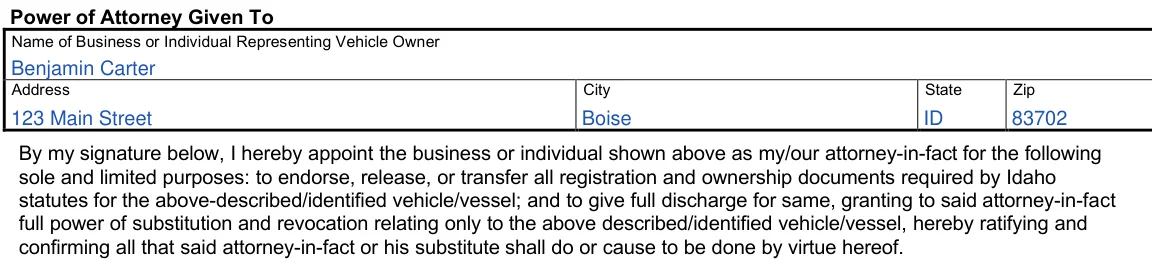
Power of Attorney Given To
Enter the name of the business or individual who will represent you, then the address, city, state and ZIP code of that business or individual.[1] The paragraph under this block is printed on the form. It appoints the business or individual you name as your attorney-in-fact for sole and limited purposes, such as endorsing, releasing or transferring the registration and ownership documents for this vehicle or vessel, so there is nothing to enter there.
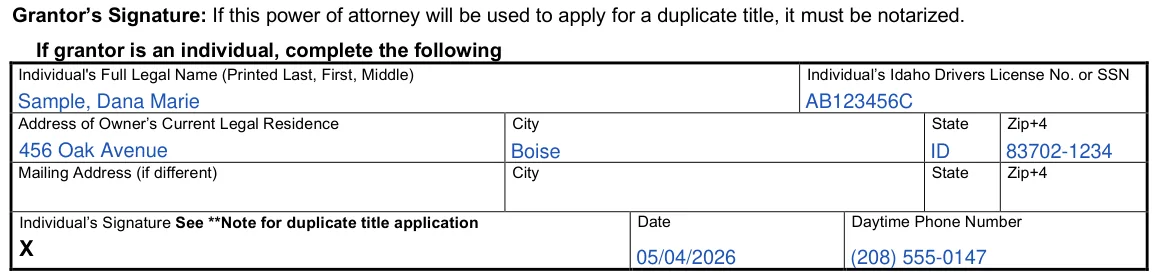
If grantor is an individual, complete the following
If you own the vehicle or vessel as an individual, fill in this block: your full legal name (last, first, middle), your Idaho driver’s license number or SSN, the address of your current legal residence with city, state and ZIP+4, a mailing address if it is different, the date and your daytime phone number. You sign on the Individual’s Signature line marked X. If you will use the form to apply for a duplicate title, read step 5 before you sign.
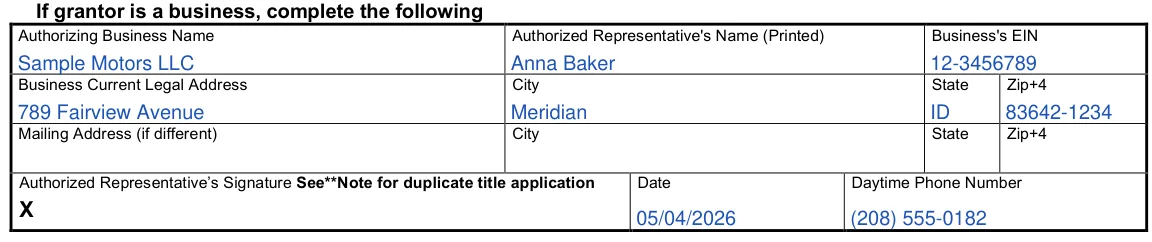
If grantor is a business, complete the following
If a business owns the vehicle or vessel, fill in this block instead: the authorizing business name, the authorized representative’s printed name, the business’s EIN, the business’s current legal address with city, state and ZIP+4, a mailing address if it is different, the date and a daytime phone number. The authorized representative signs on the Authorized Representative’s Signature line marked X.
Subscribed and sworn before me
The block at the bottom right of page 1 is for a notary public or ITD agent, who completes the date, county and state lines, the seal, the commission expiration and the signature line. Leave it blank. The note beside it says that if this form is used to grant power of attorney when applying for a duplicate title, the grantor’s signature must be notarized.[1] The footnote above that note says federal regulations prohibit using ITD 3368 to make an odometer disclosure on behalf of the seller or transferor. For that purpose, dealers must use the secure power of attorney, ITD 3582, for trade-in vehicles, and that secure form may only be used when the title has been lost or is being held by a lienholder. Otherwise, the seller or transferor must disclose the mileage on the title itself.[1]
Page 2 explains how your representative uses the form. Only the person or firm named as representative on the form may use it. To sign a title or registration document for you, the representative writes the owner’s name followed by the representative’s own signature, as in the form’s example “Sharon Smith by Jane Doe, POA”. If the named representative is a company, an authorized individual of that company signs. The power of attorney must be used on the title or document for which the authority was granted.[1]
Tip: Check that every name on the form matches your ID and the vehicle paperwork. Read the whole form once more before you print it.
When the form is filled in, print it and work through these steps in order. What signing takes depends on the document you use: the ITD 3368 form this page hands out, or the FormsPal template you get from Create My Document.
The POA must bear the principal’s signature.[2] This signature must be made by the principal or by another individual on behalf of the principal in their conscious presence and as per their direct instruction.[2] If given for a duplicate title application, the ITD 3368 form must be notarized.[1]
The Idaho power of attorney granted by Form ITD-3368 can be revoked at any time by the principal, provided the revocation is in writing and communicated to any relevant parties, including the agent and the Idaho Transportation Department.
A vehicle power of attorney raises the same few questions for most people, from who the agent is to what to have on hand. The answers below are short and practical.
The principal is the vehicle owner who names a helper. The agent, also called the attorney-in-fact, is the helper who acts for the principal. On the ITD 3368 form, the agent’s name and address go in the Power of Attorney Given To block near the top, and the principal, called the grantor, fills in the individual or business block below it and signs.
Have these details ready:
Yes. Download the PDF, then fill in, edit and sign it with the FormsPal PDF editor, or print it and write in the details by hand.
Not on the ITD 3368 form, which has no successor line. The FormsPal template from Create My Document has a successor attorney-in-fact block at the top of its page 2, with the name and address of a backup agent.
General information, not legal or tax advice.
