
Behavior Incident Report Form

Updated:

Get Form Now
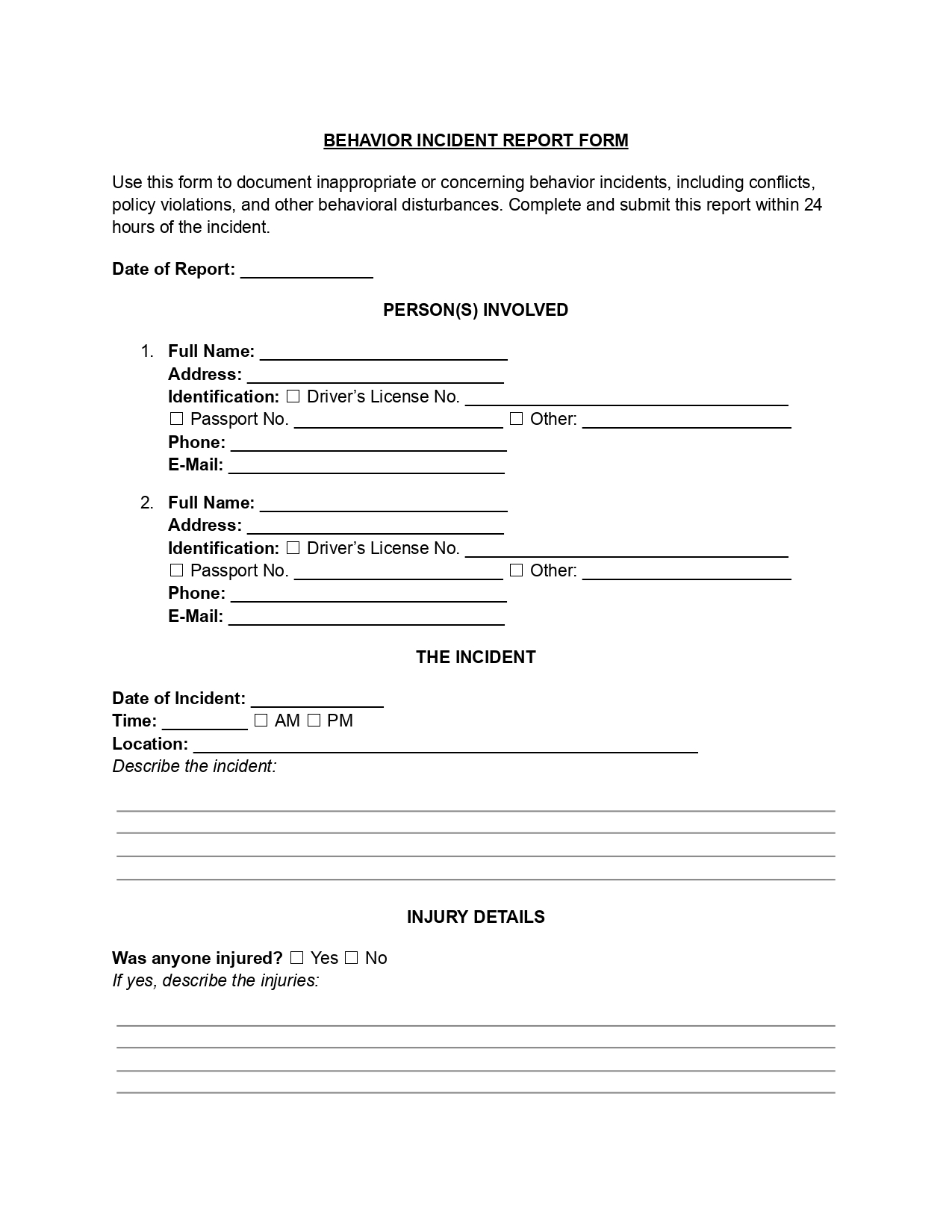
Behavior incident report form preview
Get Form Now
Edit
Fill out
Sign
Export or Print
Download your fillable Behavior Incident Report Form in PDF

A behavior incident report form is a written account of one behavior event. The form records who was involved, what happened, where and when, any injuries, and who saw it. Teachers, supervisors, and caregivers use it, especially after aggression, threats, or property damage.

This guide covers when to use the report, what each section asks for, a filled-in example, and how to keep the account factual.

Key facts

  • The report is a factual record of one event, written so a reader who was not there can follow it.
  • The person who saw or first handled the incident usually fills it out.
  • The form covers people, time and place, behavior, injuries, witnesses, and the response.
  • The most common mistake is an opinion in place of an observed action, such as “was angry” for “pushed a chair.”
  • The report is easiest to write right after the situation is safe, while the details are fresh.

When to Use a Behavior Incident Report

A behavior incident report template fits any event where a person’s behavior breaks the expected standards of a school, college, workplace, program, or care facility. The report gives staff one account to review for trends, to support an investigation, or to consult during disciplinary or legal actions.

In schools and colleges, a student behavior incident report often follows events such as:

  • Physical altercations between students or between students and staff.
  • Verbal conflicts that escalate beyond simple disagreements, including threats.
  • Property damage, whether intentional or due to reckless behavior.
  • Bullying and harassment, including cyberbullying.
  • Substance abuse incidents within school or college premises.

A student who shouts slurs in class, pushes a classmate, or damages a school computer is a typical case. The same layout works on a sports field, in a youth program, at a job site, or in a residential care home.

Major and Minor Behavior Incidents

Many schools sort behavior into major and minor incidents, and the report notes which level applies. A minor incident is low level and handled on the spot, such as talking out of turn or a brief refusal to follow a direction. A major incident involves harm, a safety risk, or repeated behavior, such as fighting, threats, or vandalism.

The school or employer sets the line between the two levels in its own behavior policy. A report that names the level helps the office decide who follows up and how fast.

What to Include in a Behavior Incident Report

A complete behavior report includes the people, the time and place, the behavior, the result, and the response, each in its own part of the form. The list below shows the parts in the order most forms use.

  • The date of the report and the name of the person writing it.
  • Each person involved, with contact details and an ID type and number.
  • The date, time, and place of the incident.
  • A factual description of the behavior, in the order it happened.
  • Any injuries and the care given.
  • Witness names and contact details.
  • Whether police or medical staff responded.
  • The writer’s signature, and an office section for follow-up.

Antecedent, Behavior, and Consequence

The description of an incident reads best in three parts: antecedent, behavior, and consequence, often called ABC data. The antecedent is what happened just before, such as a task demand, a transition, or a conflict with a peer. The behavior is what the person did, in observable terms. The consequence is what followed, including how staff responded and how the person reacted.

ABC notes across several reports show patterns, such as one class period or one trigger, that a single report does not show. Teams that write a behavior intervention plan (BIP) often start from these notes.

De-escalation and Staff Response

The staff response section records each step adults took to calm the situation, such as giving space, offering a break, or moving other students away. Listing what was tried, and what worked, helps the next adult who supports the same person.

How to Fill Out a Behavior Incident Report Form

The behavior incident report form is filled out section by section, in plain and neutral words, describing what you saw or heard rather than what you think caused it. The eight steps below follow the sections of the form.

Before You Start

Have these details ready before you start:

  • The full names and contact details of everyone involved
  • The ID type and number for each person, such as a driver’s license or passport
  • The date, time, and place of the incident
  • Your notes on what happened and on any injuries
  • The names and contact details of any witnesses

Steps 1 to 4: The People and the Incident

  1. Write the date of the report. This date shows when the account was written, which may differ from the day of the incident.
  2. List each person involved. Give the full name, address, and contact details, select the ID type (Driver’s License, Passport, Other), and enter the number. Check that the spelling matches the ID.
  3. Describe the incident. Enter the date and time, mark AM or PM, and name the place. Write the antecedent, the behavior, and the consequence in the order they happened, such as “raised voice and pushed a chair,” not “was angry.”
  4. Answer the injury question. Check “Yes” or “No.” If someone was hurt, name the part of the body, for example “scraped left elbow,” and the first aid given.

Steps 5 to 8: Response, Signature, and Office Use

  1. Note the witnesses. Check “Yes” or “No,” then add each witness’s name with a phone number or email address.
  2. Mark the police and medical response. Show whether the police were notified and whether a formal report was filed, then whether medical treatment was given and where (On-site, Hospital, Other).
  3. Sign the report. Read the whole report once more, then sign, print your name, and add the date at the bottom.
  4. Leave the internal use section to the office. The staff member who receives the report enters who received it, the report number, the date received, and any follow-up actions.

Behavior Incident Report Example

A good behavior incident report example describes actions a reader can picture, in time order, with no guesses about motive. The sample below is invented to show the format.

Sample description (invented): On Tuesday at 10:15 AM in Room 204, during the shift from reading to math, the teacher asked the class to put books away. Student A said “No, I’m not done,” tore a page from a workbook, and threw the workbook toward the wall. The workbook hit a desk; no one was hurt. The teacher moved the nearby students to the reading corner and offered Student A a break in the hallway. Student A sat in the hallway for five minutes, then returned and started the math task. Witnesses: the classroom aide and one student.

The sample names the antecedent (the switch between subjects), the behavior (the words, the torn page, the throw), and the consequence (the staff response and the outcome). It leaves out labels such as “defiant” or “out of control.”

How to Write a Clear Incident Report

A clear incident report sticks to facts that someone else can check, uses the same names and times throughout, and leaves out guesses. These habits keep the account easy to read later:

  • Write what you saw and heard, not what you think someone felt or meant.
  • Use full names instead of nicknames.
  • Quote short phrases word for word when the exact words matter.
  • Give the time and place, and say whether a time is AM or PM.
  • Describe actions step by step, in the order they happened.
  • Note what the adults present did to calm or support the person involved.
  • Leave out opinions about who was to blame.
  • Keep a signed copy for your own records.
Tip: Check that every name, date, and time matches your class list, schedule, or ID. A second read catches mixed-up digits and misspelled names.

Behavior Reports in Schools, Workplaces, and Care Settings

The behavior report follows the same core sections in every setting, while each setting adds a few details worth noting for the people who read it later.

  • Schools and colleges: Note the class, the room, and the lesson or activity under way. Name the teachers and other adults present.
  • Workplaces: Note the department, the shift, and the task being done. Describe how coworkers reacted, using facts only.
  • Care facilities and ABA programs: Note the time of day, the activity, and the support given to the child or resident. Record any calming steps that were tried.
  • Youth programs and sports: Note the team or group, the coach on duty, and where the event took place.

Violent Incident Logs at California Workplaces

A violent incident log is a separate employer record that California sets out in Cal. Lab. Code § 6401.9 for employers within that law’s scope. Under Cal. Lab. Code § 6401.9, those employers record information about each violent incident in a violent incident log, according to Cal/OSHA’s workplace violence overview. Cal/OSHA states that employers covered by Cal. Lab. Code § 6401.9 keep violent incident logs for at least five years. A behavior incident report can hold the notes an employer later enters in that log; employers in other states follow their own state’s rules, if any.

What to Do After the Report

A finished report goes to the person who receives and files reports at your school or workplace, with a copy kept by the writer. These steps close the loop:

  1. Read the report once more and fix any name, date, or time that does not match.
  2. Sign and date it.
  3. Hand the original to the office, the principal, or the supervisor named in your policy.
  4. Keep a copy for your own records.
  5. Ask a witness who has more to say to write a separate witness incident report.
  6. Follow your school’s or employer’s policy on contacting parents, guardians, or a manager.

Frequently Asked Questions

Who fills out a behavior incident report?

The person who saw the incident or handled it first usually fills it out, such as a teacher, coach, supervisor, behavior technician, or caregiver.

How much detail should I include?

Give enough detail that a reader who was not there can picture what happened. Cover the order of events, the place, and what each person said or did, in neutral words.

How do I keep the report neutral?

Describe actions, not character. Write “threw a book at the wall” instead of “was out of control.” Facts are easier to review than labels.

Is a behavior incident report the same as a police report?

No. The behavior report is an internal record for a school, employer, or program, while a police report is made to law enforcement. The form only notes whether the police were contacted.

What is the difference between a behavior report and a general incident report?

A behavior report centers on what a person did and how staff responded. A general incident report also covers accidents, hazards, and near misses at work, as in a workplace incident report.

Can I use one form for a group of students?

Yes. List each person in the people section, then describe each person’s actions in the description, in time order.

Where can I find other incident report forms?

The incident report forms page lists the other incident report types on FormsPal.

General information, not legal or tax advice.

Jennifer M. Settles
Jennifer M. Settles
Author & Attorney
With over 25 years of experience as a business and transactional attorney, Jennifer has mastered the craft of closing highly successful deals for her clients. Through her wide-ranging expertise in commercial contracts, real estate transactions, M&A and corporate law, Jennifer secures results that are second-to-none.