
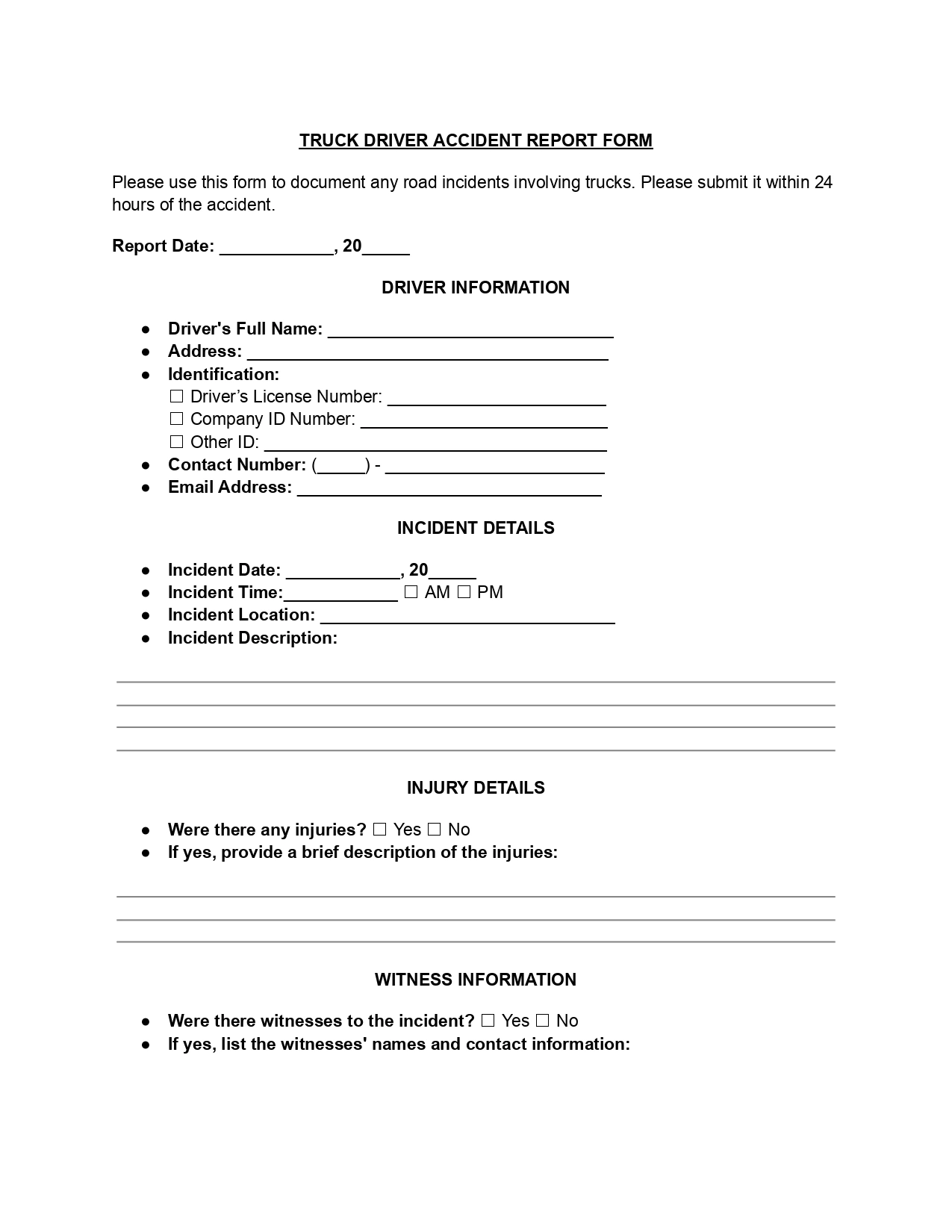
A truck driver accident report is a document truck drivers use to record details about any incidents while operating their vehicle. This is an official record that can be used by the trucking company, insurance firms, and law enforcement to understand the circumstances of the accident. It also helps analyze incident patterns and implement safety measures.
A truck accident report should be used whenever a truck driver is involved in an incident on the road. This form helps record details of significant accidents involving injuries or extensive damage, as well as minor collisions and close calls. Completing this form provides a reliable basis for any necessary actions, such as insurance claims, legal cases, or internal reviews.
The incident does not have to be large. Even if the damage looks minor, writing it down helps a fleet assess whether the truck or its equipment could pose other risks on the road. Typical situations include:
Using this form is critical when legal liability is questioned or when claiming insurance coverage. Accurate and prompt documentation significantly influences the resolution of disputes and the assignment of financial responsibility. Therefore, the accident report form helps protect both the driver’s and the company’s interests while ensuring adherence to road safety regulations.
This form typically includes information on the accident’s date, time, location, the parties involved, witness statements, and a detailed event description. Each part has its own space, so you can collect the facts in order and work through the page from top to bottom without skipping anything that matters later.
The main elements to include in the form template are:
Accurately completing this form is critical to documenting all roadway incidents and providing information for insurance claims, legal issues, and safety analysis. This guide will walk you through each section of our printable truck driver accident report form.
Before you start, have these items at hand:
Start by entering the date you are filling out the form. Ideally, this should be done within 24 hours of the incident.
Fill in the driver’s full name and address in the designated fields. Under “Identification,” check the appropriate box and provide your driver’s license number, company ID number, or any other form of ID you use.
List your contact number and email address. This information is necessary for any follow-up communication regarding the incident.
Record the date and time of the incident, specifying AM or PM. Provide the exact location where the incident occurred. Describe the incident in detail in the space provided, including what happened before, during, and after the incident.
Indicate whether there were any injuries by checking “Yes” or “No.” If there were injuries, describe the nature and extent of the injuries in the space provided.
Check the appropriate box to indicate if there were any witnesses. If there were witnesses, list their names and contact information. This can be crucial for insurance and legal purposes.
Check the appropriate boxes to indicate whether the police were notified and whether a police report was filed. Also, document whether medical attention was required and where it was provided, selecting from on-site, hospital, or other options.
The driver or the person filling out the form should sign and date at the bottom. This verifies the accuracy of the information provided.
This section is for administrative use and should be filled out by the relevant office personnel to note the receipt of the report and any actions taken in response to the incident.
A clear report is easy to follow for someone who was not at the scene, because it lets that reader assess what happened without calling you. Write in plain words, stick to what you saw, and keep the events in the order they happened.
Here is a short sample of how the incident description in step 4 can read when it is written in plain words and in the order things happened. The names and places in this sample are made up.
Sample entry: On March 3 at about 7:15 AM, Anna Baker was driving a box truck north on Route 9 near 123 Main Street when she hit a patch of ice. The truck slid into the guardrail on the right side.
The front bumper and the right headlight are damaged, and the cargo stayed in place. No one was hurt. Tom Reed stopped to help and gave his phone number, and Anna took ten photos before she called her dispatcher.
Once the form is filled in, a few quick steps keep things moving. Read the report once more for mistakes, add your attachments, and hand it to the right person at your company or at your insurer.
Reporting the incident to your own company is the usual route. If the truck belongs to a fleet, your company may also keep a commercial vehicle incident report in its files.
The driver usually fills it out, because the driver knows best what happened on the road. If the driver cannot, a supervisor or another person can write the details down and the driver signs it afterward.
Fill it out as soon as you can after the incident, while the details are fresh. Immediate notes tend to hold clearer times, places, and contact details than a report written days later.
Any event on the road can go in, from a minor scrape or a near miss to a serious crash.
Check “No” in that part of the form and skip the lines that do not apply. The rest of the form still gives a full picture of what happened.
Describe what you saw and leave the cause open. A plain note is better than a guess.
Yes. Download the PDF and fill it in with the PDF editor, or print it and write by hand.
Attach anything that backs up what you wrote:
Keep a copy for yourself and give one to your company. Your insurance contact may ask for one too.
General information, not legal or tax advice.

Last Updated: October 2026. This guide is reviewed and updated regularly to reflect current law. If you notice an error or outdated information, please contact us.