
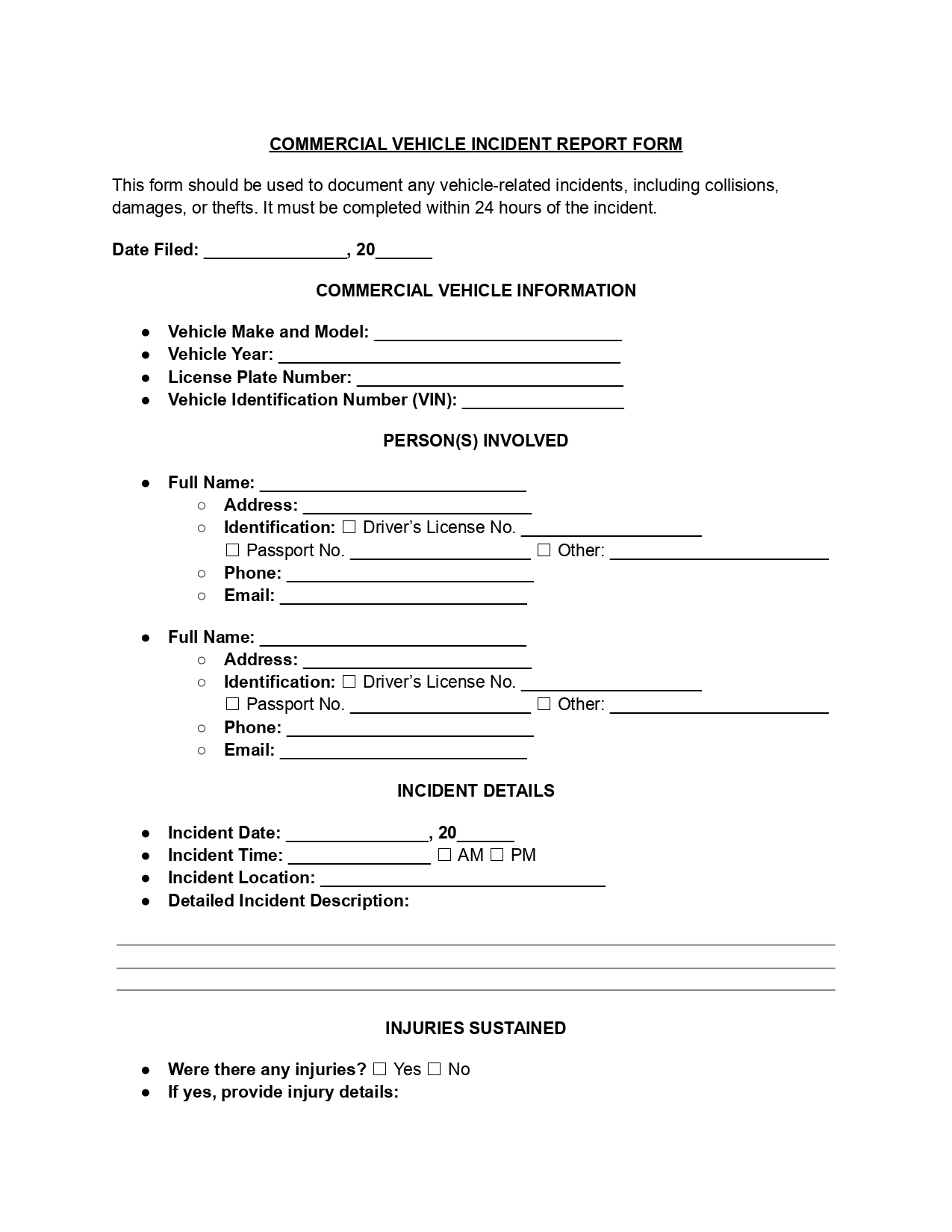
A commercial vehicle incident report is a written record of an accident involving commercial vehicles such as trucks and buses. This form can be used to report the accident to law enforcement or other relevant authorities. It might also be necessary for insurance claims processing and legal considerations. FormsPal’s free template keeps the vehicle, the people, the injuries, and the witnesses in one clear record.
Last Updated: October 2026. This guide is reviewed and updated regularly to reflect current law. If you notice an error or outdated information, please contact us.
The commercial vehicle accident report form should be used immediately after the car incident. This form is crucial for complying with legal and insurance requirements, maintaining internal company records, and implementing future safety measures.
For companies managing fleets of vehicles, such reports help comply with regulatory requirements, conduct internal safety audits, and analyze accidents.
For instance, if a delivery truck is involved in a minor collision with another vehicle while making urban deliveries, it’s important to fill out this template. Even if the damage appears insignificant, the form should document the specifics of the incident, the road condition, weather conditions, and any witness statements. Other scenarios where the commercial vehicle accident report form is necessary include:
Consider a scenario where a commercial bus experiences a brake failure and rear-ends a car at a traffic stop. This form is helpful for insurance claims and legal purposes, and it can also trigger an inspection of other vehicles in the fleet, possibly avoiding more accidents.
This form ensures all relevant details are captured for insurance, legal, and internal record-keeping purposes. Below is a step-by-step guide to completing our commercial vehicle accident report template. Work through the sections in order and use plain, neutral words. Describe what you saw instead of what you think caused it.
Have these details ready before you start:
Write the date the report is being filed. To ensure timely and accurate reporting, this should be done within 24 hours of the incident. Use the month, day, and year so the date is easy to read.
Fill in detailed information about the vehicle involved in the incident, including the make and model, year, license plate number, and Vehicle Identification Number (VIN). Copy the plate number and VIN straight from the vehicle or its registration, and check each character twice.
Record the full names, addresses, identification (such as driver’s license number or passport number), phone numbers, and email addresses of all individuals involved in the incident. Check that each name matches the person’s ID.
Specify the date, time (AM or PM), and incident location. Provide a thorough description of what occurred during the incident. Stick to facts, such as “brake lights came on late,” instead of opinions such as “the driver was careless.”
Indicate whether there were any injuries resulting from the incident. If yes, provide detailed descriptions of the injuries sustained. Name the part of the body, for example “bruised left wrist.”
State whether there were witnesses to the incident. If there were, list their names and contact information for any follow-up or legal processes. Add a phone number or email address for each witness so someone can reach them later. A witness incident report form can hold a longer account from each person.
Document whether the police were notified and if a police report was filed. Also, note whether any medical assistance was provided at the scene or if the involved parties were taken to a medical facility for treatment. Add the report number or the officer’s name if you have it.
The person responsible for filling out the report must sign and date the form. They should also print their name to validate the information provided. Read the whole report once more before you sign.
This section is for internal use by the company. It should be filled out by the staff member who receives the report, noting the date received and any actions taken following the incident.
A clear report is easy to read and easy to check. Drivers, supervisors, and fleet managers do best when they write down the facts soon after the event and leave out guesses. Use the same spelling, dates, and numbers throughout, so the details line up when someone reads the report later.
The same form works for a single driver or a large fleet, but each role has its own details worth noting. These tips help the people who fill out, review, and file the report capture what matters most for whoever reads it later.
Whatever the role, keep the same neutral tone and the same order of events. A report that follows one format each time helps you collect the same details and compare incidents.
People tend to ask the same few questions when they sit down to write a commercial vehicle report, from who fills it out to how much detail to include. These answers cover the most common ones.
It is a written record of an accident or event involving a commercial vehicle, such as a truck, bus, or delivery van. It lists the vehicle, the people involved, what happened, any injuries, and who saw it.
Usually the driver or the person who handled the incident first, such as a supervisor or fleet manager. A second staff member then completes the internal use section.
Trucks, buses, delivery vans, and other vehicles a business uses to carry people or goods. The same layout works for a single van or a large fleet.
Give enough detail that a reader who was not there can picture what happened. Cover the order of events, the place, and what each person said or did, in neutral words.
Gather these before you sit down to write:
Ask the witness to write their own account, then attach it to your report. Keep the witness’s name and phone number with it so someone can follow up.
Read it once more, check that names and numbers match, then sign and date it. Keep a copy for your records and pass the original to the person at your company who files these reports.
Yes. FormsPal also has a free truck driver accident report, a car accident police report, and a workplace incident report template. Browse them all on the incident report forms page.
General information, not legal or tax advice.
