
W-2 vs. W-4 Explained
Written by FormsPal Editorial Team
- Time to read
- 7 min
Tax forms with similar names and numbers can be confusing. For example, forms W-2 and W-4 are often mistaken for each other, although they have different purposes in the workplace and during tax season. One IRS form controls how much federal tax comes out of your paycheck. The other shows what you earned and what you already paid.
Taking a moment to see how these two forms work and when you use them will make tax filing feel much more straightforward.
What Is Form W-4?
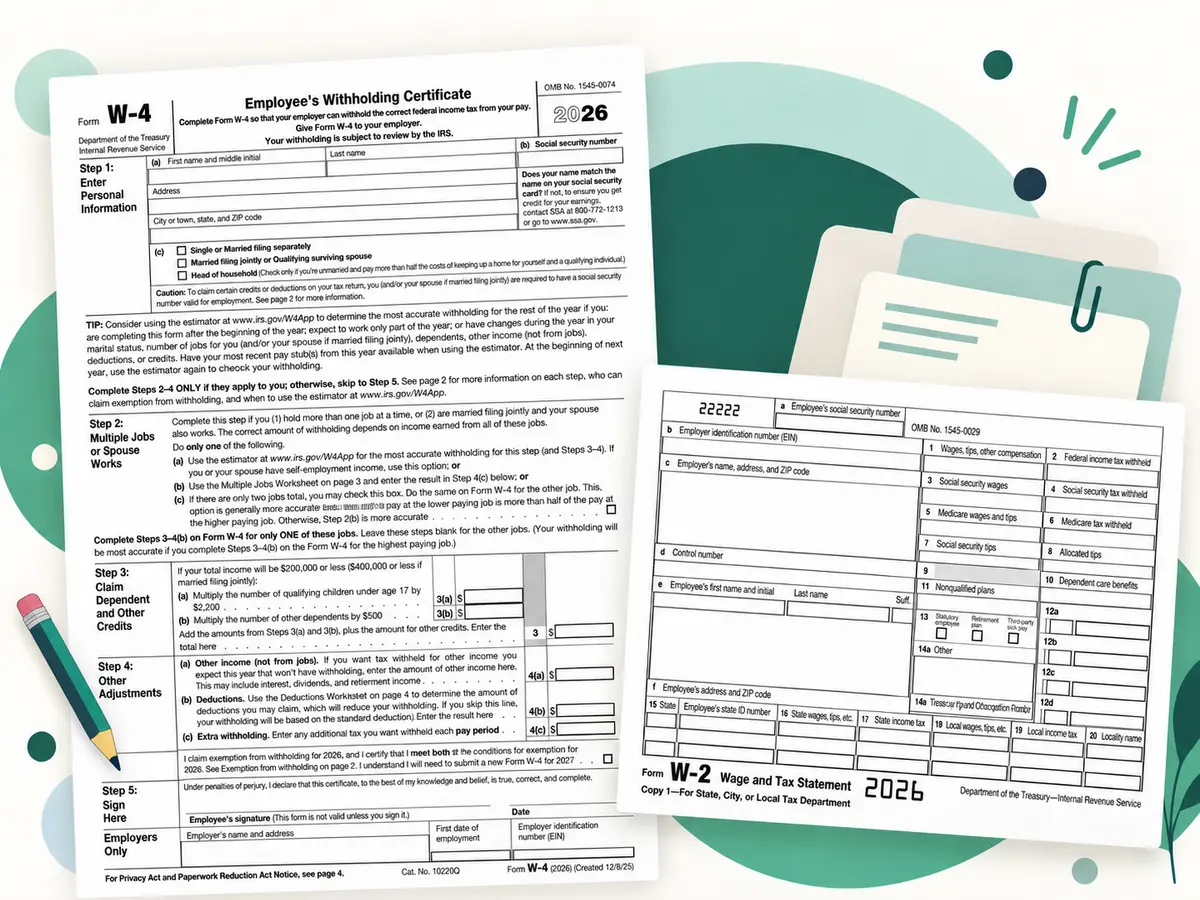
Form W-4, Employee's Withholding Certificate, determines how much federal income tax comes out of each paycheck. Employees complete a W-4 when starting a new job so payroll can calculate withholding based on income, household details, and adjustments the worker decides to include. This form does not report taxes. Instead, it covers what happens before taxes ever reach the IRS, like a set of instructions for each paycheck.
Most taxpayers complete a W-4 on their first day. But updates can also make sense after major life changes or when someone wants to adjust how much tax gets taken out.
Updating a W-4 can make a lot of sense in various situations:
- Starting a whole new job and finding out they were withholding too little (or too much!)
- Getting married or divorced
- Having or adopting a child
- If you're working multiple jobs
- Noticing a large refund or unexpected tax bill
- Simply deciding you want a bit more tax withheld from your paycheck
When filling out the W-4 form, employees enter basic personal information, indicate whether they have multiple jobs, claim qualifying dependents, and optionally request extra withholding. Too little information and too little tax may result in a payment due later in the filing season.
On the flip side, requesting too much withholding means smaller paychecks. Some workers prefer that tradeoff because it can lead to a larger refund, though that also means giving the government an interest-free loan throughout the year.
What Is a W-2 Form?
Form W-2, Wage and Tax Statement, shows an employee's total earnings and the taxes withheld from their paychecks throughout the year. After the year ends, employers send a copy of Form W-2 to each employee and submit the information to the Social Security Administration, which shares it with the IRS.
A W-4 basically determines how much tax is going to come out of your paycheck, but a W-2 gives you the final numbers for the whole year. Basically, like a receipt that closes out your books from the previous year.
A W-2 has some key numbers that employees definitely need to take a close look at:
- Employer identification details
- Total annual wages and compensation
- Federal income tax withheld
- Social Security wages and taxes paid
- Medicare taxes and wages paid
- State and local tax information, when required
By the way, lenders may request this tax form during loan applications. And landlords sometimes ask for it during rental screening, and benefit programs may require it as proof of income.
Employees should check names, Social Security numbers, and wage totals as soon as the form arrives. Fixing mistakes early is much easier than correcting a filed return later. And if something looks wrong, the employee should contact the employer right away. The employer can issue a corrected version called Form W-2c to fix the record.
Form W2 vs. W4: Side-by-Side Comparison
The first form tells your employer how much tax to hold back from your pay, but the second one only shows up after the year ends, with the actual numbers.
| Form W-4 | Form W-2 | |
|---|---|---|
| Purpose | Set withholding taxes | Report wages and taxes |
| Completed by | Employee | Employer |
| Timing | Start of job or updates | End of tax year |
| Main data | Withholding instructions | Compensation paid and taxes |
| Filing role | Helps estimate tax liability | Used to ensure accurate filing |
| Reporting agencies | Internal payroll use | IRS and Social Security Administration |
| Compliance role | Supports correct withholding | Required under tax regulations |
Employees fill out a W-4 as a setup document so payroll knows how much federal tax to deduct based on their situation. That directly affects their tax liability when they file a return.
The W-2, on the other hand, is a report. Employers use it to report wages, show compensation paid, and document taxes already sent to the IRS and the Social Security Administration.
Key Differences Between W-2 and W-4 Forms
W-4 and W-2 forms differ in terms of purpose, timing, and the type of tax information they contain.
1. Purpose and Timing
As mentioned above, Form W-4 is how you tell your employer how much federal income tax to take out of each paycheck. Form W-2 arrives afterward, once the year closes, and spells out what you earned and how much tax was withheld along the way.
You fill out a W-4 when you start a new job, and in most cases you’ll redo it whenever life changes: you get married, pick up a second job, or simply want your withholding to fit your situation a little better.
But the W-2 falls to your employer, who reports after the year ends how much each employee earned and how much came out of their paychecks for federal income tax, Social Security, and Medicare.
2. Who Fills Out These Forms
Employees must complete the W-4 to determine how much tax to withhold based on their household and income situation.
Meanwhile, the W-2 gets filled out by your employer's payroll department. They compile wage totals, calculate total earnings, and report all tax payments connected to each worker. The resulting document becomes a permanent record of your income tied directly to the tax rules your employer has to follow.
3. Information It Includes
A W-4 covers marital status, multiple job adjustments, dependents, and optional extra withholding requests. All that influences how much tax to withhold from future wages.
On the other hand, W-2 focuses on results. This form shows total earnings, federal income tax payments, and Medicare taxes withheld. The W-2 form also includes other deductions that reflect what actually happened during the year rather than what someone expected.
4. Role in Tax Compliance
Both forms are pretty important when it comes to getting your taxes right. If you get the W-4 wrong, you can end up paying too little in taxes and getting hit with fines or a surprise bill when you do your tax return.
Accurate W-2 reporting also matters. Incorrect wage reporting can cause filing delays or IRS notices, something small businesses especially try to avoid because corrections take time and resources.
5. Different Use Cases
Not everyone gets both of these forms. Most regular employees get W-4 and W-2 forms as part of doing their job with payroll. But if you're an independent contractor, you follow a different path, first submitting a W-9, then getting a 1099 to tell you how much cash you got in non-employee income instead of a W-2.
Related Forms:
Common Mistakes to Avoid on W-4 and W-2 Forms
Often, employees and employers alike treat them as routine paperwork and only notice something is wrong later when the numbers don't match.
One of the biggest issues starts with the W-4. A person may pick the wrong filing status, forget to account for additional income, or simply guess how much income tax to withhold. That often leads to too little tax coming out of each paycheck, or too much.
Some of the most common mistakes include:
- Forgetting to update a W-4 after marriage or other life changes.
- Typos in Social Security numbers.
- Old address details that no longer match payroll records.
- Not checking the totals reported for the past year.
- Missing mistakes before the employer sends the W-2.
Too much withholding creates a different problem. It may not seem serious at first. However, it reduces take-home pay throughout the year, which means the employee has less access to more money when they actually need it.
Sometimes taxpayers wait too long to fix things, and instead of updating the form right away, they leave it as is and promise themselves they will deal with it the following year. That usually just drags the same problem forward.