
A New Hampshire last will and testament is an estate planning document that states how a person wants their assets distributed after death and identifies who should carry out those wishes under New Hampshire law. This page covers New Hampshire will requirements for signing and witnessing.
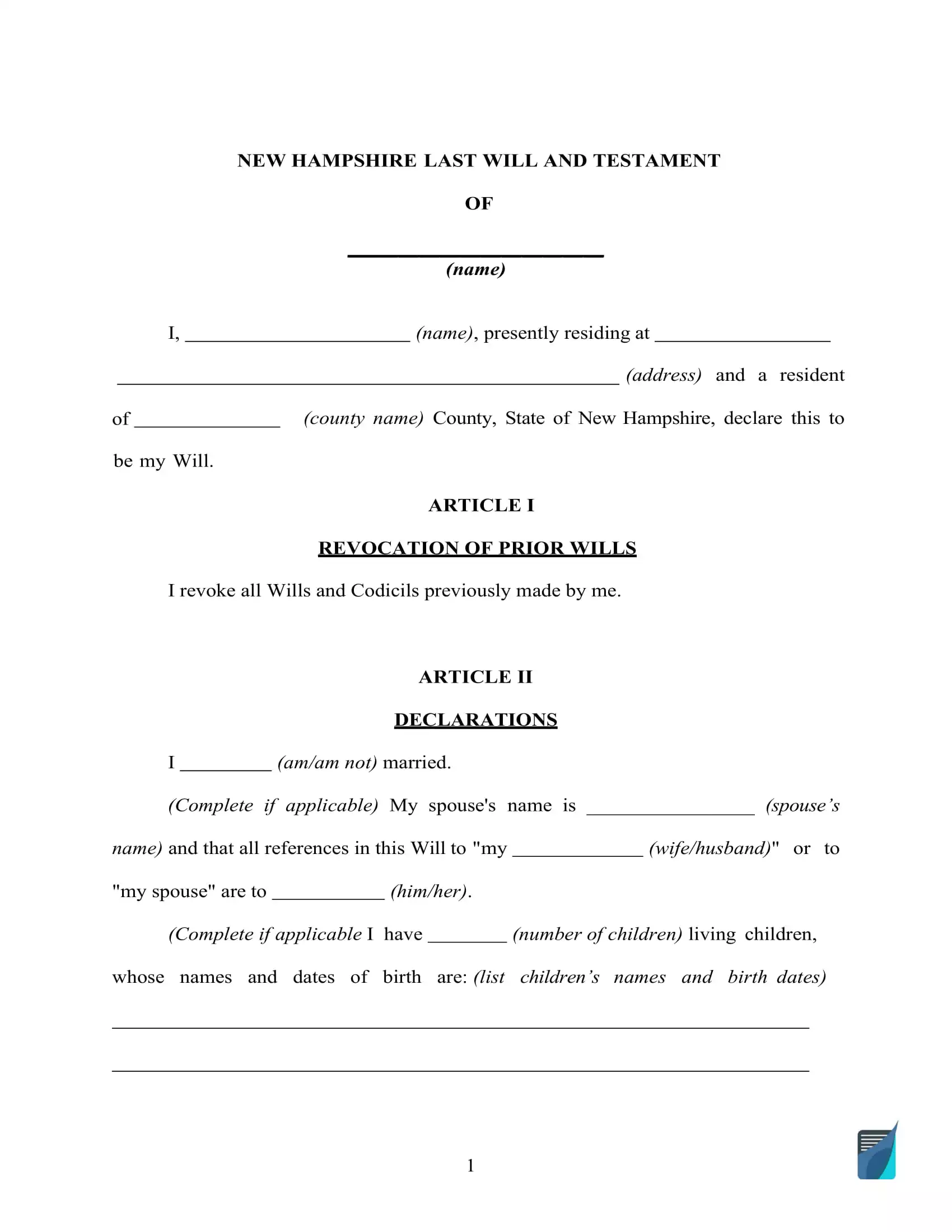
If you are in search of a fillable and printable NH will template, you will find one on this page in PDF and Word format, along with step-by-step instructions and answers to commonly asked questions further below.
Build Your Document
Answer a few simple questions to make your document in minutes
Save and Print
Save progress and finish on any device, download and print anytime
Sign and Use
Your valid, lawyer-approved document is ready
Under New Hampshire law, a valid will must be in writing[1.1] and signed by the testator, or by another person at the testator's express direction and in the testator's presence[1.1]. It also needs two or more credible witnesses who attest to the testator's signature in the testator's presence[1.2]. New Hampshire does not allow an electronic will or codicil[1.1].
Last Updated: September 2026. This guide is reviewed and updated regularly to reflect current New Hampshire law. If you notice an error or outdated information, please contact us.
A last will and testament is not the same as a living will. A last will and testament directs who inherits your property after you die, while a living will (see the related documents table below) states your wishes for medical treatment while you are still alive.
New Hampshire's presence requirement can also be met electronically: witnesses satisfy it if they can communicate with the testator simultaneously by sight and sound through an electronic device at the time of signing[1.1]. A will can also become self-proved by attaching a sworn affidavit, so the witnesses do not need to testify in probate court[2.1].
The affidavit must be sworn before a notary public or another officer authorized to administer oaths, and it must state that this was the testator's free and voluntary act for the purposes expressed in the will[2.1]. New Hampshire law provides a statutory self-proving affidavit form that can be signed at the same time as the will[2.2].
| Requirements | State laws | |
| Statutes | Chapter 551 – Wills | |
| Signing requirement | Two witnesses | 551:2 Requirements |
| Age of testator | 18 or older or married minor | 551:1 Testators |
| Age of witnesses | 18 or older | 551:2 Requirements |
| Self-proving wills | Allowed | 551:2-a Self-Proved Wills |
| Handwritten wills | Recognized if witnessed according to the state law | 551:2 Requirements |
| Oral wills | Recognized if meeting certain conditions | 551:15 Nuncupative Will Validity |
| Holographic wills | Not recognized | 551:2 Requirements |
Making a New Hampshire last will and testament follows seven steps, from deciding whether to write it by hand or use a template to signing in front of two witnesses. The sections below walk through each step, including how to select an executor, choose beneficiaries, and handle situations like an out-of-state executor or a testator who cannot sign in person.
1. Think about your possibilities. One important thing to take into consideration, first of all, is if you want to write the whole document by hand (holographic will) or use a fillable last will and testament form accessible here in two formats. Also, you can try our document wizard for more options and better personalization.
2. Indicate your (if you are the testator) information. Establish the testator and their details: full name and residence (city, county, and state). Reread the remaining portion of the section to check for errors.

3. Indicate the executor. Choose a person to be the executor of your will and specify their full legal name and place of residence, which should preferably be within the same state the testator lives in due to special rules regarding out-of-state executors. In New Hampshire, an out-of-state executor must be first approved by the probate court judge. Then, this executor must appoint a person who resides in the state to serve as a resident representative and deal with paperwork. (553:5, 553.25)
It may happen that the primary representative will not be able to execute your last will. In such a case, the court can designate its own agent to undertake the duties. In order to avoid that, it is possible to choose an alternate executor under this section.

4. Choose the guardian (optional). It’s possible to choose a trusted person as a guardian if you have underage or dependent children that need to be taken care of. In case there are no directions regarding exactly who should take care of your kids, the guardian will be selected by the court.

5. Specify your beneficiaries. At this point, establish people to whom you want to pass down your property, that is, your beneficiaries. Fill in their full names, places of residence, and your relationship to them (e.g., spouse, child, friend).
6. Allocate property. In the event that you have got an asset allocation planned that’s different from even, you’ll be able to explain it in this part. Cash, stocks, real estate, company control, money for unpaid arrears, as well as any tangible items of financial worth in your possession, can be mentioned in your last will. Please notice that there are things that cannot be distributed in your last will and testament, such as joint and living will property and life insurance.

7. Proceed with the witnesses putting their signatures at the end of the document. New Hampshire law requires the will to be signed by two or more credible witnesses who attest to the testator's signature in the testator's presence[1.2]. New Hampshire law does not require witnesses to gain nothing from the will. But using a witness who is also a beneficiary can put that person's own gift at risk, so it is safer to choose witnesses with no stake in your estate.
It can also help to name a witness younger than you, so they are more likely to still be available if your will is ever challenged. After reviewing each paragraph, all signatories, you and the two witnesses, must each print their full name and address and sign the document.


Other New Hampshire Forms
Here are answers to the questions New Hampshire will-makers ask most often: notarization, self-proving affidavits, disinheriting a spouse, altering a will, handling a lost will, and signing when the testator cannot sign in person.
In New Hampshire, there’s no need to notarize your will. However, in case you need to attach a self-proving affidavit to your last will and testament, you’ll need to notarize it before a notary public or another officer authorized to administer oaths[2.1]. In the event that you make your last will self-proving, the court won’t need to make contact with the witnesses to ascertain the legality of the document, which will expedite the probate.
It’s not strictly necessary in New Hampshire[2.1]. But, in case you wish to add a self-proving affidavit, it can be quite advantageous as the document functions as an alternative for in-court testimony of witnesses in the course of probate.
No, in New Hampshire, you cannot disinherit your spouse. They will be able to receive a determined amount of your property (elective share) after signing a special waiver.
Based on New Hampshire law, it is possible to alter or revoke the will if you aren’t obligated by a legal agreement that indicates the opposite. Additionally, it will be a good idea to revise your last will at the time you undergo a significant life event, including:
In line with New Hampshire law, the absence of the will can be regarded as its revocation. That means the trustee should provide proof of the last will’s validity, which in turn may be found to be quite troublesome.
Under New Hampshire law, someone else may sign the will for the testator, as long as it is done at the testator's express direction and in the testator's presence[1.1]. It’s possible to give a particular instruction using some methods. They include verbal communication, a positive answer to a query, or a gesture.
You can get a notary to sign the name of a testator that is physically incapable of doing so if the latter guides the notary with a witness present. It is worth mentioning that these witnesses can’t have an interest (equitable or legal) in any of the assets that are the focus of or impacted by such a document (the last will).
A last will and testament is often just one part of a complete estate plan. New Hampshire wills commonly work alongside the related estate planning documents below, and an estate planning attorney can help you decide which ones fit your situation.
| Related documents | Instances when you may want to have one |
| Codicil | You want to make one or several minor adjustments to your will. |
| Self-proving affidavit | You want to avoid possible difficulties during the probate. |
| Living will | You would like to state your wishes concerning the end-of-life treatment and life-prolonging procedures. |
| Living trust | You need extra protection and confidentiality once the time to distribute your assets comes. |
Every state sets its own rules for who may witness a will, whether notarization is required, and how the document must be signed. FormsPal publishes last will and testament templates for other states as well, each written to match that state's own requirements, so you can find the right form no matter where you live.
This page is general information about New Hampshire last wills, not legal advice. For advice on your situation, talk to a New Hampshire attorney.
Unless noted otherwise, the sources below are from the New Hampshire Revised Statutes Annotated.
