
A Texas last will and testament is a written document. It states how a person's property is divided after death and who will care for any minor children left behind.
Any person of sound mind who is at least 18 years old may create a valid Texas last will once it meets the required witness rules.[2.1]
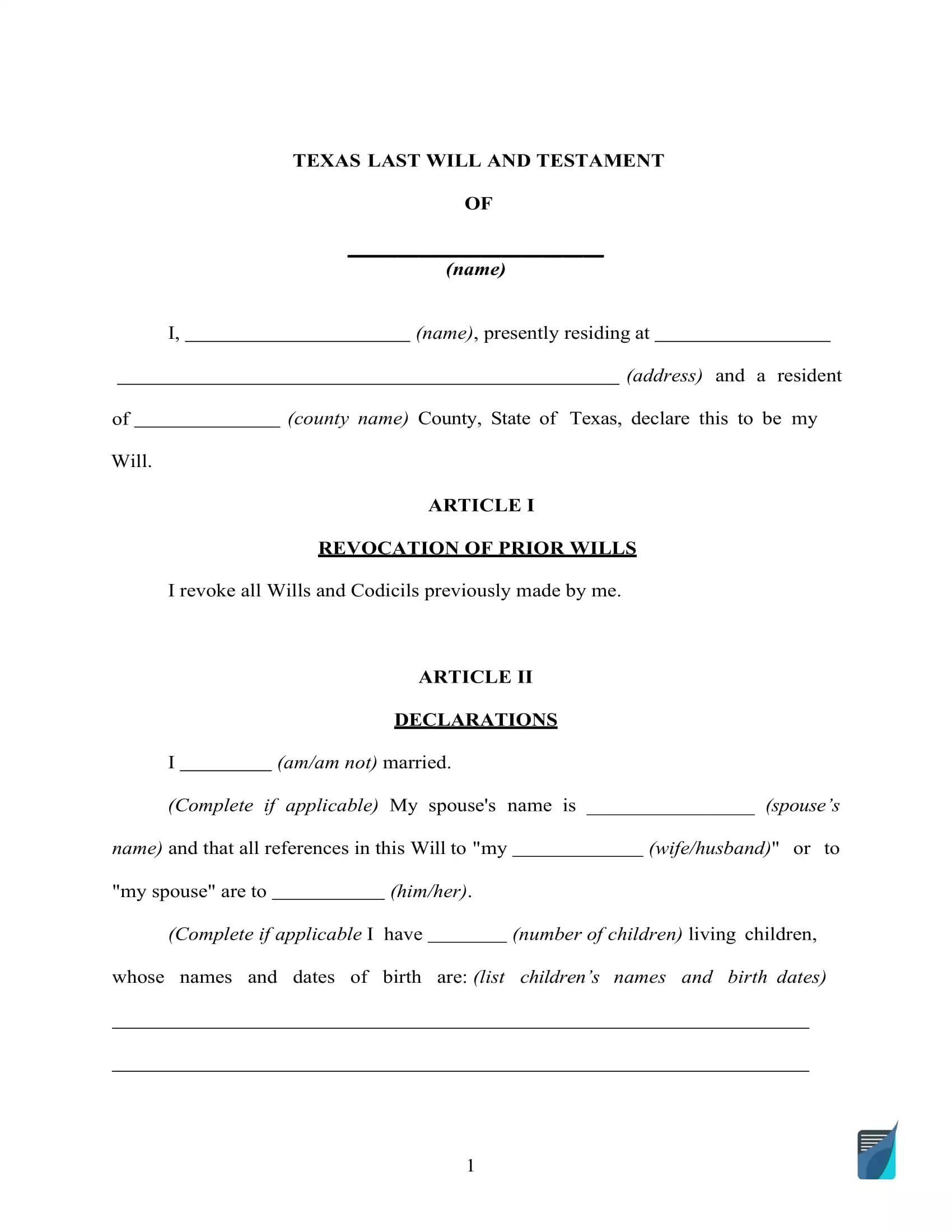
This page includes a free, fillable Texas last will and testament template you can build online, along with a plain language walkthrough of the state's requirements and downloadable PDF and Word copies.
Build Your Document
Answer a few simple questions to make your document in minutes
Save and Print
Save progress and finish on any device, download and print anytime
Sign and Use
Your valid, lawyer-approved document is ready
Without a valid last will, Texas law decides who inherits your property, and the result may not match what you actually want for your estate. A last will lets you name a guardian for any minor children, choose an executor to manage your estate, and say exactly how you want your property distributed among the beneficiaries you choose.
Many families find that a clear last will and testament reduces disputes among heirs after a death. Update your will if you get married, get divorced, have a child, or acquire additional property, so your estate plan stays current and your wishes remain legally known. Keep the signed original in a safe place and tell your executor, or a backup executor, where to find it.
A last will does not cover every kind of property. Review the list below alongside your beneficiary designations so the two do not conflict with each other.
Last will requirements in this state are set out in the Estates Code. A valid document must be in writing, executed by a testator who is of sound mind and at least 18 years old, and witnessed by two people who are at least 14 years old and watch the testator sign. The table and list below summarize the core rules in plain language.[2.2]
Last Updated: September 2026. This guide is reviewed and updated regularly to reflect current Texas law. If you notice an error or outdated information, please contact us.
| Requirements | State laws | |
| Statutes | Estates Code, Chapter 251 - Fundamental Requirements and Provisions Relating to Wills | |
| Definitions | Chapter 22. Definitions | |
| Signing requirement | Two witnesses | Sec. 251.051 Written, Signed, and Attested |
| Age of testator | 18 years of age or older | Sec. 251.001 Who May Execute Will |
| Age of witnesses | 14 or older | Sec. 251.051 Written, Signed, and Attested |
| Self-proving wills | Allowed | Sec. 251.101 Self-proved Will |
| Handwritten (holographic) wills | May be recognized if it meets the state's written, signed and witnessed formalities | Tex. Est. Code Ch. 251 |
| Oral wills | Not recognized | Sec. 251.051 Written, Signed, and Attested |
Texas also recognizes a will that was validly executed under the law of another state or country, based on the law in place at the time and place of signing. This matters if you moved to Texas after making a will elsewhere.[2.3]
State rules also control how a will can be revoked, or canceled.
A written will, or a clause or devise in a written will, may not be revoked, except by a subsequent will, codicil, or declaration in writing that is executed with like formalities, or by the testator destroying or canceling the same, or causing it to be destroyed or canceled in the testator's presence.
Telling someone you want to change your will does not revoke it. Only a later will, codicil, or signed written declaration made with the same formalities, or physically destroying or canceling the original, will revoke it.
A self-proving affidavit is not required, but adding one means your witnesses will not need to testify in court when the will is probated, which can save time for your family and your executor.[2.4]
Writing this document means putting your wishes in writing, executing it yourself or through someone acting on your behalf, and having two qualified witnesses watch you do it. The numbered steps below walk through the process, and the video and template further down give you a starting point.[2.2]
Once your Texas last will and testament template is signed and witnessed, store the original in a fireproof safe, a bank safe deposit box, or with your attorney. Give your executor a copy along with instructions on where to find the original.
Review your will every few years, and sooner if your assets, beneficiaries, or family circumstances change, so your executor can carry out your wishes in the correct order and without confusion. If any individual beneficiary's circumstances change significantly, or you move to another state, update the will to reflect your current wishes.
| Related documents | Times when you might need to make one |
| Codicil | There are a number of slight modifications you wish to make to your last will. |
| Self-proving affidavit | You want the probate to be faster when the time comes. |
| Living will | You would like to express your wishes about the end-of-life medical treatment and life-prolonging measures. |
| Living trust | You would like to take care of your end-of-life affairs without probate. |
| Power of attorney | You want someone to manage your property or finances on your behalf while you are alive. |
This page is general information about Texas last wills, not legal advice. For advice on your situation, talk to a Texas attorney.
Unless noted otherwise, the sources below are from the Texas Family Code, published by the Texas Legislature Online.
