
Connecticut LLC Operating Agreement

A Connecticut LLC operating agreement is an agreement that governs relations among the members of a limited liability company (LLC) and between the members and the company.[1.2] The statute fills in anything the agreement leaves out.[1.3] It also names terms an agreement cannot change.[1.1] You can fill out our free single-member form online or download it as a PDF.

Last Updated: October 2026. This guide is reviewed and updated regularly to reflect current Connecticut law. If you notice an error or outdated information, please contact us.
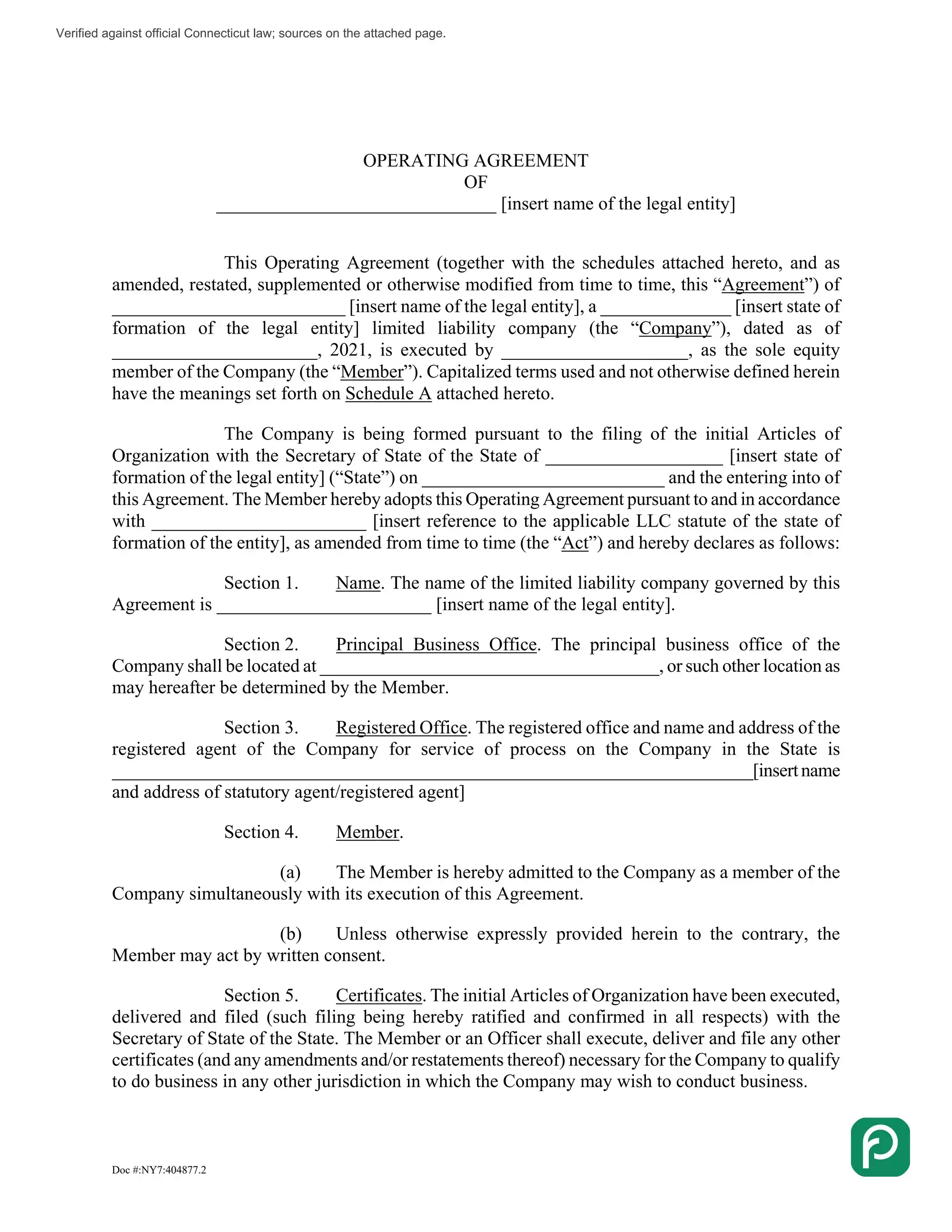
Connecticut LLC operating agreement preview

Create a free high quality Connecticut LLC Operating Agreement online now!

Build Your Document

Answer a few simple questions to make your document in minutes

Save and Print

Save progress and finish on any device, download and print anytime

Sign and Use

Your valid, lawyer-approved document is ready

Download the Connecticut LLC Operating Agreement: PDF or Word (.docx) or OpenDocument (.odt)

Use the builder above to fill in the Connecticut form online. You can also download the PDF, Word, or OpenDocument file, complete it by hand, and sign it.

Connecticut LLC Laws and Definition

Connecticut’s LLC statute provides for an operating agreement to govern a company’s internal affairs. The agreement governs four matters, and the statute fills in whatever the agreement does not cover. Both rules are in Section 34-243d of the Connecticut General Statutes and are explained below.

Under Section 34-243d(a), the operating agreement governs the following.[1.2]

  • Relations among the members as members and between the members and the company.
  • The rights and duties of a person in the capacity of manager under Sections 34-243 to 34-283d.
  • The activities and affairs of the company and the conduct of those activities and affairs.
  • The means and conditions for amending the operating agreement.

Section 34-243d(b) fills the gaps. Its own words are quoted below.

To the extent the operating agreement does not provide for a matter described in subsection (a) of this section, the provisions of sections 34-243 to 34-283d, inclusive, govern the matter.

Conn. Gen. Stat. § 34-243d(b) [1.3]

Our form is a single-member, manager-managed agreement. If your LLC has more than one member, use the multi-member template linked in the next sections.

Connecticut law shields the owners whether or not the company has an operating agreement. Under Section 34-251a(a), a member or manager is not personally liable for a debt, obligation or other liability of the company solely by reason of being or acting as a member or manager.[1.6]

Who Is Bound by a Connecticut Operating Agreement

A person who becomes a member of a Connecticut LLC is deemed to assent to the operating agreement. The company is bound by the agreement too. It may enforce the agreement, whether or not the company has itself manifested assent to it.[1.4]

Read the agreement before you join a company, because joining means the statute treats you as agreeing to its terms.[1.4]

The agreement also reaches people who are no longer full members. The obligations of the company and its members to a person as a transferee, or to a person dissociated as a member, are governed by the operating agreement.[1.5]

One-Member and Multi-Member Agreements in Connecticut

The statute covers both kinds of company. One person intending to become the initial member may assent to terms that become the operating agreement when the company is formed. Two or more persons intending to become the initial members may make an agreement that becomes the operating agreement on formation.[1.4]

Our free form is the one-member type. If your LLC will have two or more members, use our multi-member form instead.

What a Connecticut Operating Agreement Cannot Change

An operating agreement gives the members room to set their own terms, but not unlimited room. Under Section 34-243d, an agreement may not vary the law applicable under Section 34-243c. It also may not vary the company’s capacity to sue and be sued in its own name. The statute names more limits, listed below.[1.1]

  • It may not vary the law applicable under Section 34-243c.
  • It may not vary the company’s capacity under subsection (a) of Section 34-243h to sue and be sued in its own name.
  • It may not vary any requirement, procedure or other provision of Sections 34-243 to 34-283d about registered agents or the Secretary of the State. That includes records delivered to the Secretary of the State for filing.
  • It may not alter or eliminate the duty of loyalty or the duty of care, except as the statute allows.
  • It may not eliminate the implied contractual obligation of good faith and fair dealing. It may prescribe the standards for measuring that obligation, if the standards are not manifestly unreasonable.
  • It may not relieve or exonerate a person from liability for conduct involving bad faith, wilful or intentional misconduct, or knowing violation of law.
  • It may not unreasonably restrict a member’s right to maintain an action under Sections 34-271 to 34-271e.[1.1]

What a Connecticut Operating Agreement May Change

Within those limits, an operating agreement may adjust some duties, as long as the change is not manifestly unreasonable. The statute lets the agreement do the four things below, so long as the result stays within the limits listed above.[1.1]

  • Alter or eliminate the aspects of the duty of loyalty set forth in subsections (b) and (i) of Section 34-255h.
  • Identify specific types or categories of activities that do not violate the duty of loyalty.
  • Alter the duty of care.
  • Alter or eliminate any other fiduciary duty.[1.1]

The agreement may not authorize conduct involving bad faith, wilful or intentional misconduct, or knowing violation of law.[1.1]

The agreement may also specify a method for a specific act or transaction that would otherwise violate the duty of loyalty. One or more disinterested persons may authorize or ratify it after full disclosure of all material facts.[1.1]

A second rule applies to a member-managed LLC. Suppose the agreement expressly relieves a member of a responsibility the member would otherwise have under Sections 34-243 to 34-283d. Suppose it also imposes that responsibility on one or more other members. Then the agreement may also eliminate or limit any fiduciary duty of the relieved member that would have pertained to that responsibility.[1.1]

If a member challenges a term as manifestly unreasonable, the court makes its determination as of the time the term became part of the operating agreement. It considers only circumstances existing at that time.[1.1]

The court may invalidate the term in only one of two situations. Either it is readily apparent that the objective of the term is unreasonable, or the term is an unreasonable means to achieve its objective. The court weighs this in light of the purposes, activities and affairs of the company.[1.1]

Amending a Connecticut Operating Agreement

The operating agreement governs the means and conditions for amending it. Connecticut’s statute adds rules on who must approve an amendment, how an amendment affects a transferee, and what happens when a filed record conflicts with the agreement. Each rule is in Section 34-243f.[1.5]

  • Approval by an outsider. An operating agreement may specify that its amendment requires the approval of a person that is not a party to the agreement, or the satisfaction of a condition. An amendment is ineffective if its adoption does not include the required approval or satisfy the specified condition.
  • Amendments after a transfer. An amendment made after a person becomes a transferee or is dissociated as a member is effective with regard to any debt, obligation or other liability of the company or its members to that person in that capacity. It is not effective to the extent it imposes a new debt, obligation or other liability on the transferee or dissociated person. A court order issued to effectuate a charging order is the one exception.
  • Filed records. Suppose a record the company delivers to the Secretary of the State for filing becomes effective and conflicts with a provision of the operating agreement. The agreement prevails as to members, persons dissociated as members, transferees and managers. The record prevails as to other persons to the extent they reasonably rely on the record.[1.5]

What Our Connecticut Form Covers

Our free Connecticut form has 15 pages and is made for an LLC with one member and one or more managers. It has 31 numbered sections and three schedules. The list below shows what the main sections cover, so you can see what the document does before you fill it in.

  • Company details: the name, the principal business office, and the registered agent (Sections 1 to 3).
  • The Member and the purpose of the company (Sections 4 and 6).
  • Management structure: a Board of one or more Managers, plus optional Officers (Sections 8 and 9).
  • Money: capital contributions, profits and losses allocated to the Member, and distributions (Sections 11 to 14).
  • Fiscal year, books, and records (Section 15).
  • Limited liability, exculpation, and indemnification (Sections 10 and 17).
  • Resignation, admission of additional members, and dissolution (Sections 19 to 21).
  • Amendments, effectiveness, and disregarded entity status for federal tax (Sections 27, 30, and 31).

What to Gather for the Connecticut Form

Our single-member Connecticut form asks for a small set of details. Collect them first, so you can fill in the blanks in one sitting and sign only when the form is complete.

  • The company name, as it appears in the Articles of Organization, and the date those articles were filed.
  • The name and address of the Member, who is the single owner of the company.
  • The principal business office address and the name and address of the registered agent.
  • The number of Managers and the names of the initial Managers, and the Officers if the company has any.
  • The start and end dates of the fiscal year.
  • A short description of what the Member contributed to the company as the initial capital contribution.

The form is a single-member agreement, so it names one Member and the company they own. A company with several owners needs the multi-member form instead.

How to Fill Out Our Connecticut Operating Agreement Form

Our Connecticut form is the single-member type of operating agreement for a manager-managed LLC. Fill it in with the builder above, or download the PDF and complete it with the PDF editor or by hand. Work through the parts below in the order they appear on the form. Each step names the part of the form and says what goes in it.

  1. Opening paragraphs. Enter the company name, the state, and the date. Then add the Member’s name, the date the Articles of Organization were filed, and the LLC statute reference where each bracketed prompt asks. The form prints the year 2021 in the date line, so check it.
  2. Sections 1 to 3. Repeat the company name in Section 1. Write the principal business office address in Section 2. Enter the registered agent’s name and address in Section 3.
  3. Section 6, Purposes. Select one box. Either describe the company’s business in the blank or select All matters permitted by applicable law.
  4. Section 8, Managers. Enter the initial number of Managers in Section 8(a). The Managers’ names go on Schedule B.
  5. Section 8(g), Compensation of Managers. Select one box. Managers may be paid expenses for attending meetings, or there is no compensation or expense reimbursement.
  6. Section 9, Officers. Select whether the Company has no Officers or has Officers. If you choose Officers, write each Officer’s role where the form asks.
  7. Section 15, Fiscal Year. Enter the date the fiscal year starts and the date it ends.
  8. Section 30, Effectiveness. Enter the day the entity was formed, which is when the Articles of Organization were filed.
  9. Signature block. Sign on the By line as the Member, then print the name and title below it. Sign only after every blank above is filled in. The form has no notary or witness lines.
  10. Schedule A, Definitions. Enter the date the entity was formed in the Articles of Organization definition. Leave the other definitions as printed.
  11. Schedule B, Member, Managers and Officers. Enter the Member’s name and address, for example Anna Baker, 123 Main Street, Austin TX 78701. Then list the initial Managers and, if Section 9 has Officers, the initial Officers.
  12. Schedule C, Initial capital contribution. Describe what the Member contributed to the company on the Insert Description line.

The LLC operating agreement template page lists forms for other states.

Under Section 34-243k(b), the company name must be distinguishable on the records of the Secretary of the State from existing, registered and reserved names.[1.7]

Frequently Asked Questions

These answers come from Connecticut’s LLC statute and cite the section behind each rule. They describe only what the statute provides, not what your own company must do in each case.

Can I write my own operating agreement for my LLC?

Connecticut’s LLC statute provides for an operating agreement that governs the members’ relations, the company’s activities and affairs, and the means and conditions for amending the agreement.[1.2] The statute also limits what an agreement can change, so check that your terms stay inside those limits.[1.1]

Can an LLC operate without an operating agreement?

Connecticut’s statute has default rules for the matters an operating agreement covers. To the extent the agreement does not provide for a matter, Sections 34-243 to 34-283d govern the matter.[1.3]

Does Connecticut recognize a single-member operating agreement as valid and enforceable?

Connecticut’s statute covers the single-member case. One person intending to become the initial member may assent to terms that become the operating agreement when the company is formed. The company is bound by the agreement and may enforce it.[1.4]

seal of connecticut state
Other Connecticut Forms
Interested in some other Connecticut templates? We provide free templates and straightforward customization experience to anyone who would love less hassle when handling forms.

General information, not legal or tax advice.

Sources

  1. Conn. Gen. Stat. §§ 34-243d to 34-243f.
    • 1.1 Conn. Gen. Stat. § 34-243d
    • 1.2 Conn. Gen. Stat. § 34-243d(a)
    • 1.3 Conn. Gen. Stat. § 34-243d(b)
    • 1.4 Conn. Gen. Stat. § 34-243e
    • 1.5 Conn. Gen. Stat. § 34-243f
    • 1.6 Conn. Gen. Stat. § 34-251a(a)
    • 1.7 Conn. Gen. Stat. § 34-243k(b)
Published: Jul 25, 2022
Jennifer M. Settles
Jennifer M. Settles
Author & Attorney
With over 25 years of experience as a business and transactional attorney, Jennifer has mastered the craft of closing highly successful deals for her clients. Through her wide-ranging expertise in commercial contracts, real estate transactions, M&A and corporate law, Jennifer secures results that are second-to-none.