
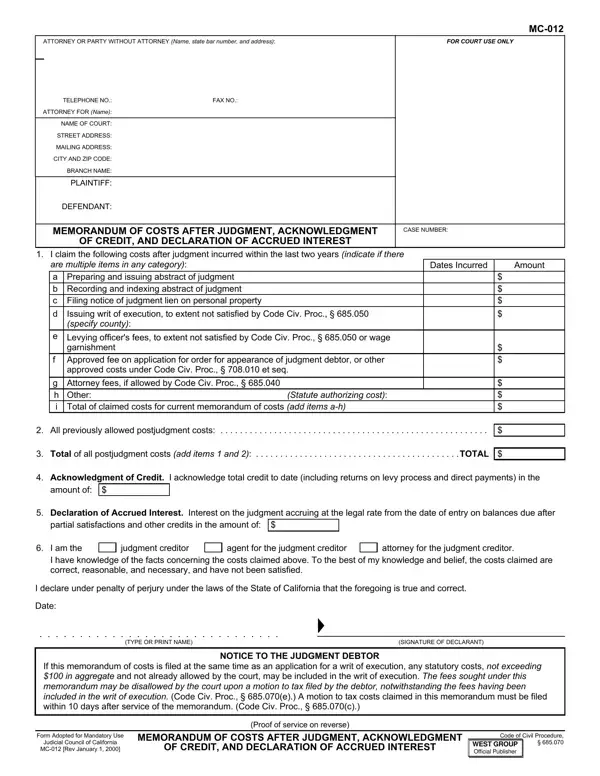
The California MC 012 form has three main sections. Each section collects different information about your post-judgment costs, credits, and interest. The guide below walks through each section and explains what to enter.
Who Should File the MC 012?
The judgment creditor or their authorized attorney files this form. You file it when you have incurred costs after a California civil court judgment was entered in your favor. Common reasons to file include recovering writ of execution fees, levy charges, or judgment lien recording fees.
The form is filed in the same court that entered the original judgment. A filed copy must be served on the judgment debtor as well.
How to Complete Section 1: Costs After Judgment
Section 1 is for costs you paid while enforcing the judgment. List each cost on its own line. Include the date the cost was incurred and the amount paid.
Allowable costs under California Code of Civil Procedure section 685.040 include:
- Fee for issuance of a writ of execution or possession
- Levying officer's fee
- Fee for recording an Abstract of Judgment with the county recorder
- Fee for filing a notice of judgment lien on personal property
- Other post-judgment enforcement costs allowed by statute
Do not include costs that were already listed in the original judgment. Only list costs incurred after the judgment date.
How to Complete Section 2: Credits Against Judgment
Section 2 is for any payments you received from the judgment debtor after the judgment was entered. List each payment separately, including the date and the amount.
Reporting credits keeps the court record accurate. It prevents the debtor from being charged for amounts already paid. It also reduces the outstanding balance used to calculate accrued interest.
How to Complete Section 3: Declaration of Accrued Interest
Section 3 requires you to calculate the interest that has accrued on the unpaid judgment balance. In California, post-judgment interest accrues at 10 percent per year on civil money judgments under California Code of Civil Procedure section 685.010.
To calculate interest, multiply the unpaid principal balance by 10 percent. Then divide by 365 to get the daily interest rate. Multiply the daily rate by the number of days since the judgment was entered (or since the last payment was received).
Enter the total accrued interest amount on the line provided. Round to the nearest cent.
Signing the MC 012
The bottom of the form requires a signature under penalty of perjury. The person signing confirms that the information on the form is true and correct. The judgment creditor or their authorized attorney of record signs here.
Review all entries carefully before signing. Errors can delay filing or result in a court rejection of the form.
Where to File and How to Serve
File the completed MC 012 with the clerk of the Superior Court that entered your judgment. You can file in person at the courthouse or by mail, depending on local court rules. Check with your local court for the current filing fee.
After filing, serve a copy on the judgment debtor. Use a method of service allowed under California law, such as first-class mail or personal service. Keep a proof of service for your records.
Common Mistakes to Avoid When Filing the MC 012
Avoid these errors when completing and filing the form:
- Including costs that were already awarded in the original judgment
- Failing to serve a copy on the judgment debtor before or at the time of filing
- Using an outdated version of the form (always use the current version from the California courts website)
- Incorrectly calculating accrued interest by using the wrong start date or interest rate
- Omitting payments received from the debtor in Section 2, which overstates the balance owed
Frequently Asked Questions About Form MC 012
What costs can I claim on the MC 012?
You can claim any costs allowable under California Code of Civil Procedure section 685.040. These include fees for issuing writs of execution, levying officer fees, and fees for recording a judgment lien. You cannot claim costs already included in the original judgment.
Can I file the MC 012 without an attorney?
Yes. Judgment creditors may file the MC 012 without an attorney. The form is designed to be completed by self-represented parties. The California courts self-help center can provide guidance on proper filing procedures.
How long do I have to file the MC 012?
There is no fixed filing deadline, but costs should be claimed promptly. Some enforcement rights may be time-limited under California law. Consult an attorney if you are unsure about timing requirements for your specific judgment.
Related California Court Forms
Other forms often used alongside the MC 012 include:
- California Form MC-011 (Abstract of Judgment, used to create a lien on real property)
- California Form MC-194 (related California court form)
- Docketing Judgments Form (for recording a judgment in another county or state)
- California Form MC-358 (related California court form)
