
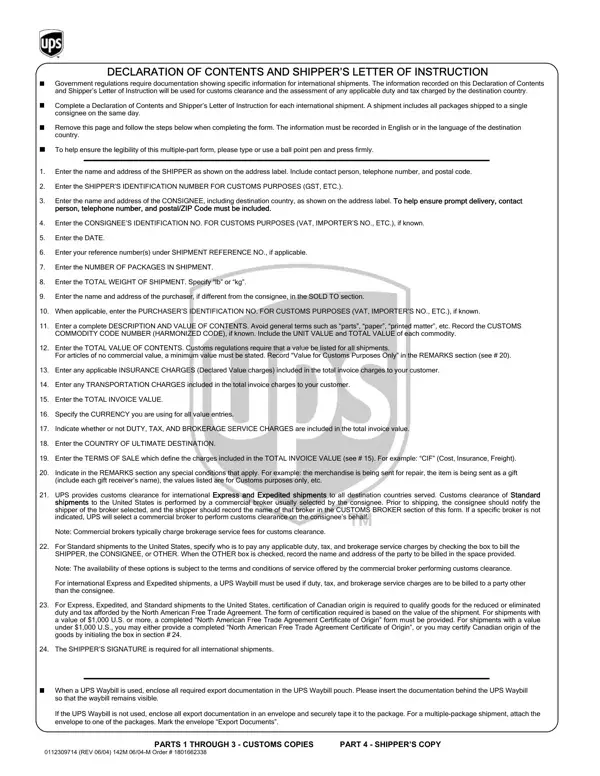

Declaration of Contents and Shipper's Letter of Instruction at a glance
What it is: The information recorded on the Declaration of Contents and Shipper's Letter of Instruction is used for customs clearance of international shipments.
Who signs: The SHIPPER'S SIGNATURE is required for all international shipments.
Complete a Declaration of Contents and Shipper's Letter of Instruction for each international shipment. A shipment includes all packages shipped to a single consignee on the same day.
Government regulations require documentation showing specific information for international shipments. The information recorded on the form will be used for customs clearance and the assessment of any applicable duty and tax charged by the destination country.
What to bring and attach to Declaration of Contents and Shipper's Letter of Instruction
When a UPS Waybill is used, enclose all required export documentation in the UPS Waybill pouch. If the UPS Waybill is not used, enclose all export documentation in an envelope and securely tape it to the package. For a multiple-package shipment, attach the envelope to one of the packages. Mark the envelope “Export Documents”.
A filled-in Declaration of Contents and Shipper's Letter of Instruction example: a gift shipped to Australia
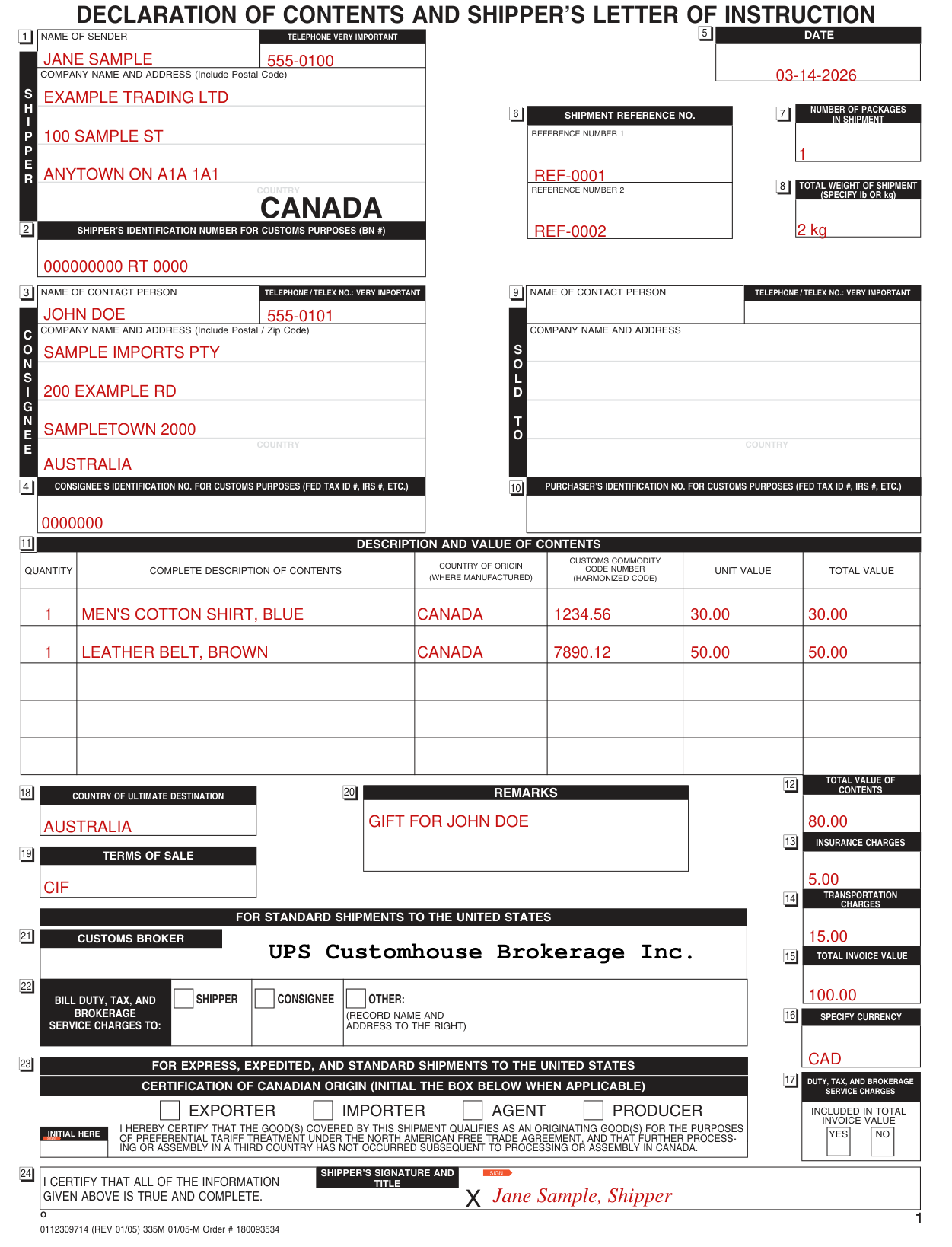
How to fill out Declaration of Contents and Shipper's Letter of Instruction, box by box
SHIPPER and its identification number
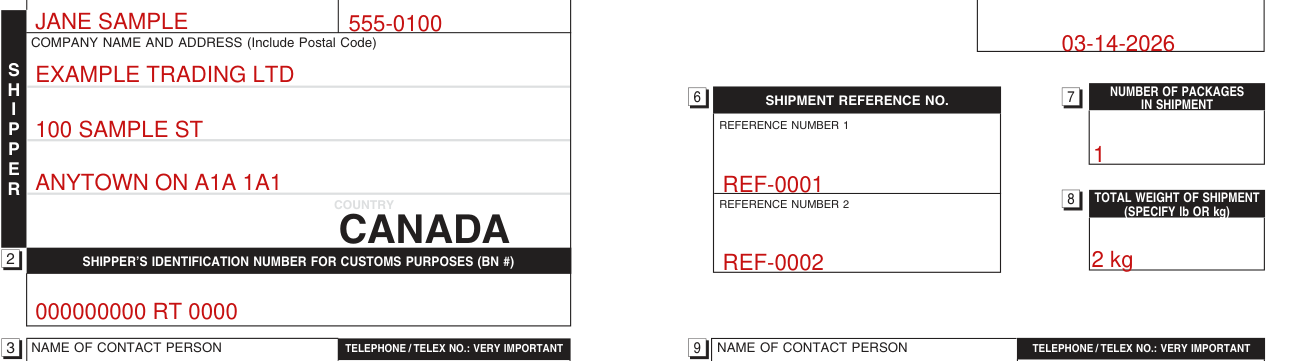
Enter the name and address of the SHIPPER as shown on the address label. Include contact person, telephone number, and postal code.
Enter the shipper's identification number for customs purposes (GST, etc.).
CONSIGNEE and its identification number
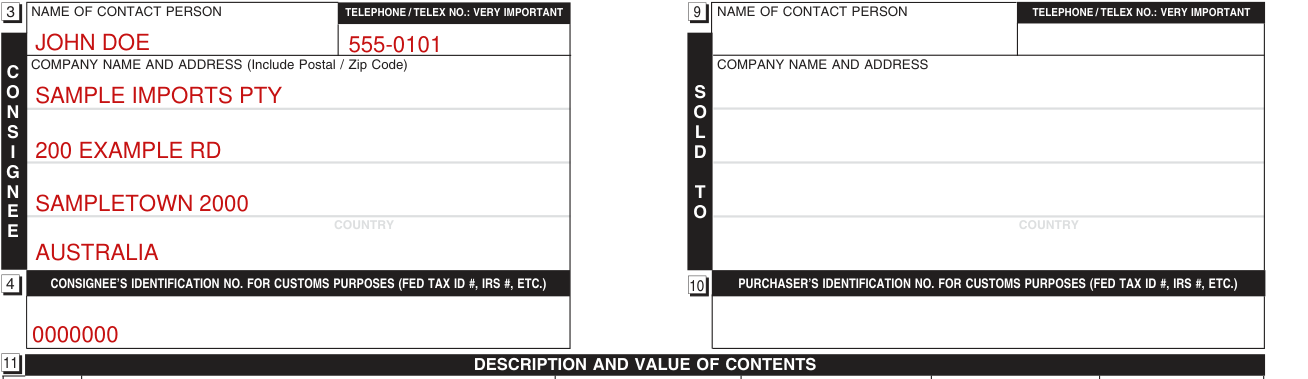
Enter the name and address of the CONSIGNEE, including destination country, as shown on the address label. To help ensure prompt delivery, contact person, telephone number, and postal/ZIP Code must be included.
Enter the CONSIGNEE'S IDENTIFICATION NO. FOR CUSTOMS PURPOSES (VAT, IMPORTER'S NO., ETC.), if known.
DATE, SHIPMENT REFERENCE NO., packages and weight
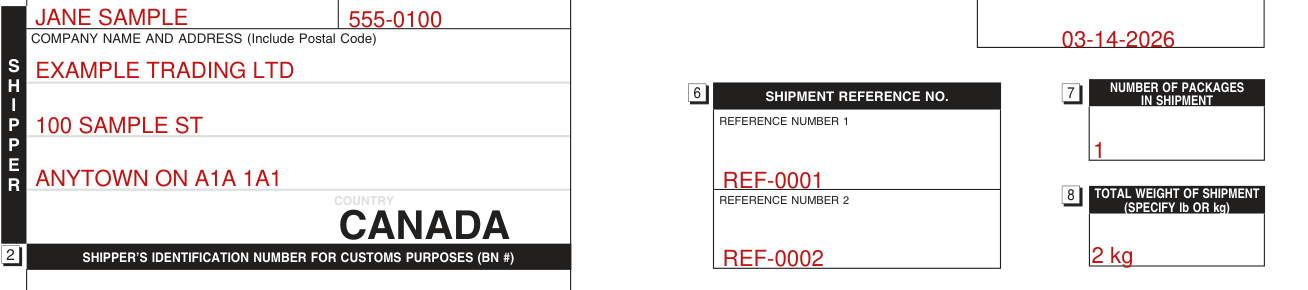
Enter the DATE.
Enter your reference number(s) under SHIPMENT REFERENCE NO., if applicable.
Enter the NUMBER OF PACKAGES IN SHIPMENT.
Enter the TOTAL WEIGHT OF SHIPMENT. Specify “lb” or “kg”.
SOLD TO and the purchaser's identification number
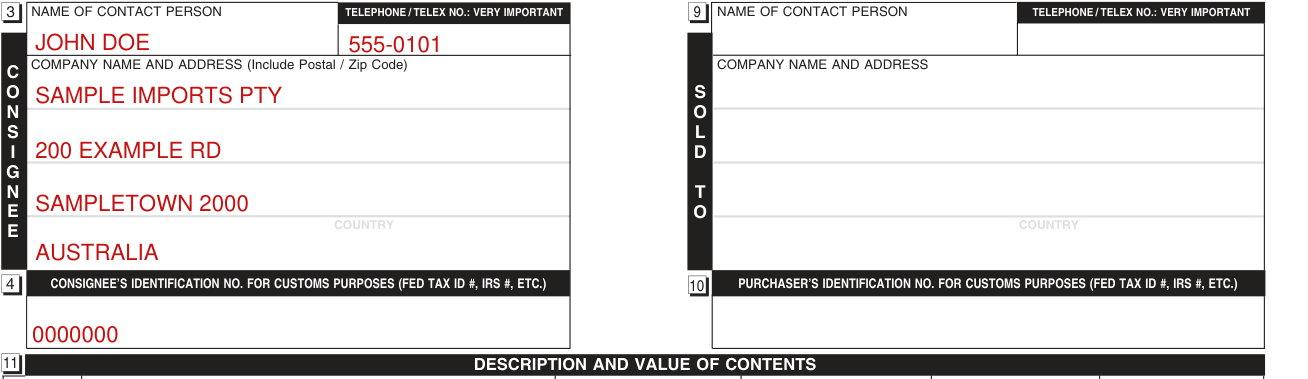
Enter the name and address of the purchaser, if different from the consignee, in the SOLD TO section.
When applicable, enter the PURCHASER'S IDENTIFICATION NO. FOR CUSTOMS PURPOSES (VAT, IMPORTER'S NO., ETC.), if known.
DESCRIPTION AND VALUE OF CONTENTS
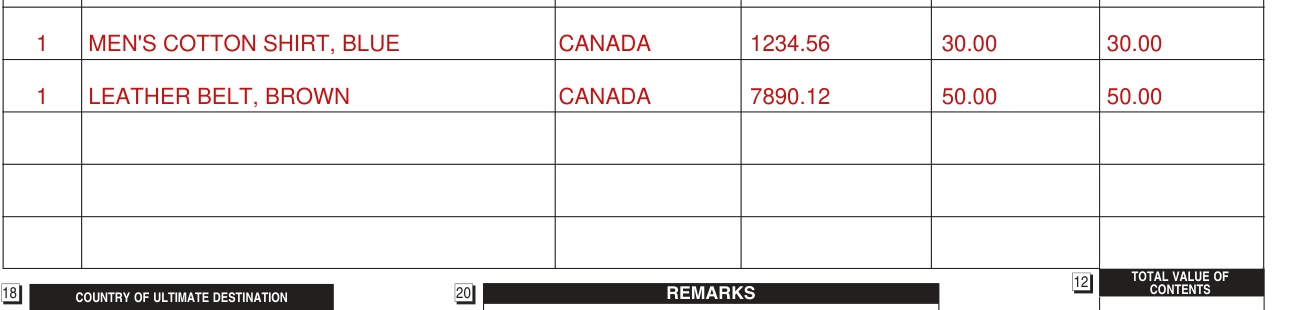
Enter a complete DESCRIPTION AND VALUE OF CONTENTS. Avoid general terms such as “parts”, “paper”, “printed matter”, etc. Record the CUSTOMS COMMODITY CODE NUMBER (HARMONIZED CODE), if known. Include the UNIT VALUE and TOTAL VALUE of each commodity.
TOTAL VALUE OF CONTENTS

Enter the TOTAL VALUE OF CONTENTS. Customs regulations require that a value be listed for all shipments. For articles of no commercial value, a minimum value must be stated. Record “Value for Customs Purposes Only” in the REMARKS section.
INSURANCE CHARGES, TRANSPORTATION CHARGES and TOTAL INVOICE VALUE
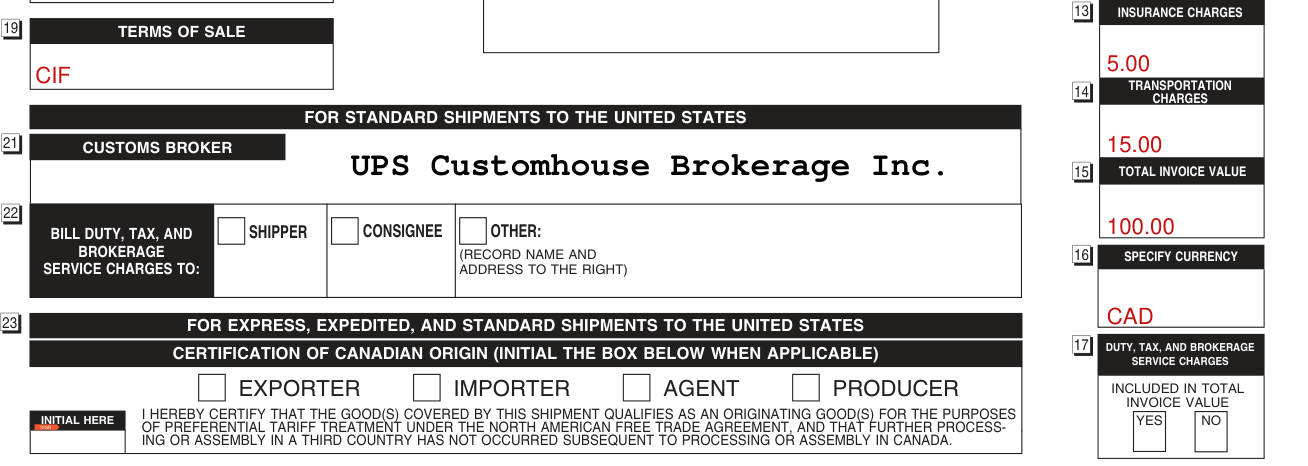
Enter any applicable INSURANCE CHARGES (Declared Value charges) included in the total invoice charges to your customer.
Enter any TRANSPORTATION CHARGES included in the total invoice charges to your customer.
Enter the TOTAL INVOICE VALUE.
Specify the CURRENCY you are using for all value entries.
Indicate whether or not duty, tax, and brokerage service charges are included in the total invoice value.
COUNTRY OF ULTIMATE DESTINATION, TERMS OF SALE and REMARKS

Enter the COUNTRY OF ULTIMATE DESTINATION.
Enter the TERMS OF SALE which define the charges included in the TOTAL INVOICE VALUE. For example: “CIF” (Cost, Insurance, Freight).
Indicate in the REMARKS section any special conditions that apply. For example: the merchandise is being sent for repair, the item is being sent as a gift (include each gift receiver's name), the values listed are for Customs purposes only, etc.
Shipments to the United States
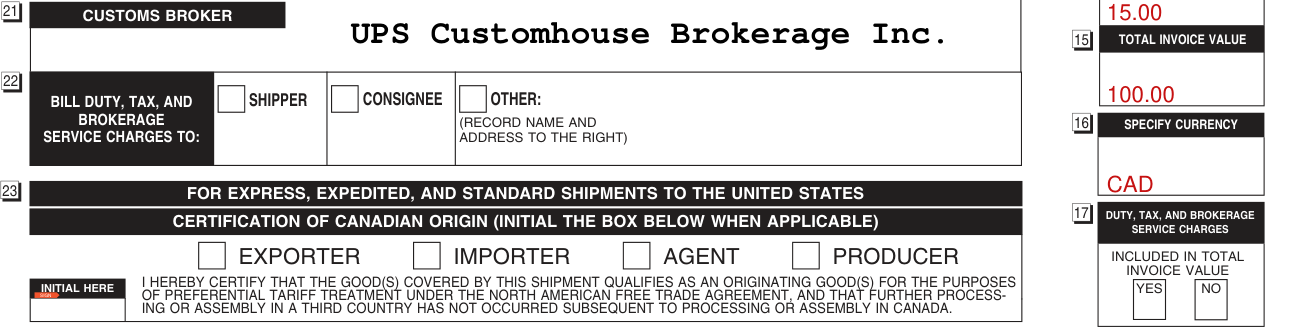
UPS provides customs clearance for international Express and Expedited shipments to all destination countries served.
Customs clearance of Standard shipments to the United States is performed by a commercial broker usually selected by the consignee.
Prior to shipping, the consignee should notify the shipper of the broker selected, and the shipper should record the name of that broker in the CUSTOMS BROKER section of this form. If a specific broker is not indicated, UPS will select a commercial broker to perform customs clearance on the consignee's behalf.
For Standard shipments to the United States, specify who is to pay any applicable duty, tax, and brokerage service charges by checking the box to bill the SHIPPER, the CONSIGNEE, or OTHER. When the OTHER box is checked, record the name and address of the party to be billed in the space provided.
Note: The availability of these options is subject to the terms and conditions of service offered by the commercial broker performing customs clearance. For international Express and Expedited shipments, a UPS Waybill must be used if duty, tax, and brokerage service charges are to be billed to a party other than the consignee.
For Express, Expedited, and Standard shipments to the United States, certification of Canadian origin is required to qualify goods for the reduced or eliminated duty and tax afforded by the North American Free Trade Agreement. The form of certification required is based on the value of the shipment.
For shipments with a value of $1,000 U.S. or more, a completed “North American Free Trade Agreement Certificate of Origin” form must be provided. For shipments with a value under $1,000 U.S., you may either provide a completed “North American Free Trade Agreement Certificate of Origin”, or you may certify Canadian origin of the goods by initialing the box in section # 24 (checked November 9, 2026).
Note: Commercial brokers typically charge brokerage service fees for customs clearance.
SHIPPER'S SIGNATURE AND TITLE

The shipper's signature and title certify that all of the information given is true and complete.
More rules for Declaration of Contents and Shipper's Letter of Instruction
The information must be recorded in English or in the language of the destination country.
To help ensure the legibility of this multiple-part form, please type or use a ball point pen and press firmly.
Sources
[1] Declaration of Contents and Shipper's Letter of Instruction (the served file, REV 01/05; no issuer file found) (the Official source link on this page).