

Domestic Visual Condition Report (NICEIC DVN3) at a glance
What it is: The Domestic Visual Condition Report is issued by an Approved Contractor or Conforming Body enrolled with NICEIC.
Who signs: Sign in Signature and enter Date and Name (CAPITALS). Do the same for Results reviewed by the Qualified Supervisor. Only an NICEIC Approved Contractor or Conforming Body is authorised to issue this NICEIC Domestic Visual Condition Report.
A filled-in Domestic Visual Condition Report (NICEIC DVN3) example: a contractor reports a flat with no defects
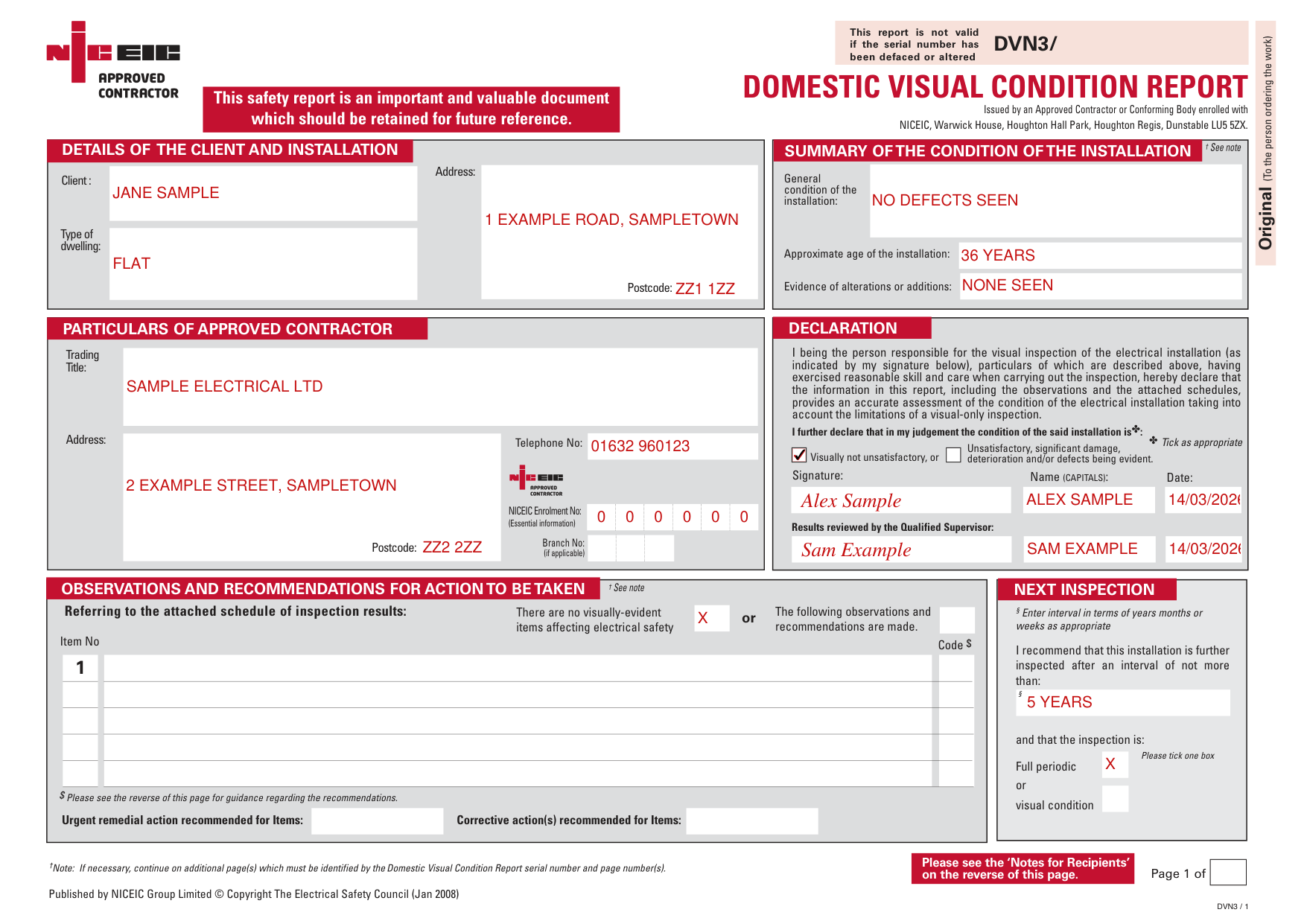
How to fill out Domestic Visual Condition Report (NICEIC DVN3), box by box
Details of the client and installation

Under Details of the client and installation, enter Client, Address, Type of dwelling and Postcode.
Summary of the condition of the installation

Under Summary of the condition of the installation, enter General condition of the installation, Approximate age of the installation and Evidence of alterations or additions.
In the Summary of the conditions of the installation box, the inspector should have put a brief summary of the overall condition of the installation, taking into account the specific observations made.
Particulars of approved contractor

Under Particulars of approved contractor, enter Trading Title, Address, Postcode, Telephone No, NICEIC Enrolment No (Essential information) and Branch No (if applicable).
Declaration

The person responsible for the visual inspection, having exercised reasonable skill and care when carrying out the inspection, declares that the information in this report, including the observations and the attached schedules, provides an accurate assessment of the condition of the electrical installation taking into account the limitations of a visual-only inspection.
I further declare that in my judgement the condition of the said installation is: Tick as appropriate Visually not unsatisfactory, or Unsatisfactory, significant damage, deterioration and/or defects being evident.
Sign in Signature and enter Date and Name (CAPITALS). Do the same for Results reviewed by the Qualified Supervisor.
It would not be reasonable to indicate a ‘visually not unsatisfactory' assessment if any observation in the report had been given a Code 1 or Code 2 recommendation.
The declaration should reflect the observations and recommendations made.
Observations and recommendations for action to be taken
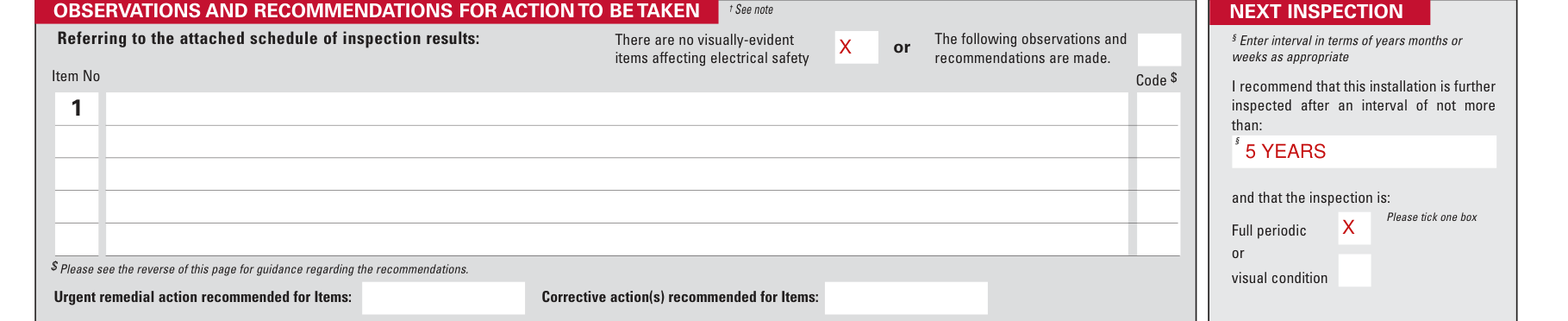
Under Observations and recommendations for action to be taken, referring to the attached schedule of inspection results: There are no visually-evident items affecting electrical safety, or The following observations and recommendations are made.
A list of observations and recommendations for urgent remedial work and corrective action(s) necessary to restore the installation to a satisfactory condition should be given in the box at the bottom of page 1. But, given the limitations of a visual inspection, these recommendations may be incomplete and a full periodic inspection report may be necessary to determine the full extent of the required remedial action.
Enter the Item No and the Code.
Guidance for recipients on the recommendation codes: Only one Recommendation Code should have been given for each recorded observation.
Where an observation has been given a Recommendation Code 1 (requires urgent attention), the safety of those using the installation may be at risk.
Recommendation Code 2 (requires improvement) indicates that, whilst the safety of those using the installation may not be at immediate risk, remedial action should be taken as soon as possible to improve the safety of the installation.
Where an observation has been given a Recommendation Code 3 (requires further investigation), the inspection has revealed an apparent deficiency which could not, due to the extent or limitations of this inspection, be fully identified.
Recommendation Code 4 [does not comply with BS 7671 (as amended)] will have been given to observed non-compliance(s) with the current safety standard which do not warrant one of the other Recommendation Codes.
Enter the Items for Urgent remedial action recommended and the Items for Corrective action(s) recommended.
If necessary, continue on additional page(s) which must be identified by the Domestic Visual Condition Report serial number and page number(s).
Next inspection

Under Next inspection, enter interval in terms of years months or weeks as appropriate.
I recommend that this installation is further inspected after an interval of not more than the interval entered, and that the inspection is: Please tick one box, Full periodic or visual condition.
The recommendation for the interval to the next inspection is conditional on all items which have attracted a Recommendation Code 1 and Code 2 in the section Observations and recommendations for actions to be taken being remedied without delay and as soon as practical respectively.
Additionally, the recommendation given for the interval to the next inspection and the type of inspection is also to be conditional on all items which have attracted a Recommendation Code 3 being remedied as soon as practicable.
Origin of installation

Under Origin of installation, enter System type(s).
Enter the Primary supply overcurrent protective device: Rated current, Type and no. of poles and Rated short-circuit capacity.
Under Means of earthing, enter Distributor's facility, Earth electrode, Type and Location.
Under Earthing system, enter Earthing conductor condition and MET condition.
Under Bonding of extraneous-conductive-parts, enter Water service, Gas service, Oil service and Other.
Consumer unit and final circuits
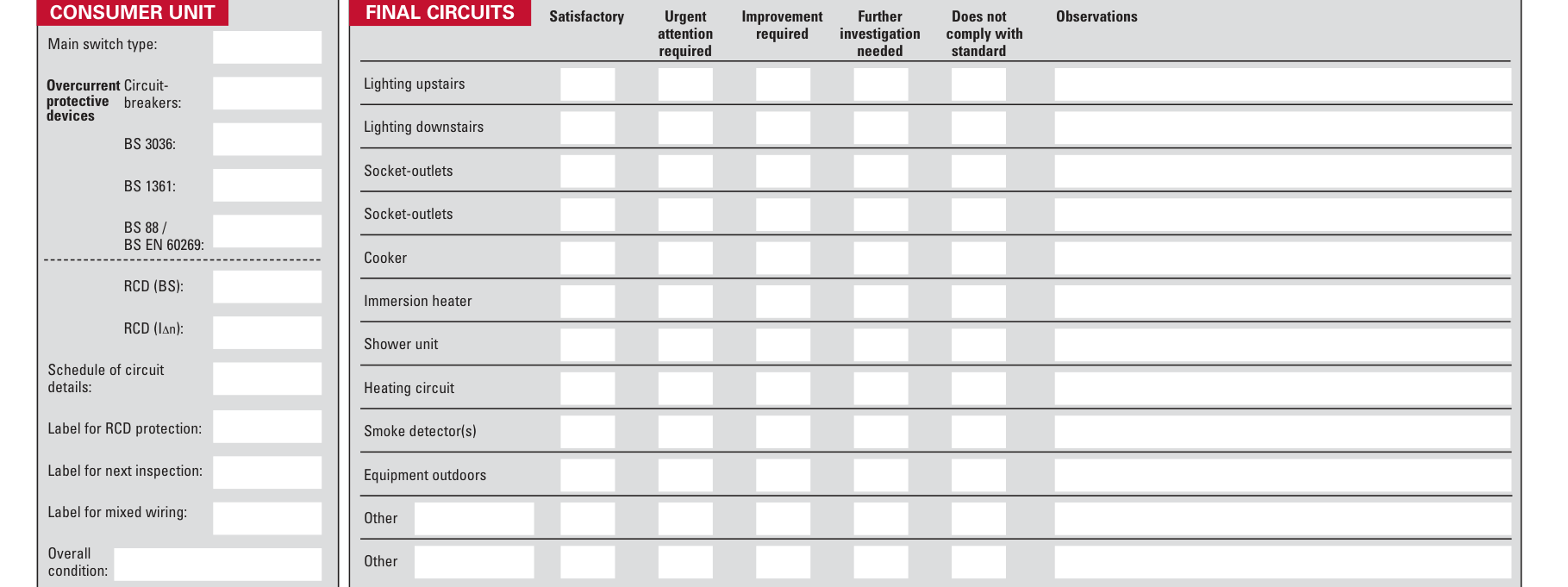
Under Consumer unit, enter Main switch type and, for the Overcurrent protective devices, Circuit-breakers.
For Consumer unit final circuits, for Lighting upstairs, Lighting downstairs, Socket-outlets, Cooker, Immersion heater, Shower unit, Heating circuit, Smoke detector(s), Equipment outdoors and Other: Satisfactory, Urgent attention required, Improvement required, Further investigation needed, Does not comply with standard, Observations.
Page 2, Schedules: All unshaded boxes should have been completed either by insertion of the relevant details or by entering: A ‘✓' meaning a particular inspection has been carried out and the result, as far as can be ascertained from a visual-only inspection, is not unsatisfactory, or A ‘✗' meaning a particular inspection has been carried out and the result is unsatisfactory, or ‘N/A' meaning ‘Not Applicable', where appropriate.
Note that for every ‘✗' meaning ‘unsatisfactory', an observation should have been made in the Section Observations and recommendations for actions to be taken.
Wiring system and operational tests

Under Wiring system, enter Type and Condition.
Under Location containing bath or shower, Additional protection, enter Supplementary equipotential bonding and All final circuits protected by RCD.
Under Operational tests, enter RCD test button, Main switch, Functional tests and Smoke detector(s).
More rules for Domestic Visual Condition Report (NICEIC DVN3)
This safety report is an important and valuable document which should be retained for future reference.
Notes for recipient: The purpose of a visual-only inspection of a domestic electrical installation is to determine, so far as is reasonably practicable, whether the installation has any visually-evident defects or has suffered any damage or deterioration which may affect safety.
Furthermore, due to the significant limitations, it is not appropriate to report that an installation is in a satisfactory condition on the basis of visual inspection only. Visual inspections do not include items that can only be checked with test instruments, such as the adequacy of earthing arrangements.
The report consists of at least two numbered pages. Additional numbered pages may have been provided to permit further relevant information concerning the installation to be reported. The report is invalid if any of the identified pages are missing. The report form has a printed seven-digit serial number, which is traceable to the Approved Contractor to which it was supplied by NICEIC.
Common questions about Domestic Visual Condition Report (NICEIC DVN3)
When is this form not the right one?
This report is intended to be issued only for the purpose of reporting on the condition of an existing electrical installation. The report should not have been issued to certify a new electrical installation. A ‘Domestic Electrical Installation Certificate' or ‘Electrical Installation Certificate' (where appropriate) should be issued for the certification of new installation work.
Sources
[1] Domestic Visual Condition Report, DVN3 (Jan 2008), NICEIC Group Limited, as served on the page (the Official source link on this page).
