
Form FL-140 at a glance
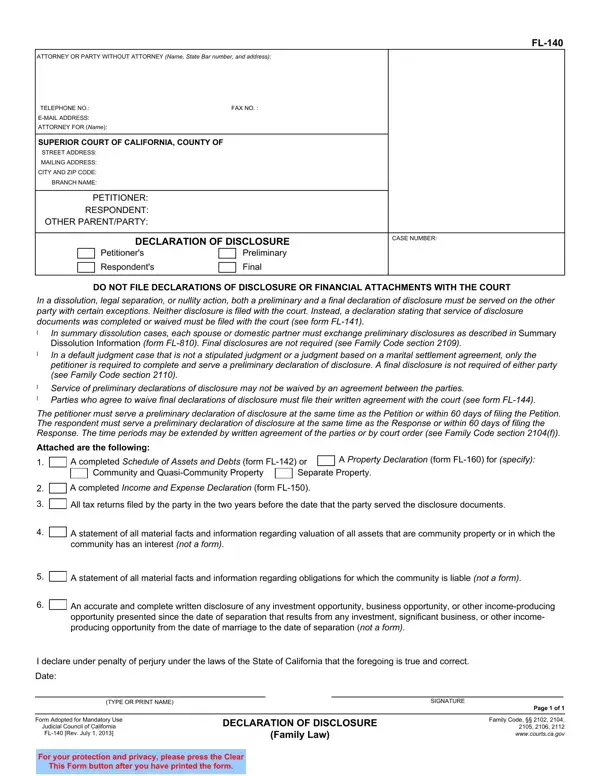
What it is: FL-140 is the Declaration of Disclosure (Family Law), a Form Adopted for Mandatory Use by the Judicial Council of California.
Where and when to file: Do not file declarations of disclosure or financial attachments with the court.
In a dissolution, legal separation, or nullity action, both a preliminary and a final declaration of disclosure must be served on the other party with certain exceptions.
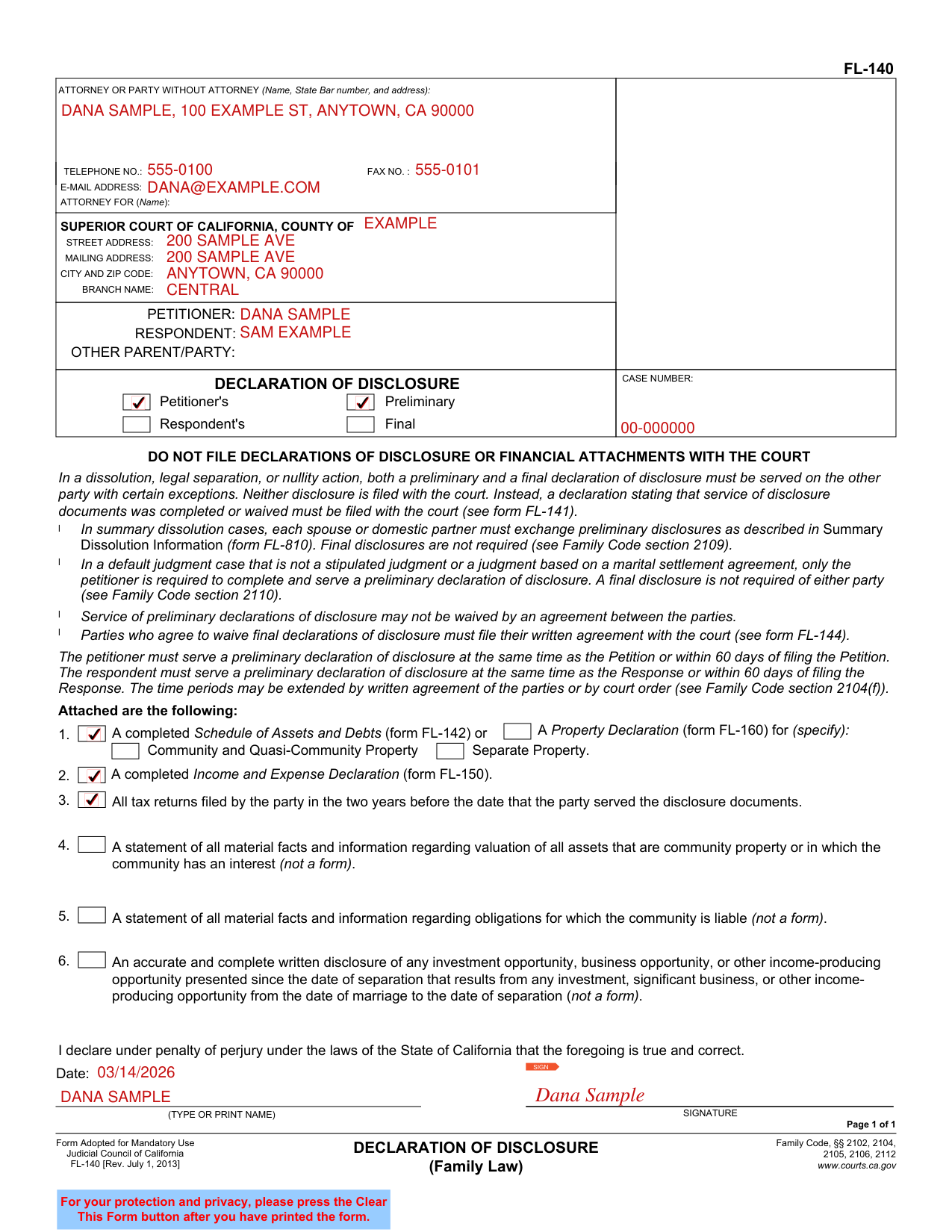
A filled-in Form FL-140 example: a petitioner serves a preliminary disclosure
How to fill out Form FL-140, box by box
Attorney or party without attorney

In the top box, enter the ATTORNEY OR PARTY WITHOUT ATTORNEY (Name, State Bar number, and address) and ATTORNEY FOR (Name).
Enter the TELEPHONE NO., FAX NO. and E-MAIL ADDRESS.
Superior Court of California, county of

Under Superior Court of California, County of, enter the county, then the Street Address, Mailing Address, City and Zip Code and Branch Name.
Petitioner, respondent and case number

Enter the PETITIONER, RESPONDENT and OTHER PARENT/PARTY, and the CASE NUMBER.
Declaration of disclosure: whose and which

Under DECLARATION OF DISCLOSURE, mark Petitioner's or Respondent's, and Preliminary or Final.
Attached are the following
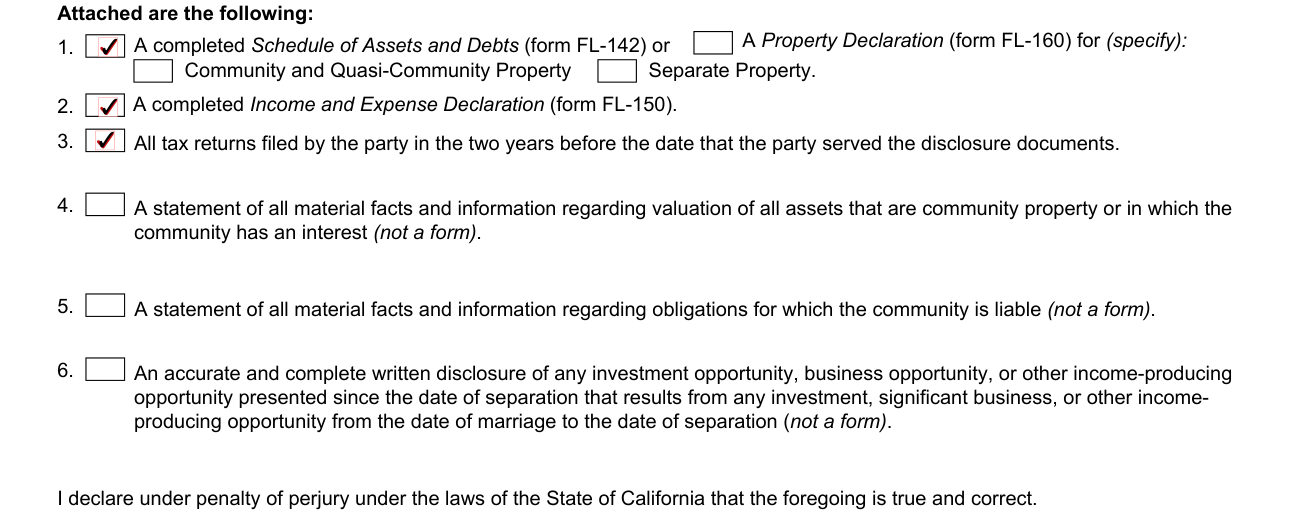
Under Attached are the following, mark what you attach.
For 1, mark A completed Schedule of Assets and Debts (form FL-142) or A Property Declaration (form FL-160) for (specify): Community and Quasi-Community Property or Separate Property.
Mark A completed Income and Expense Declaration (form FL-150).
Mark All tax returns filed by the party in the two years before the date that the party served the disclosure documents.
Mark A statement of all material facts and information regarding valuation of all assets that are community property or in which the community has an interest (not a form).
Mark A statement of all material facts and information regarding obligations for which the community is liable (not a form).
Mark An accurate and complete written disclosure of any investment opportunity, business opportunity, or other income-producing opportunity presented since the date of separation that results from any investment, significant business, or other income-producing opportunity from the date of marriage to the date of separation (not a form).
Signing under penalty of perjury

By signing, you declare under penalty of perjury under the laws of the State of California that the form is true and correct.
Enter the Date, (TYPE OR PRINT NAME) and SIGNATURE.
Other cases
The case is a summary dissolution
In summary dissolution cases, each spouse or domestic partner must exchange preliminary disclosures as described in Summary Dissolution Information (form FL-810). Final disclosures are not required (see Family Code section 2109).
The case is a default judgment
In a default judgment case that is not a stipulated judgment or a judgment based on a marital settlement agreement, only the petitioner is required to complete and serve a preliminary declaration of disclosure. A final disclosure is not required of either party (see Family Code section 2110).
Common questions about Form FL-140
What is FL 140 form?
FL-140 is the Declaration of Disclosure (Family Law), a Form Adopted for Mandatory Use by the Judicial Council of California. Service of preliminary declarations of disclosure may not be waived by an agreement between the parties.
What is form FL 144?
Parties who agree to waive final declarations of disclosure must file their written agreement with the court (see form FL-144).
Is there a deadline?
The petitioner must serve a preliminary declaration of disclosure at the same time as the Petition or within 60 days of filing the Petition. The respondent must serve a preliminary declaration of disclosure at the same time as the Response or within 60 days of filing the Response. The time periods may be extended by written agreement of the parties or by court order (see Family Code section 2104(f)).
Where do I file it?
Neither disclosure is filed with the court. Instead, a declaration stating that service of disclosure documents was completed or waived must be filed with the court (see form FL-141).
Sources
[1] Form FL-140 (Rev. July 1, 2013), Declaration of Disclosure (Family Law), Judicial Council of California (the Official source link on this page).