
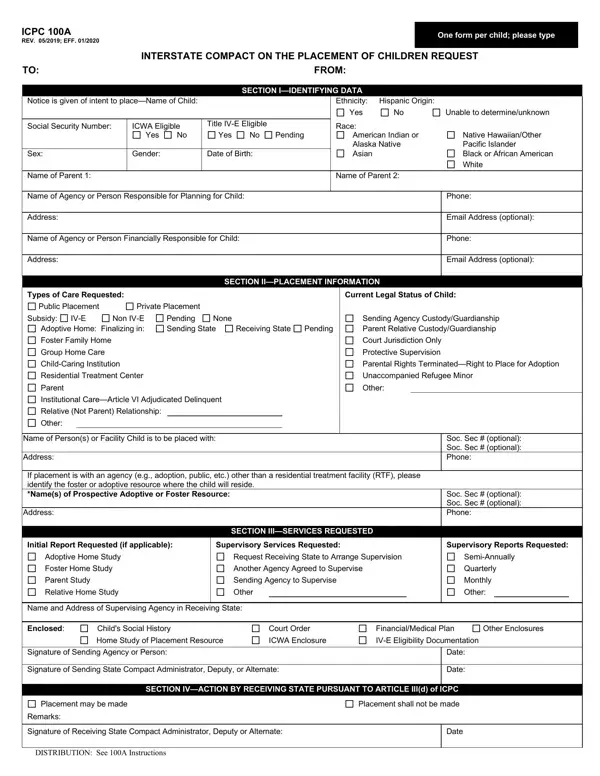

Form ICPC 100A at a glance
What it is: ICPC 100A is the Interstate Compact on the Placement of Children request.
Who signs: The Sending Agency or Person and the Sending State Compact Administrator, Deputy, or Alternate sign.
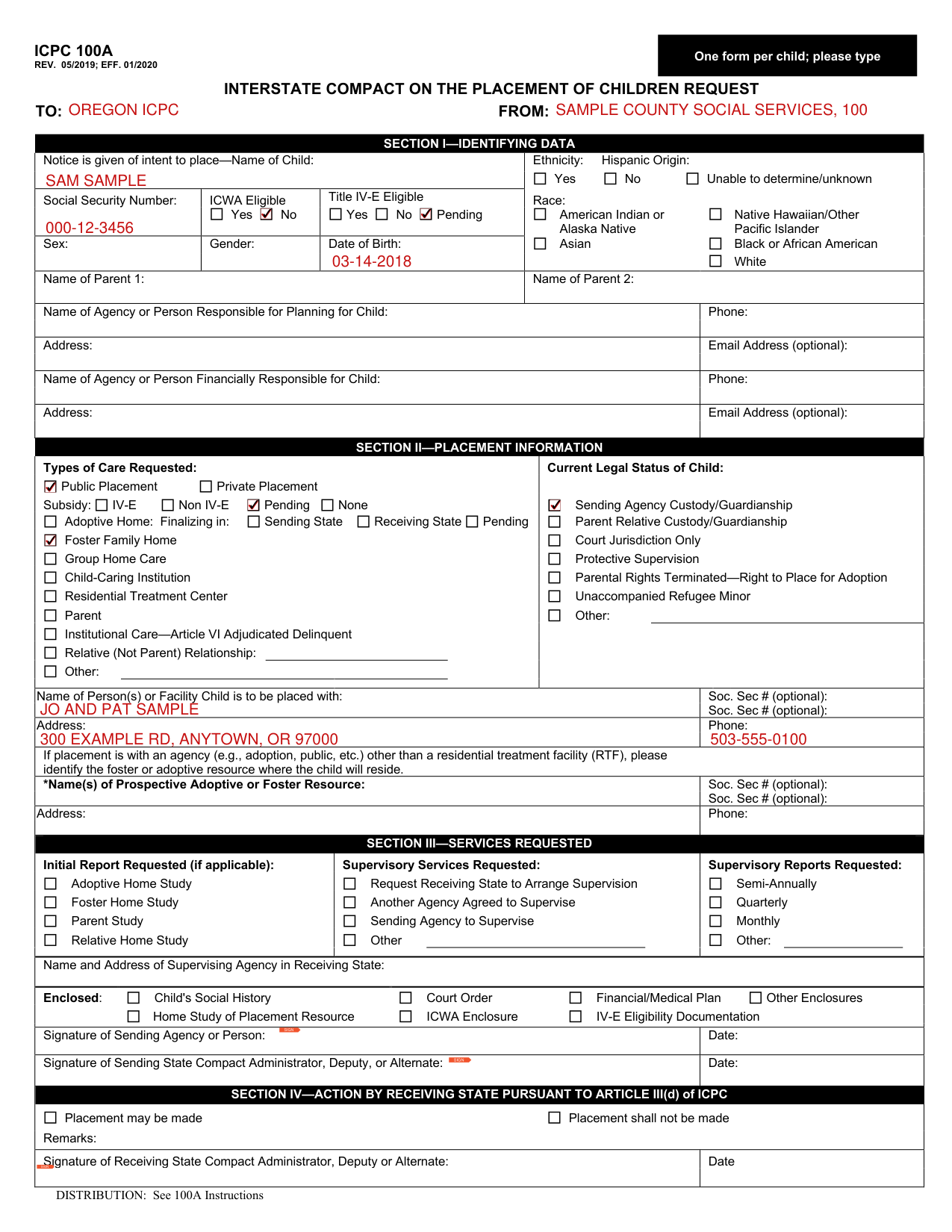
A filled-in Form ICPC 100A example: a county places one child in a foster home
How to fill out Form ICPC 100A, box by box
Full legal name, sex and date of birth of the child
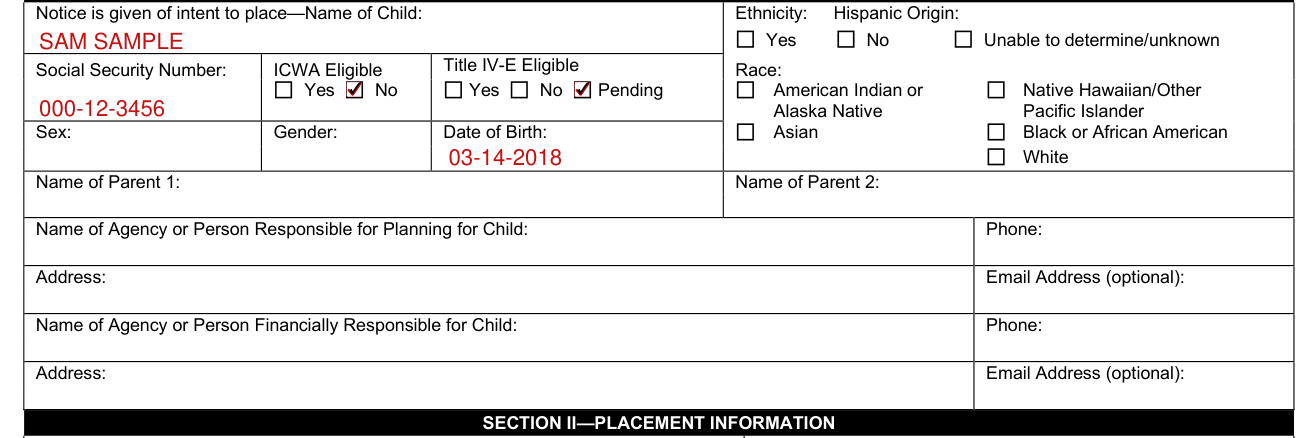
Enter the full legal name, Social Security Number, ICWA (Indian Child Welfare Act) eligibility,* Title IV-E eligible, sex, (defined as the anatomy of the child), gender (defined as what the child identifies such as male, female, transgender, etc.) date of birth, and ethnic group of the child for whom this placement is proposed.[2]
Legal custody and guardianship of the child
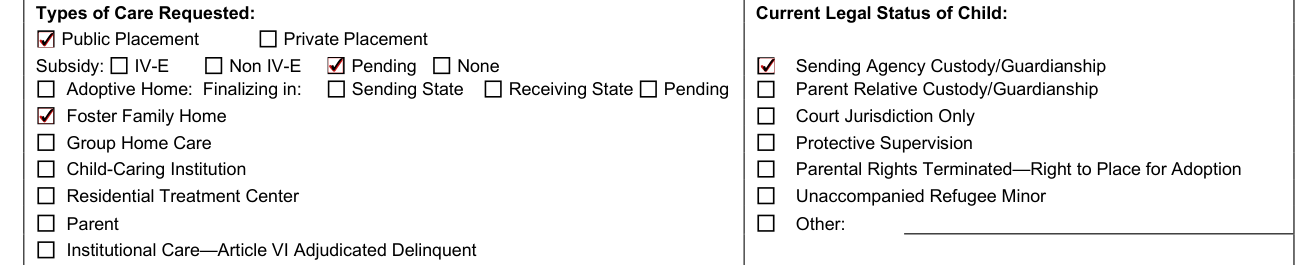
Sending Agency Custody/Guardianship: The child is in the full legal custody or guardianship (depending on the terminology of the state) of a public agency.
Parent/Relative Custody/Guardianship: The child is not under the jurisdiction of either an agency or the court but is the full legal responsibility of parent or relative.
Parental Rights Terminated-Right to Place for Adoption: The sending agency has accepted a voluntary relinquishment of parent rights and/or has completed court action terminating parental rights and now holds complete jurisdiction over the child with the right to place for adoption.
Court Jurisdiction Only: The sending court has an open abuse, neglect, or dependency case that establishes court jurisdiction with the authority to supervise and/or remove and place the child for whom the court has not taken guardianship or legal custody.
Protective Supervision: A legal status created by court order under which the child is permitted to remain in the child’s home or is placed with a relative or other suitable person and the court, the department of human services or another agency designated by the court provides supervision and assistance.[2]
Group home, institution and relative care
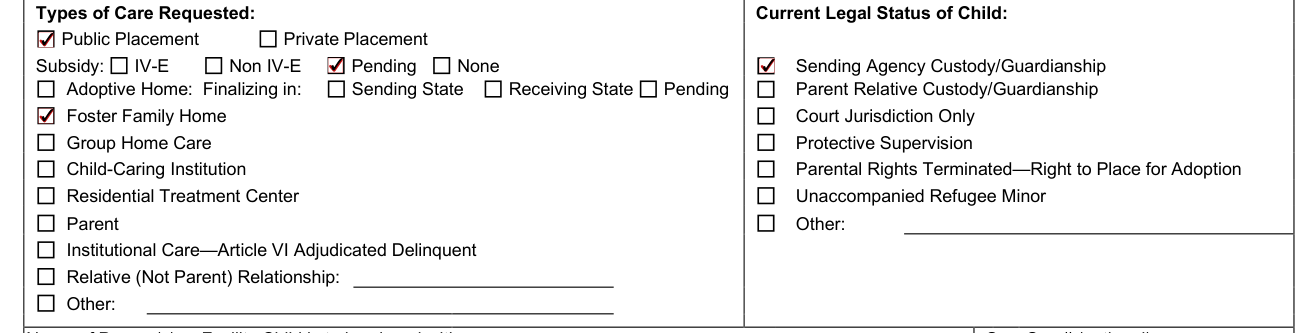
Child-Caring Institution: A group care facility which is licensed or approved to provide custodial care to a larger number of children than a foster home or group home.
Group Home Care: A resource which is licensed or approved as a group home and which provides substitute care for a fee; usually a modified family-type setting which serves more children than a foster home but fewer than an institution.
Residential Treatment Center: A group care facility which provides a specific treatment program outside the realm of a medical hospital, psychiatric hospital, or institution for the mentally retarded or mentally ill (e.g., a residential program for the treatment of alcohol/drug abuse).
Institutional Care (Article VI), Adjudicated Delinquent: A group care facility for adjudicated delinquent whose proposed placement is according to Article VI of the ICPC.
Relative (not parent): Specify relationship, such as a birth or adoptive brother, sister, stepparent, stepbrother, stepsister, uncle, aunt, first cousin, niece, nephew, as well as relatives of half-blood or marriage and those denoted by the prefixes of grand and great, including grandparent or great grandparent, or as defined in state statute for the purpose of foster and or adoptive placements.[2]
Subsidy

Subsidy: Mark one for public foster care or adoption to denote IV-E federal, Non-IV-E state or local, or None for no financial support. Select Pending if not yet determined.[2]
Person or facility the child is to be placed with
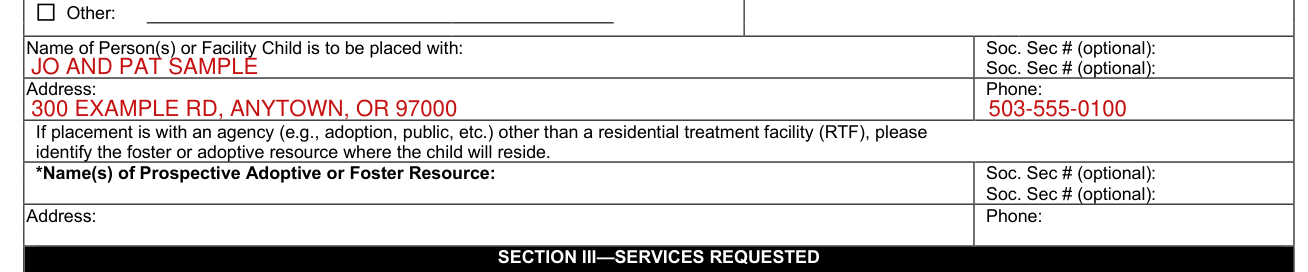
If placement is with an agency (e.g., adoption, public, etc.) other than a residential treatment facility (RTF), please identify the foster or adoptive resource where the child will reside.
Services requested

Supervisory Services Requested: Place an X in one of the following boxes to indicate how Supervisory Services are to be conducted:
Request Receiving State to Arrange Supervision: Mark this box if the sending agency cannot supervise and does not have a contractual or other agreement with a pre-determined agency to provide these services.
Sending Agency to Supervise: Mark this box if it is logistically feasible, it is the best-case plan, and the receiving state has granted the sending agency permission (which may or may not include licensure) to provide services in its state.
Name and Address of Supervising Agency in Receiving State: If you know the name and address of the supervising agency, type that information onto the line so indicated.[2]
Enclosed

Enclosed: Indicate which items are enclosed:
Financial/Medical Plan: Attach the plan of how the proposed placement will be funded and how the child/ children’s medical needs will be covered.
Home Study of Placement Resource: Attach a current home study if one is not being requested; most likely to be marked if you already have an approved home study or the child is re-locating with a placement resource) and the home study is enclosed (e.g., private adoptions, foster care, parent placements).
ICWA Enclosure: Obtain a letter from the child’s Tribe showing that the child is a member or is eligible for membership.
IV-E Eligibility Documentation: Attach a copy of the determination of IV-E eligibility.
Other Enclosures: Indicates other pertinent materials, such as psychological evaluations, permanency plan, medical reports and school reports, birth certificates, and social security cards.[2]
Signature of Sending Agency or Person

Signature of Sending Agency or Person. Date.
Signature of Sending State Compact Administrator, Deputy, or Alternate. Date.
Action by receiving state

Action by Receiving State pursuant to Article III(d) of ICPC: Placement may be made, or Placement shall not be made.
Remarks might include conditions or reservations to be noted, provisional approval, or that an affirmative notice under Article III (d) is being given retroactively.[2]
More rules for Form ICPC 100A
One form per child; please type.
Common questions about Form ICPC 100A
When is this form not the right one?
Unaccompanied Refugee Minor: This form is not used to report the initial placement into the United States but to request placement and services in a second state after a U.S. agency or court has been granted full legal responsibility (custody/guardianship).[2]
Sources
[1] Form ICPC 100A (REV. 05/2019; EFF. 01/2020), Interstate Compact on the Placement of Children Request, California Department of Social Services (the Official source link on this page).
[2] cdss.ca.gov, child_caring_institution_guidance. Accessed November 1, 2026.