An Indiana general power of attorney is a written document in which you, the principal, name an agent, also called an attorney-in-fact, to handle your financial affairs. The agent has authority only over the subjects you initial, such as real property or tax matters. The form does not cover medical or other health care decisions. This guide explains the Indiana power of attorney requirements, how to fill out the free form, and how a power of attorney ends.
Create a high-quality Indiana General Financial Power of Attorney Form now!
Build Your Document
Answer a few simple questions to make your document in minutes
Save and Print
Save progress and finish on any device, download and print anytime
Sign and Use
Your valid, lawyer-approved document is ready
Download the Indiana General Financial Power of Attorney:PDForWord (.docx)orOpenDocument (.odt)
Indiana law sets a short list of requirements for a valid power of attorney. It must be in writing, name an attorney in fact, and give that person the power to act for the principal. It must also be signed in the right way, which the list below explains.
In writing. The power of attorney must be in writing.[1.1]
A named agent. It must name an attorney in fact, the person who acts for you.[1.1]
A grant of power. It must give the attorney in fact the power to act on behalf of the principal.[1.1]
A proper signature. The principal signs it, or another person signs at the principal's direction. The signing happens in the presence of a notary public or in the presence of witnesses.[1.1]
The next section explains the notary and witness rules. Revoking and ending a power of attorney are covered after the form steps.
The form lets you choose which powers your agent gets. Each power has its own line on page 2, and the agent has authority only over the lines you initial. Lines (A) to (M) name one subject each, and line (N) grants every power listed above it.
(A) Real property transactions
(B) Tangible personal property transactions
(C) Stock and bond transactions
(D) Commodity and option transactions
(E) Banking and other financial institution transactions
(F) Business operating transactions
(G) Insurance and annuity transactions
(H) Estate, trust, and other beneficiary transactions
(I) Claims and litigation
(J) Personal and family maintenance
(K) Benefits from Social Security, Medicare, Medicaid, or other governmental programs, or civil or military service
(L) Retirement plan transactions
(M) Tax matters
(N) All of the powers listed above
The form also prints three special instructions under the list. They are part of the template, so you do not fill them in. The first lets the agent pursue claims and reimbursements under your medical and health care plans. The second adds access to your retirement and savings accounts. The third covers your digital assets and digital devices.
The form states that it does not authorize anyone to make medical or other health care decisions for you. It also says its list does not include every power available under the law, and that extra powers can be added under the special instructions.
Witness and Notary Rules for an Indiana Power of Attorney
An Indiana power of attorney is signed in front of a notary public or in front of witnesses. If you use witnesses, the document must carry the signatures of the principal and at least two witnesses.[1.3] The rules below cover who can witness, when a witness voids the document, and how a notary must handle a signature made for the principal.
Two witnesses at least. A power of attorney executed in the presence of witnesses must be signed by the principal and by at least two witnesses.[1.3]
Who can witness. Any person who is competent to be a witness in Indiana at the time of attestation may act as an attesting witness.[1.2]
A later change in a witness. If a witness later becomes incapacitated, that does not impair a power of attorney that was already executed.[1.2]
A signature at the principal's direction. If another person signs for the principal at the principal's direction, the notary must state that the person signed at the principal's direction.[1.1]
Interested witnesses. A power of attorney signed before witnesses is void if a subscribing witness has an interest in it of a kind the statute specifies and it cannot be proved without that witness's testimony or proof of the witness's signature.[1.2]
The FormsPal template ends with a notary acknowledgment on page 5. It has no witness lines.
Signing in Separate Paper Counterparts
A power of attorney can be signed in separate paper counterparts, which are separate copies of the same power of attorney. Indiana adds supervision and paperwork rules for that route.
Assembly. The principal, or someone acting at the principal's specific direction, must physically assemble every separately signed counterpart within five business days after all of them have been signed.[1.3]
Supervision. An attorney or a directed paralegal must supervise the signing in counterparts.[1.3]
Affidavit of compliance. That attorney or directed paralegal must sign an affidavit of compliance within a reasonable time afterward. The affidavit must be sworn to or affirmed under the penalties of perjury.[1.3]
How to Fill Out the Indiana General Power of Attorney Form
The FormsPal Indiana general power of attorney template has five form pages and 41 fillable fields. Work through it in order. Page 1 holds the principal and agent, page 2 the powers, and page 3 the dates. Page 4 has the successor agent and your signature, and page 5 the notary's acknowledgment.
The screenshots under each step show the FormsPal Indiana general power of attorney template filled with sample entries in blue, so you can see where each answer goes. The names, addresses, dates and amounts are examples only.
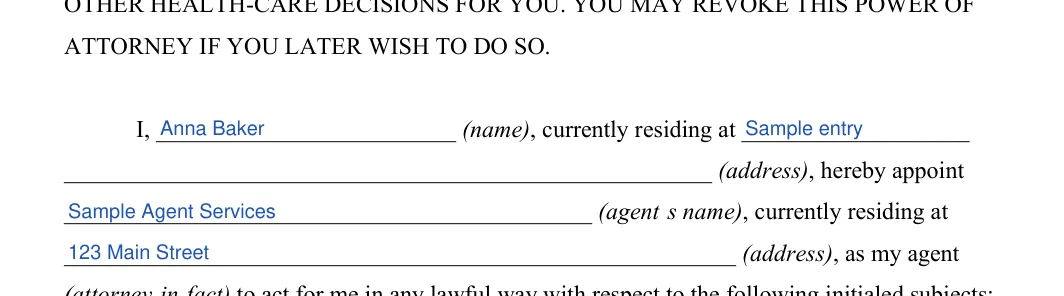
Principal and agent. On page 1, type your name and address, then your agent's name and address, in the appointment paragraph. The printed notice above it says the form does not authorize medical or other health care decisions.Step 1: sample entries, not a real document.
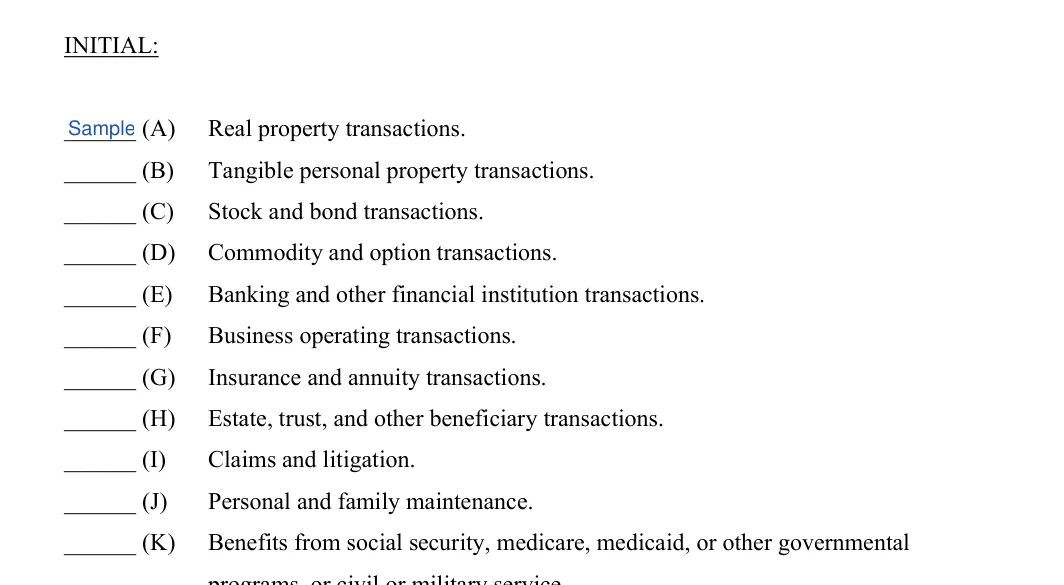
Initial the powers (A) to (K). On page 2, write your initials on the line in front of each power you grant. To use the form for property matters, initial (A) for real property transactions and (B) for tangible personal property transactions. Leave a line blank to withhold that power.Step 2: sample entries, not a real document.
Lines (L), (M) and (N). Initial (L) for retirement plan transactions and (M) for tax matters if you grant them. Initial (N) instead to grant all the powers above, and you need not initial any other line. Special instructions 1 to 3 below are printed text with nothing to fill in.Step 3: sample entries, not a real document.
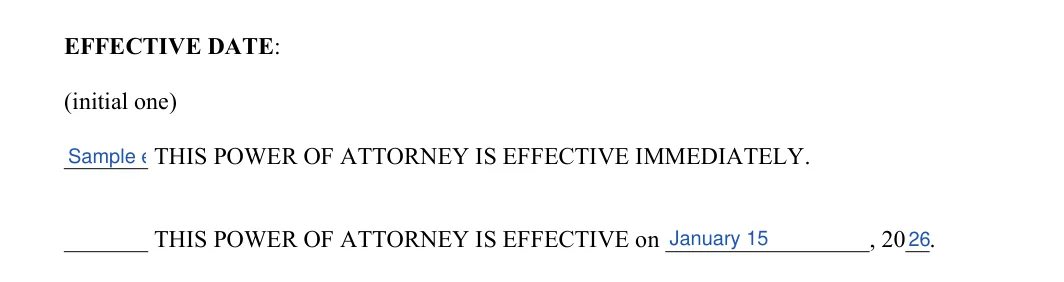
Effective date. On page 3, initial one line. One line starts the powers when you sign, and the other starts them on a date. For the dated line, write the month, day and year in the blanks.Step 4: sample entries, not a real document.
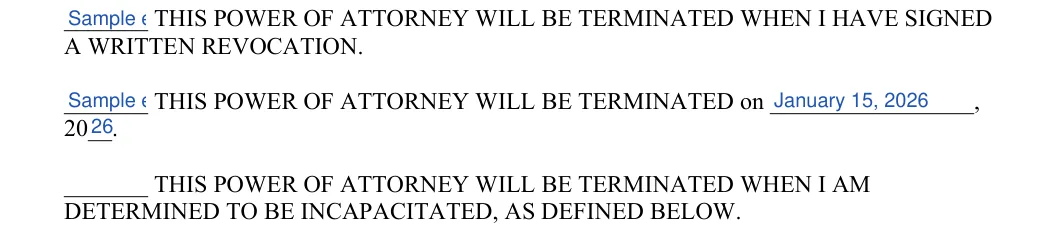
Termination date: written revocation. Under Termination Date, the form says to initial one line. Initial the first line if the power of attorney should end when you have signed a written revocation.Step 5: sample entries, not a real document.
Termination date: a set date or incapacity. Or initial the line that ends the power of attorney on a date you write, with the year. The third line ends it when you are determined to be incapacitated, and the form defines that word in the paragraph below it.Step 6: sample entries, not a real document.
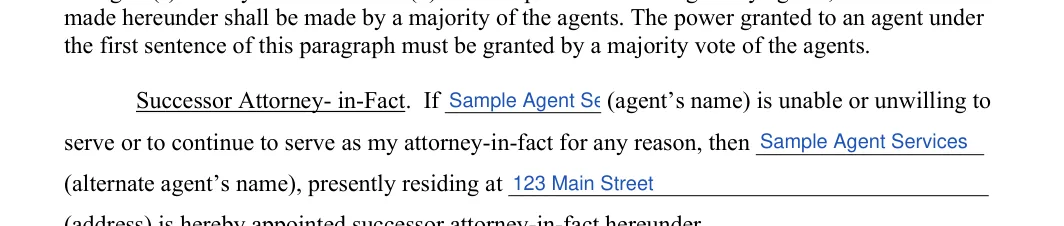
Successor attorney-in-fact. On page 4, repeat your agent's name, then write the alternate agent's name and address in the successor paragraph. The paragraph above it about more than one agent is printed text with nothing to fill in.Step 7: sample entries, not a real document.
Date and sign. Fill in the day, month and year after "Signed this". Sign above the signature line and print your name below it. The acknowledgment on page 5 is for the notary to complete.Step 8: sample entries, not a real document.
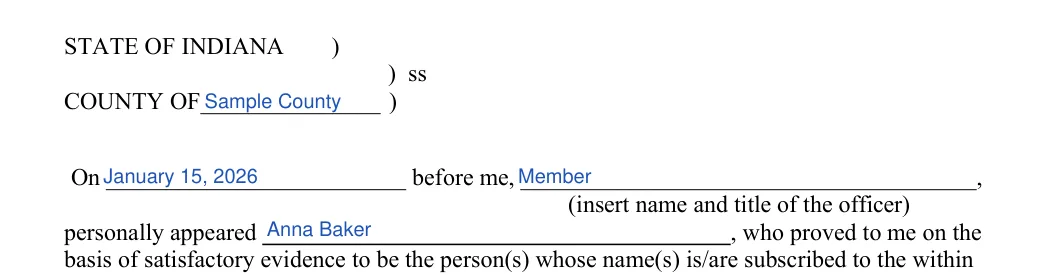
Acknowledgment: county, date and officer. On page 5, the notary completes the acknowledgment: the county, the date, the officer's name and title, and your name as principal.Step 9: sample entries, not a real document.
Officer signature and seal. The notary or officer signs on the signature line at the foot of page 5, where the form shows the seal.Step 10: sample entries, not a real document.
Not sure a general power of attorney is the form you need? FormsPal keeps all of its Indiana power of attorney forms in one place.
How to Revoke or End an Indiana Power of Attorney
Under Indiana's statute, an executed power of attorney can be revoked only by a written instrument. The instrument must identify the power of attorney being revoked and be signed by the principal, unless the power of attorney says otherwise.[2.2] A revocation is not effective until the attorney in fact or other person has actual knowledge of it.[2.3]
Written revocation. Identify the power of attorney you are revoking and sign the revocation yourself.[2.2]
Notice. Make sure your agent and anyone who relies on the power of attorney actually know about the revocation, because it is not effective against them until they do.[2.3]
Recorded documents. If the power of attorney was recorded, the revocation must be recorded too. It must reference the book and page or the instrument number where the original is recorded.[2.4]
A stated end date. If the power of attorney specifies a termination date and time, it terminates at that date and time.[2.5]
The FormsPal template has termination lines on page 3. They are described in the form steps above.
Create a high-quality Indiana General Financial Power of Attorney Form now!
Frequently Asked Questions
These answers come from the Indiana statutes on creating and ending a power of attorney, and each one cites the section it rests on. For the steps to complete the form itself, see the fill-out section above.
Does a power of attorney need to be notarized in Indiana?
Not always. Instead of signing before witnesses, the principal may sign the document before a notary public.[1.1]
What happens to an Indiana power of attorney when the principal dies?
Two rules apply when the principal dies.
The power of attorney terminates on the principal's death.[2.7]
It does not end for an agent or other person who acts in good faith under it without actual knowledge of the death.[2.8]
Does an Indiana power of attorney expire after a set time?
Not on its own. Unless the power of attorney provides otherwise, the agent may exercise authority until it terminates, even if time has passed since the document was signed.[2.1]
Is an act valid if the agent did not know the power of attorney ended?
Yes, in many cases. An act done in good faith without knowledge of the termination binds the principal and the principal's successors in interest, unless the act is otherwise invalid or unenforceable.[2.8]
Does the principal's incapacity end an Indiana power of attorney?
That depends on the document. Some powers of attorney are written to end on the principal's incapacity. Even then, the incapacity does not end it for an agent or other person who acts in good faith under it without actual knowledge of the incapacity.[2.6]
General information, not legal or tax advice.
Sources
Unless noted otherwise, the sources below are from the Ind. Code.
Last Updated: October 2026. This guide is reviewed and updated regularly to reflect current Indiana law. If you notice an error or outdated information, please contact us.