
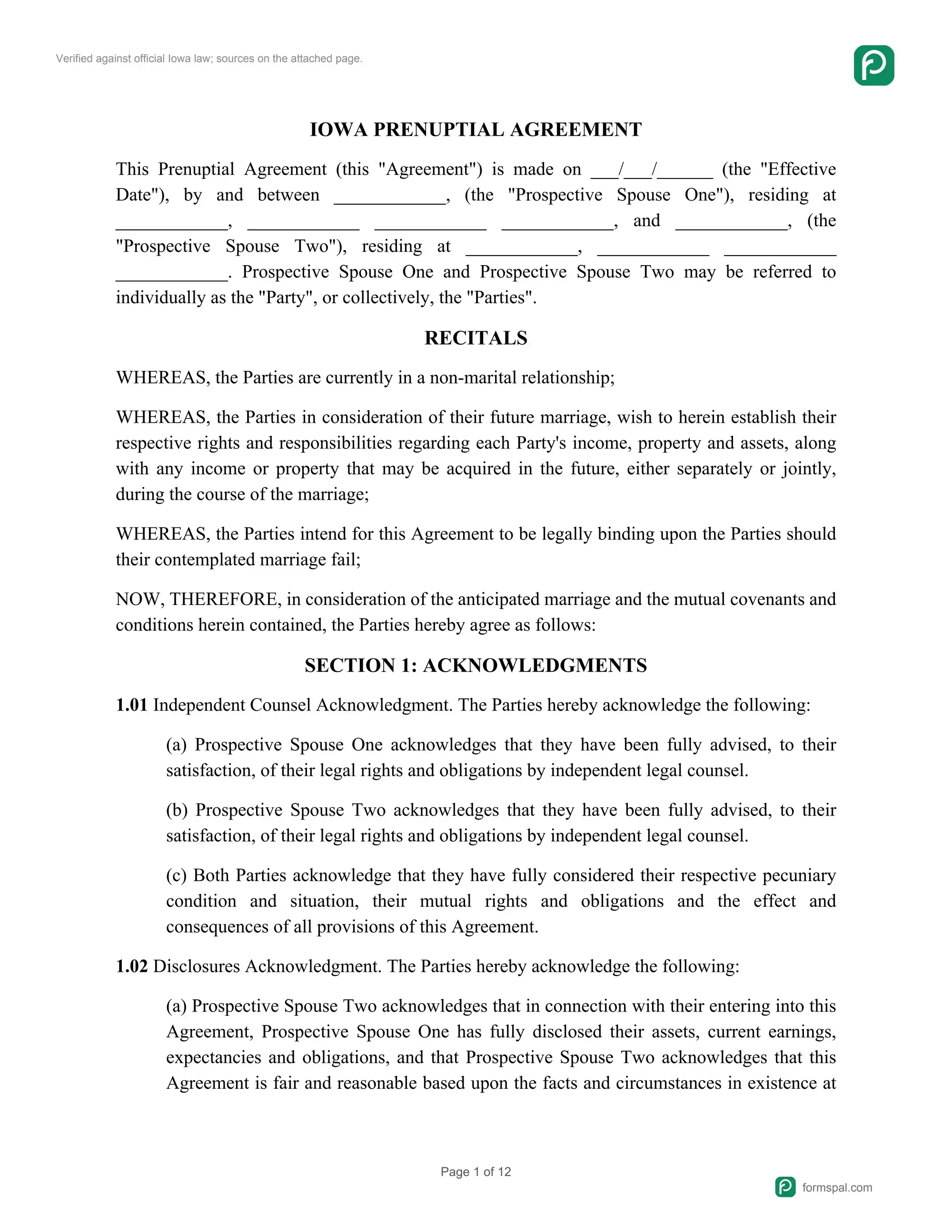
An Iowa prenuptial agreement is a written contract signed before the wedding that sets out the property and financial rights each spouse will have once the marriage begins.[1.1] Chapter 596 of the Iowa Code governs it. The contract has to be in writing and signed by both prospective spouses.[1.2] It takes effect on the day the couple marries.[1.4]
Last Updated: September 2026. This guide is reviewed and updated regularly to reflect current Iowa law. If you notice an error or outdated information, please contact us.
Build Your Document
Answer a few simple questions to make your document in minutes
Save and Print
Save progress and finish on any device, download and print anytime
Sign and Use
Your valid, lawyer-approved document is ready
A prenup can settle who owns what, how each asset is managed during the marriage, and where property goes on separation, divorce, or death. It cannot adversely affect a spouse's or a child's right to support, and no term may violate public policy or a statute imposing a criminal penalty.[1.3]
Chapter 596 of the Iowa Code holds every rule that governs premarital agreements in this state. It sets out what the document must look like to be valid and when it starts to bind the couple. It also lists what a prenup can decide and the narrow grounds for refusing to enforce one. The chapter applies to every premarital agreement signed on or after January 1, 1992.[1.10]
Section 596.4 of the Iowa Code sets the form rules for an Iowa prenup.
Notarization is not on that list, and neither is a witness. In practice, many Iowa couples still sign in front of a notary so that neither signature is easy to dispute later.
A premarital agreement becomes effective upon the marriage of the parties.[1.4] Sign it a year before the wedding and it still sits idle until the ceremony. If the wedding never happens, the prenup never starts.
A void marriage is handled differently. If a court determines the marriage to be void, an agreement that would otherwise have been a premarital agreement is enforceable only to the extent necessary to avoid an inequitable result.[1.8]
Both spouses can undo the prenup after the wedding by signing a written agreement that revokes it. The revocation is enforceable without consideration.[1.5]
One spouse acting alone has a harder job. Section 596.7 puts the burden on the person seeking revocation. That person must prove either that they did not execute the agreement voluntarily, or that the agreement was unconscionable when it was executed.[1.5]
Section 596.5 of the Iowa Code lists what a premarital agreement may decide, and the list is wide. It reaches every kind of property either partner owns or later acquires, how that property is handled during the marriage, and where it goes on separation, divorce, or death.[1.3] Two limits sit outside the couple's control, and no clause can get around them.
An Iowa prenup can settle any of the following.
In practice that reaches a home one partner owned before the wedding and a mortgage the couple will carry together. It also reaches a business one partner already runs, retirement savings, and an inheritance either of them expects. If a term asks one of you to make a will, you will need an Iowa last will to carry it out.[1.3]
Two subjects stay off the table. First, the right of a spouse or child to support cannot be adversely affected by a premarital agreement. Second, no term may violate public policy or a statute imposing a criminal penalty.[1.3]
Child custody and parenting time are also outside the agreement. An Iowa court decides those questions on the child's best interest, whatever the couple wrote before the wedding.
Iowa courts enforce premarital agreements, and Chapter 596 gives a spouse only narrow grounds to escape one. Under Section 596.8, the agreement fails if the spouse resisting it proves one of two things. Either they did not execute it voluntarily, or they were denied a fair and reasonable disclosure of the other spouse's property and debts.[1.6]
A court will refuse to enforce the agreement when the spouse resisting it proves either of the following.
Get the financial disclosure right. A spouse who was never given a fair and reasonable picture of the other's assets and debts can defeat the prenup in court years later. The same is true if they could not reasonably have known it.[1.6]
Unconscionability is not a jury question. In any action under Chapter 596 to revoke or enforce a premarital agreement, the court decides the issue of unconscionability as a matter of law.[1.7]
One bad clause does not sink the contract. If a court finds a provision unenforceable, that provision is severed from the rest of the agreement, and the remaining provisions still take effect on their own.[1.6]
Timing runs differently here. Any statute of limitations on a claim under a premarital agreement is tolled during the marriage, so the clock does not run while the couple is married. Equitable defenses that limit the time for enforcement, including laches and estoppel, are still available to either party.[1.9]
Building an Iowa prenup takes four steps. List what each of you owns and owes, agree on how those items will be treated, put the terms in writing, and both sign before the wedding. Section 596.4 sets the form requirements and Section 596.5 sets the range of subjects you can settle.
Our prenuptial agreement builder fills the Iowa template for you, and the download links at the top of this page give you the blank form. If your finances are complicated, an Iowa family law attorney can review the terms before either of you signs.
An Iowa prenuptial agreement is a contract between two people who plan to marry. It is written and signed before the wedding, and it fixes the property and financial terms of the marriage in advance.[1.1] The document carries no legal force until the couple actually marries.[1.4] Chapter 596 of the Iowa Code runs from section 596.1 to section 596.12, and it opens by defining the document itself.[1.10]
"Premarital agreement" means an agreement between prospective spouses made in contemplation of marriage and to be effective upon marriage.
If you are already married, this is not the document you need. An agreement signed after the wedding is a postnuptial agreement, which is a separate contract with its own rules.

