
Updated:
An owner financing contract is a property sale agreement with seller financing. The buyer repays the seller in installments with interest, instead of borrowing the price from a bank. The template suits home sellers and buyers, especially when a mortgage is out of reach.
Fill it in online with the form below, then download it as a PDF or Word file, print it and sign it.
An owner financing contract is an agreement in which the seller of a home or other real estate lends the buyer part of the price and the buyer repays the seller over time. The seller finances all or part of the price, sometimes alongside a bank loan that holds the first mortgage.
The contract sets the price, the down payment, the interest rate, the loan length and what happens if a payment is late. It works as an addendum to a real estate purchase contract, so it sits next to the main real estate purchase agreement and adds the financing terms to it.
A seller commonly establishes a higher interest rate than financial institutions’ mortgage rates. Buyers who have credit problems or income that is hard to prove are good candidates for owner loans. Self-employed buyers and buyers with a new business often fit this group.
The example below shows how an owner financed home sale can look on paper.
Example: a seller lists a home for $300,000. A self-employed artist who cannot qualify for a bank mortgage makes a full-price offer and asks the seller to finance it with 15% ($45,000) down. The seller owns the home free of any mortgage and accepts, and the buyer signs a mortgage note.
These figures are made up for the example and are not market rates.
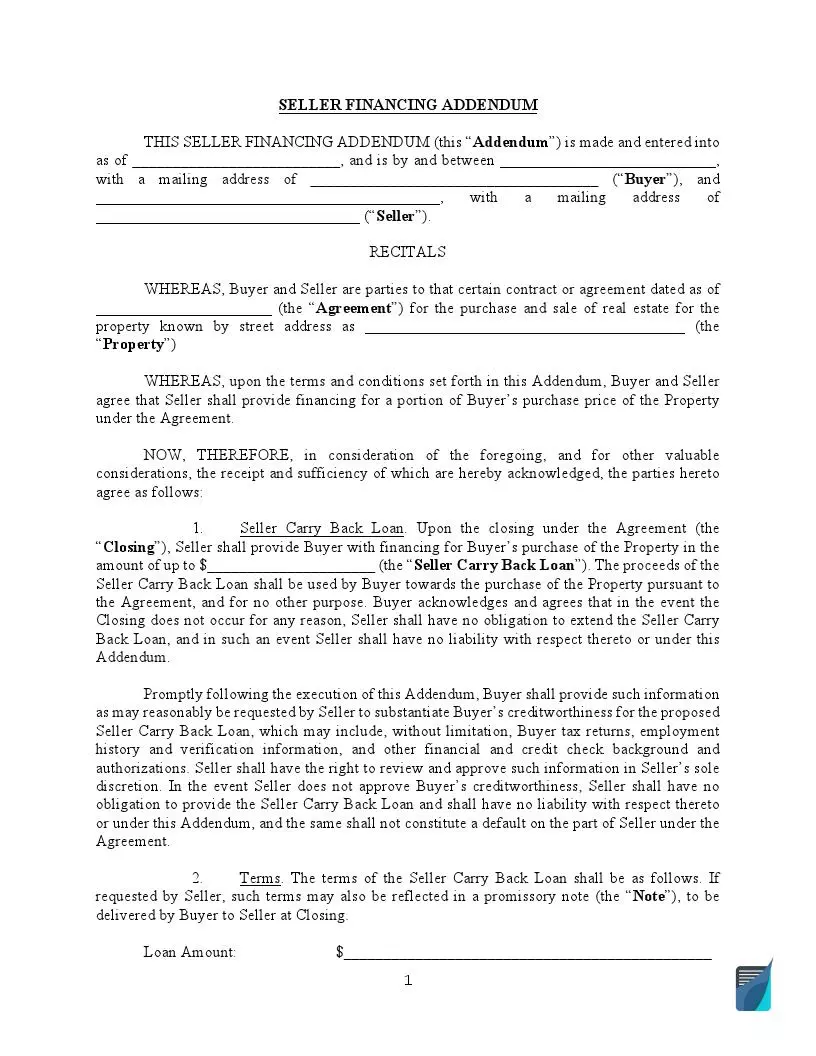
An owner financing addendum adds seller financing terms to a purchase agreement the buyer and seller have already drafted. Use it when the sale terms are settled and only the loan terms are left to put in writing.
The addendum covers the loan: the amount financed, the rate, the payment schedule, taxes, insurance, early payment and late payment. The purchase agreement covers the sale itself: the property, the price, the closing date and the condition of the home. Together they form the full owner finance real estate contract.
A separate document, the promissory note, holds the buyer's promise to repay. Our template attaches one, so the buyer signs the note together with the addendum.
Some areas have their own seller financing addendum forms. For a sale in North Carolina, Texas or Utah, see the versions linked above this article, such as our TREC seller financing addendum. If you prefer a blank document to fill in by hand, open the owner financing contract PDF.
Seller financing comes in four common types, and each fits a different home-buying need. They differ in who sets the loan terms, whether the buyer already has a mortgage and who holds the title until the last payment.
This template is built for seller-held financing and junior mortgages, where the buyer receives the property at closing and repays the seller under a promissory note secured by a mortgage or a deed of trust on the property.
An owner finance agreement includes the parties, the property, the price, the down payment, the interest rate, the loan length and the type of repayment. The four loan terms below shape the monthly payment and the way the loan ends.
The buyer signs a mortgage or a deed of trust that pledges the property as security for the promissory note. If the buyer stops paying, this document lets the seller act against the property, not only against the buyer.
After closing, the seller sends the signed mortgage or deed of trust to the county office that keeps land deeds, so anyone who searches the property sees the seller's claim on it.
The loan length is the period over which the buyer repays the seller, and the seller and buyer agree on it. A short term with a balloon payment lets the seller get the money back sooner, while a long term keeps each payment smaller.
The down payment is the money the buyer pays upfront, and it is applied toward the purchase price. The rest of the price is the amount the seller finances. A larger down payment lowers the seller's risk and the buyer's monthly payment.
The interest rate is the yearly charge on the financed amount, and owner financed loans usually carry a higher rate than bank loans. The seller takes on the risk of late payment and default, and the rate reflects that risk.
Check the usury limit that applies where the property sits before you set the rate.
The agreement names one of four repayment types, and each one changes how the balance falls over time.
To fill out the owner financing contract template, select Create My Document, answer the questions in the builder and download the finished contract. The steps below follow the sections of the contract in order.
Have these details ready before you start:
Start with the name of the contract and its date. Then add the names, addresses, and contact numbers of both parties.
Add the legal description of the property, copied from the current deed, so the contract points to one parcel only.
Enter the price at which the buyer agrees to buy the property.
Enter the interest rate that applies to the financed amount each year.
Set the number of days the buyer has to give the seller credit, employment and other financial information. The seller uses it to decide whether to go ahead with the loan.
Pick the type of financing the seller offers: a balloon mortgage, a fixed-rate mortgage, an adjustable-rate mortgage or an interest-only mortgage. Then fill in the details of the chosen option, such as the payment amount and the payment dates.
Say whether property taxes and liability insurance are escrowed. If they are not, give the number of days the buyer has to show the seller proof of payment.
Indicate whether or not a penalty will be imposed on the buyer in case they make an early payment before the last payment date.
Federal and local rules for home loans can bar or cap a prepayment penalty, so check the rules where the property sits before you choose one.
Say what happens if the buyer pays late. For example, the contract can make the whole balance due once a payment is a set number of days late, and only after any written notice of default and time to catch up that the rules where the property sits give a buyer of a home. A contract term cannot always take that notice away, so check the local rules before relying on this clause.
Have a mortgage or a deed of trust prepared that pledges the property as security for the promissory note, for the buyer to sign at closing. The seller then sends it to the county office that keeps land deeds.
Add a clause that any change to the contract is valid only if it is in writing and signed by both parties.
Here, indicate which state’s laws will apply to this contract.
The signatures, names, and dates of both parties should finalize the contract. Each party keeps a signed copy.
The attached promissory note holds the buyer's promise to pay the seller the agreed amount at the agreed yearly interest rate. In the note, the buyer is the borrower and the seller is the lender.
The promissory note should also include the repayment terms: the number of installments, how often they are paid, and the date of the first payment. Other information to include in the note is counterparts, agreement modifications, non-waiver provision, and the governing law. The promissory note should be signed by the borrower.
A contract for the sale of land has to be in writing and signed to be enforced in Alabama (Ala. Code § 8-9-2), Massachusetts (Mass. Gen. Laws ch. 259, § 1) and Utah (Utah Code § 25-5-3). In West Virginia, W. Va. Code § 36-1-3 covers only a contract for the sale of land, or the lease of land for more than one year: such a contract is enforceable only if it, or a note or memorandum of it, is in writing and signed by the party to be charged or that party's agent. Each code words the rule, and its exceptions, a little differently.
| Where | Rule for a contract for the sale of land | Citation |
|---|---|---|
| Alabama | Void unless the contract, or a note or memorandum of it stating the consideration, is in writing and signed by the party to be charged or an agent authorized in writing; this does not apply if the buyer has paid all or part of the price and the seller has put the buyer in possession of the land | Ala. Code § 8-9-2 |
| Massachusetts | No action on the contract unless it, or a memorandum or note of it, is in writing and signed by the party to be charged or a person that party lawfully authorized | Mass. Gen. Laws ch. 259, § 1 |
| Utah | Void unless the contract, or a note or memorandum of it, is in writing and signed by the seller or the seller's agent authorized in writing | Utah Code § 25-5-3 |
| West Virginia | For a contract for the sale of land, or the lease of land for more than one year: not enforceable unless the contract, or a note or memorandum of it, is in writing and signed by the party to be charged or that party's agent | W. Va. Code § 36-1-3 |
The table lists only the codes our sources hold, so a missing row means no data here, not the absence of a rule. Our template is a written contract with signature lines for both parties.
The disclosure codes below cover home sales in general, not owner financed sales alone, and they reach an owner financed sale that falls within their terms. Many state codes require the seller of a home to give the buyer a written disclosure for the sales they cover, each with its own exemptions, for example Cal. Civ. Code § 1102.3, Va. Code Ann. § 55.1-703 and Wash. Rev. Code § 64.06.020. The table below is a selection, not a full list: the codes that name installment land contracts, which fit owner financed sales, plus Connecticut, Florida and Texas. The District of Columbia, Maine, Michigan, Ohio and South Carolina codes name installment land contracts (D.C. Code § 42-1301; Me. Rev. Stat. tit. 33, § 172; Mich. Comp. Laws § 565.952; Ohio Rev. Code Ann. § 5302.30; S.C. Code Ann. § 27-50-20).
| Where | What the seller gives the buyer | When | Citation |
|---|---|---|---|
| Connecticut | A written residential condition report, when the seller offers residential property for sale, exchange or lease with option to buy | Before the buyer signs any binder, contract to purchase, option or lease with a purchase option | Conn. Gen. Stat. § 20-327b(a) |
| District of Columbia | A real property disclosure statement on a form approved by the Mayor, for 1 to 4 residential units sold by sale, exchange, installment land contract or lease with an option to purchase, only where the buyer expresses, in writing, an intent to reside in the property, and except exempt transfers such as court-ordered transfers | In a sale, before or at the time the buyer signs the purchase agreement; if it comes after the buyer signs a purchase agreement, installment sales contract or lease with option, the buyer may terminate by written notice within 5 calendar days after receipt, and deposits are returned | D.C. Code § 42-1301; D.C. Code § 42-1302 |
| Florida | A flood disclosure for residential real property, and an ad valorem tax disclosure summary for residential property; unless a substantially similar summary is in the contract, a separate summary is attached to it | At or before the time the sales contract is executed | Fla. Stat. 689.302; Fla. Stat. 689.261 |
| Maine | A property disclosure statement from the seller of residential real property, unless the transaction is exempt under section 172; the rules cover transfers by sale, exchange, installment land contract, lease with an option to purchase or any other option to purchase | Not stated in our sources | Me. Rev. Stat. tit. 33, § 172; Me. Rev. Stat. tit. 33, § 173 |
| Michigan | A seller's disclosure statement on the statutory form, for 1 to 4 residential units transferred by sale, exchange, installment land contract, lease with an option to purchase or any other option to purchase, except exempt transfers such as court-ordered transfers | In a sale, before the seller signs a binding purchase agreement; failure to provide a signed statement enables the buyer to terminate an otherwise binding purchase agreement | Mich. Comp. Laws § 565.952; Mich. Comp. Laws § 565.953; Mich. Comp. Laws § 565.954(1); Mich. Comp. Laws § 565.957 |
| Ohio | A signed and dated copy of the completed property disclosure form, for residential real property transferred by sale, land installment contract, lease with option to purchase or exchange, except the transfers the section exempts, such as court-ordered transfers | As soon as is practicable | Ohio Rev. Code Ann. § 5302.30 |
| South Carolina | A written disclosure statement, for 1 to 4 dwelling units transferred by sale, exchange, installment land sales contract or lease with an option to purchase, except transactions exempted under S.C. Code Ann. § 27-50-30 | Before the buyer and owner sign the contract, or as otherwise agreed in it | S.C. Code Ann. § 27-50-20; S.C. Code Ann. § 27-50-40; S.C. Code Ann. § 27-50-50 |
| Texas | A written seller's disclosure notice, for residential real property of not more than one dwelling unit, except exempt transfers such as court-ordered or foreclosure sales | On or before the effective date of an executory contract binding the buyer to purchase | Tex. Prop. Code § 5.008 |
A Texas seller of residential real property of not more than one dwelling unit gives the buyer a written seller's disclosure notice, under Tex. Prop. Code § 5.008. The notice is delivered on or before the effective date of an executory contract binding the buyer to purchase (Tex. Prop. Code § 5.008). If the contract is entered without the notice, the buyer may terminate it for any reason within seven days after receiving the notice, under Tex. Prop. Code § 5.008. The full text of Tex. Prop. Code § 5.008 is on the Texas Legislature site.
For a Texas sale, our TREC seller financing addendum is the Texas version of this document.
A Florida seller gives the buyer of residential real property a flood disclosure at or before the time the sales contract is executed, under Fla. Stat. 689.302. The buyer of residential property also receives an ad valorem tax disclosure summary at or before execution of the contract for sale, under Fla. Stat. 689.261. Unless a substantially similar summary is in the contract, a separate summary is attached to it (Fla. Stat. 689.261, Florida Senate text).
In Ohio, the disclosure form applies to transfers by land installment contract as well as by sale, except the transfers the section exempts (Ohio Rev. Code Ann. § 5302.30, Ohio Revised Code text).
Seller financing gives buyers a path to a home without a bank mortgage and gives sellers interest income and a faster sale. Each side also takes on risks, so it helps to weigh both before you agree to the terms.
Buyers get several benefits from a seller-financed mortgage, but there are also complications to weigh.
A specific proposal works better than a general question. For example: “I offer to split the purchase price in down payment at X percent, owner financing for $XXX,XXX at X percent, amortized over X years with an X-year balloon loan.”
For sellers who are considering financing the sale of real property, here are some pros and cons:
A balloon payment is a single large payment at the end of the loan. The buyer makes smaller regular payments first, then pays off the remaining balance when the term ends.
An owner financing loan lasts as long as the seller and the buyer agree, and the contract sets the term. Many sellers prefer a short term with a balloon payment, while a longer term keeps each payment smaller.
The late payment clause of the owner financing contract decides what happens when the buyer misses a payment. It can, for example, make the whole remaining balance due once a payment is a set number of days late, after any written notice of default and time to catch up that the rules where the property sits give a buyer of a home. Check the local rules before relying on this clause.
No, this owner finance contract is built for real property, not vehicles. For a car sold on payments, use a bill of sale for the sale and a promissory note for the payment terms.
Select Create My Document, answer the questions in the online builder and save the result. You can then download the contract in PDF or Word, print it and sign it. If you prefer the PDF, fill it in with the online PDF editor.
Many buyers and sellers ask an attorney to read the contract before they sign it. A second pair of eyes can catch missing details and unclear wording.
General information, not legal or tax advice.
