
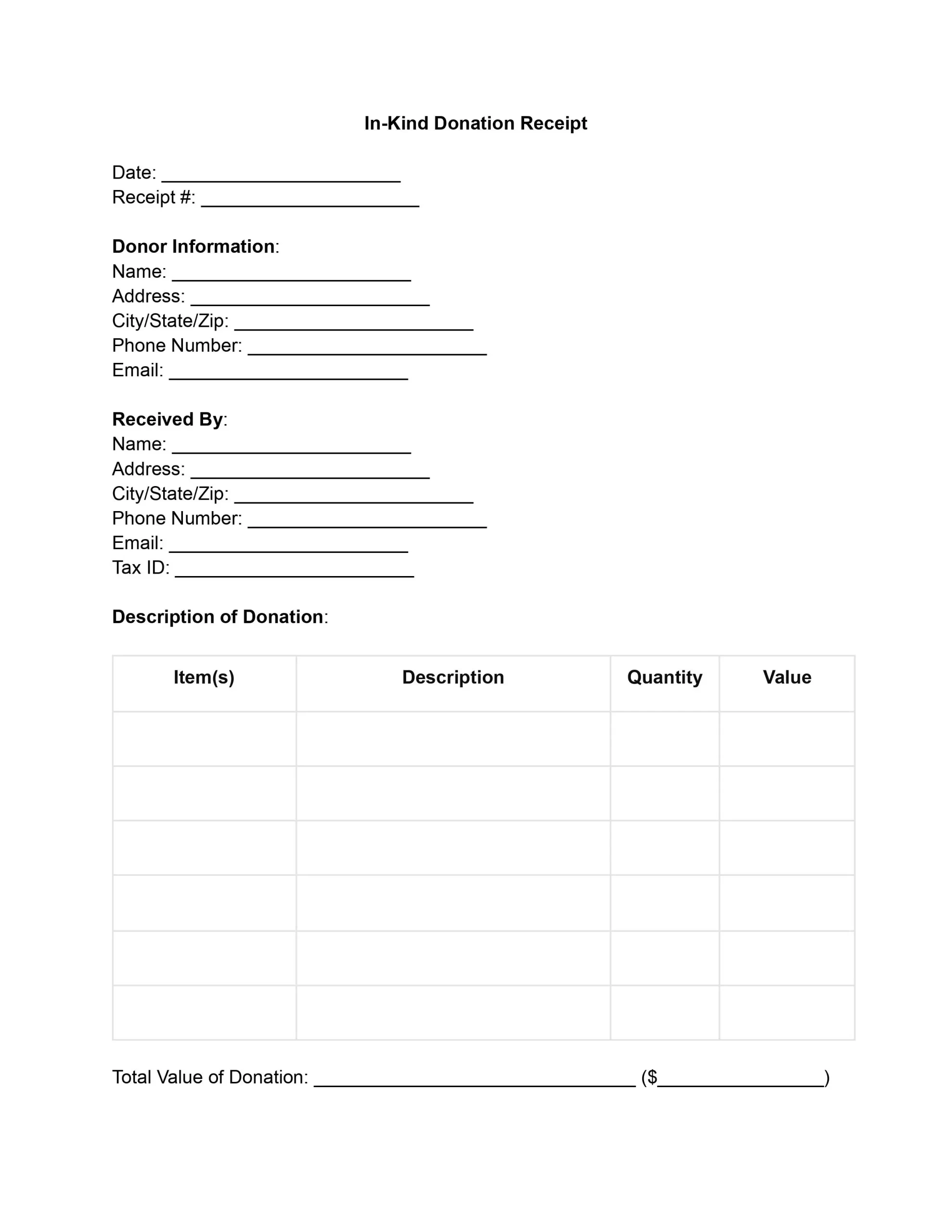
An in kind donation receipt template is a simple form a nonprofit fills in to thank a donor and record a gift of goods or services instead of cash. In kind donations are invaluable support for nonprofit organizations. Unlike monetary contributions, they consist of goods and services that directly benefit the organization, from office supplies and furniture to professional services and software.
Last Updated: October 2026. This guide is reviewed and updated regularly to reflect current law. If you notice an error or outdated information, please contact us.
An in kind donation receipt letter is a document nonprofit organizations provide to donors who contribute goods or services instead of cash. This receipt serves several functions for both the donor and the recipient organization. It recognizes the donor’s generosity, keeps a record of both parties’ contributions, and is essential in the financial and tax reporting processes related to charitable giving. A gift in kind receipt template includes several elements:
An in kind receipt provides a tangible record of donor contribution, which can be used for tax deduction purposes under IRS regulations. These receipts also help nonprofits maintain accurate records of contributions received, aiding in financial reporting, budgeting, and planning.
Fill in the template from top to bottom, one field at a time, and keep each entry short and specific. By following these steps, you can ensure that the donation receipt is completed accurately and thoroughly, reflects the value of the contribution, and meets legal requirements for tax documentation.
Have these details ready before you start:
Record the exact date when the donation was received. This date is crucial for both the donor’s and the organization’s records, especially for tax purposes. Write the month as a word, such as March 15, so nobody mixes up the day and the month.
Include the donor’s full name, address, and, if applicable, contact number or email address. It ensures the donation can be accurately attributed and allows for proper acknowledgment. Copy the details the way the donor writes them, and ask if you are unsure of a spelling.
Document the name of your nonprofit organization, its contact information, tax-exempt status, and tax ID number. This information reassures donors of the legitimacy of their donation and aids in their tax preparation. Save this block as a header so you do not have to retype it for every receipt.
Provide a detailed description of the items or services donated. For physical goods, list the items and their condition. For services, describe the nature of the service provided and the time spent. Avoid vague entries such as misc. items, and give each type of item its own line with a count.
While the donor is typically responsible for determining the fair market value of the donated goods or services for tax purposes, the receipt can note this estimated value if the donor provides it. Be clear that it is an estimate and not an official appraisal. Write the amount as a single figure, such as $450, next to the words donor’s estimate.
An authorized representative of the nonprofit organization should sign the receipt. It formalizes the document and adds a level of verification. Print the signer’s title under the signature and add the date it was signed.
A completed in kind donation receipt lists who gave, who received, what was given, and who signed. Use these made-up entries as a pattern, then swap in the details of your own donor and gift.
| Field | Example entry |
|---|---|
| Receipt number | IK-0001 |
| Date of donation | March 15 |
| Donor | Anna Baker, 123 Main Street, Springfield |
| Organization | Maple Street Food Pantry, tax ID 00-0000000 |
| Description | 12 office chairs (used, good condition) and 2 folding tables (like new) |
| Donor’s estimated value | $450 (donor’s estimate, not an appraisal) |
| Signed by | Jordan Lee, Volunteer Coordinator, March 15 |
Close the receipt with a short thank-you line, such as: Thank you for your generous gift of furniture. Your support helps us serve more families in our community.
Short, plain wording works best in the description field. Copy one of these two samples, then change the items, counts, names and dates to match your gift, and read the result once more before you sign.
Received from Anna Baker on March 15: 12 office chairs, used, good condition, and 2 folding tables, like new. Donor’s estimate: $450.
Received from Sam Rivera: 8 hours of website design work, completed between April 3 and April 10. The work included a new home page and a contact form.
Good wording does three things:
A good description tells the reader exactly what was given, how many and in what condition. Use plain words, count the items, and describe work by its kind and the time spent. These examples show how to write each type of gift.
Describe what you received, not what you think it is worth. A plain list of items and time keeps the receipt clear and easy to read.
Any group that accepts gifts of goods or volunteer work can use an in kind donation receipt template. Food pantries, schools, animal shelters, congregations and community theaters all receive donated items, and each group describes its gifts a little differently.
| Organization | Common gifts | Example description |
|---|---|---|
| Food pantry | Canned food, fresh produce, delivery help | 15 cases of canned vegetables, unopened |
| School | Classroom supplies, books, tutoring | 30 boxes of crayons and 20 paperback novels |
| Animal shelter | Blankets, pet food, grooming help | 25 fleece blankets and 10 bags of dog food, 20 lb each |
| Congregation | Furniture, sound equipment, repair work | 1 sound mixer, working order, cables included |
| Community theater | Costumes, props, set building | 10 costumes, adult sizes, clean and ready to wear |
An in kind donation receipt lists what was given, while a cash donation receipt lists how much money arrived. The two documents look alike, but the details you record are different.
| In kind donation | Cash donation | |
|---|---|---|
| What the donor gives | Goods, volunteer work or professional help | Money by check, card or transfer |
| What the receipt lists | Items, counts, condition or hours | The amount received and the date |
| Example entry | 12 office chairs, used, good condition | $450 received by check |
| Best fit for | Furniture, food, clothing, equipment and donated work | Gifts of money of any size |
Keep both kinds of receipts in one folder or shared drive, filed by date, so your donation records stay together and are easy to search.
Make the template look like your own paperwork by adding your logo and contact details at the top. Keep the layout simple so a donor can read the receipt at a glance, whether it is printed or sent as a PDF.
Send the receipt soon after the gift arrives, with a short thank-you note, and keep a copy for your own files. A simple routine keeps every receipt easy to find when a donor asks about it later.
A thank-you note can be as short as this: Thank you for the gift of 12 office chairs. They are already in use in our meeting room, and we appreciate your support.
A receipt confirms what arrived, while a short thank you note tells the donor what the gift means to your group. Sending both in the same envelope or email takes little extra time and helps donors feel noticed. Here is a sample note you can adapt.
Dear Maria, thank you for the 12 boxes of canned food you dropped off on March 3. Your gift will fill our pantry shelves this month and help many neighbors put dinner on the table. Your receipt is attached. With gratitude, Jordan Lee, Volunteer Coordinator.
Receipts are easier to manage when every donor has one tidy record. A simple spreadsheet works well for a small group, and a free donor tool can do the same job as your list of donations grows. Whichever you choose, keep the same columns for every entry.
At the end of each quarter, scan the list for gaps. A donor with a gift on file but no receipt sent is easy to spot when the columns line up, and a quick follow up keeps your donation receipts complete.
Most receipt problems come from small gaps, such as a missing date or a vague item list. A quick check before you send each receipt catches them. Look for these mistakes first.
Read each receipt twice before you send it, once for names and dates and once for item counts and the signature.
An in kind receipt covers gifts of goods and volunteer work. For gifts of money, a standard donation receipt template is the better fit, and some types of gifts have their own wording. Pick the receipt that matches the gift you are recording.
An in kind donation is a gift of goods or services instead of money. Examples include furniture, food, equipment, software and professional work given free of charge. The receipt records what was given in place of a cash amount.
A complete receipt has these parts:
Yes. Save the completed receipt as a PDF, attach it to a short thank-you message, and keep a copy for your own files.
State the kind of work and the time given, such as 6 hours of bookkeeping help. Keep the description short and factual.
Give the original to the donor and keep a copy with your donation records. Filing copies by date or receipt number makes them easy to find.
The nonprofit usually fills in and signs the receipt, using the details the donor provides. Donors can help by sending a list of what they gave and the date it arrived.
Use one receipt per gift, or one receipt that lists several items from the same donor on the same day. Separate receipts for separate gifts keep the records easy to follow.
List the items clearly and leave the value line empty. If the donor sends a figure later, you can issue a new receipt that includes it.
General information, not legal or tax advice.
