
The Utah firearm bill of sale is a document that records a private gun sale between two Utah residents. It names the seller and the buyer, describes the firearm by make, model, caliber and serial number, and shows the price on the day of the sale. The completed free bill of sale has to be notarized.
Last Updated: October 2026. This guide is reviewed and updated regularly to reflect current law. If you notice an error or outdated information, please contact us.
Build Your Document
Answer a few simple questions to make your document in minutes
Save and Print
Save progress and finish on any device, download and print anytime
Sign and Use
Your valid, lawyer-approved document is ready
The gun laws of Utah are democratic, allowing all citizens to acquire, store, and carry firearms. Under Utah legislation, an individual should not file an official application for a firearm permit to buy a gun. Thus, a bill of sale completed between the seller and buyer serves as their mutual guarantee and a track record of firearm’s change of ownership.
Gun dealers and shops specializing in firearm sales have to seek the Public Safety Bureau of Criminal Identification (BCI) approval for the operation. These dealers also need to conduct a background check for every buyer coming to obtain a firearm from them. The background check fee is charged from the buyer, equaling $7.50.
Because no specialized documentation package is required for registering a gun in Utah, the buyer and seller need to complete the Utah firearm bill of sale correctly to have their transaction notarized and legally recorded. The bill of sale should include:
The buyer signing the bill of sale automatically agrees to get the item in the “as-is” state with no warranty suggested by the seller. The sale of a firearm also suggests its precautionary inspection at a qualified gunsmith to verify its working order and avoid any traumas and damages. After the bill of sale is signed, any damage caused by the sold firearm is beyond the seller’s scope of responsibility.
Though there is no special firearm legislation in Utah, all buyers and sellers should comply with the Federal Law statutes suggesting that a firearm transaction may take place only between two residents of Utah. A gun owner from Utah thus can’t sell a gun to a resident of another state, even if there are lax gun laws as well.
Private gun transfers via a local FFL are allowed since March 2013 in Utah, with no waiting periods for the background checks.
| Subject | Long Guns | Hand Guns |
| Registration of a Firearm | Not required | Not required |
| Permit to Purchase | Not required | Not required |
| Concealed Weapons Permit Fee | $53.25 for residents and $63.25 for non-residents | |
| Background Check for Private Sales | Not required | Not required |
| Persons Prohibited from Carrying Firearms | Utah Code, Section 76-10-503 | |
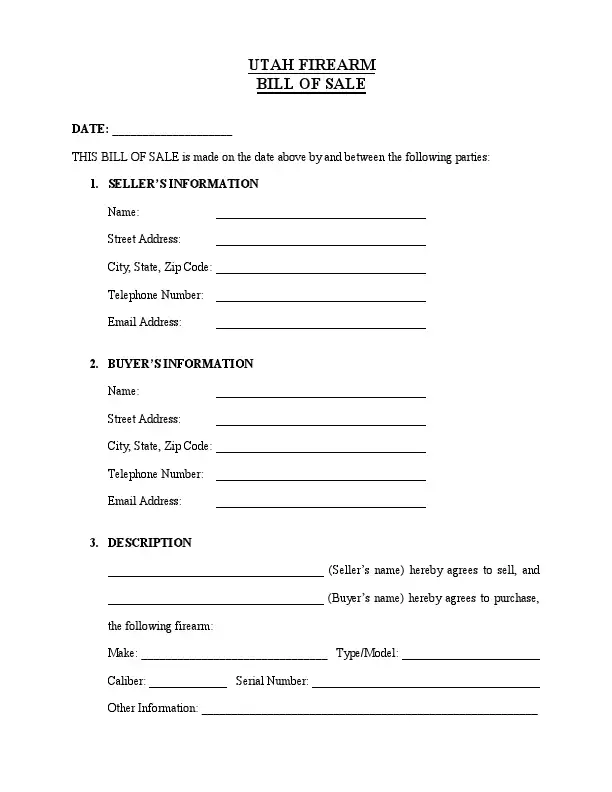
The FormsPal template runs to five pages and has seven numbered sections plus a notary page. Knowing what each part holds makes the form quicker to fill in. It also helps the seller and the buyer see what they are agreeing to before anyone signs.
Sections 1 and 2 collect contact details for the seller and the buyer. Section 3 names both people and describes the gun by make, type or model, caliber and serial number, with a line for any other information.
Section 4 records the purchase date, the total price and how it is paid. It offers four ways to describe the sale:
Payment can be marked as cash, check, cashier's check or money order.
Section 5 lists statements that the seller and the buyer each agree are true, with a signature line under each list. Section 6 holds the miscellaneous provisions, including the as-is wording and a line saying the document is the only agreement between the two sides.
Section 7 has date, signature and printed name lines for the seller, the buyer and one witness. Page 5 is a notary acknowledgment that is filled in with a notary public present. The Utah notary acknowledgment page has more on that part of the paperwork.
These steps follow the FormsPal Utah firearm bill of sale template that this page offers as a PDF. Go through the form from the top, one part at a time, and enter the details of the seller, the buyer and the firearm on the matching lines. You can fill in the downloaded PDF on screen with the PDF editor, or print it and write by hand.
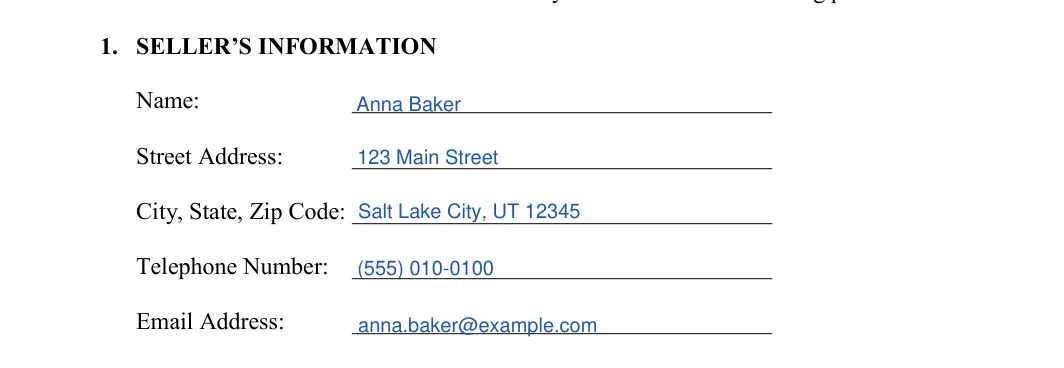
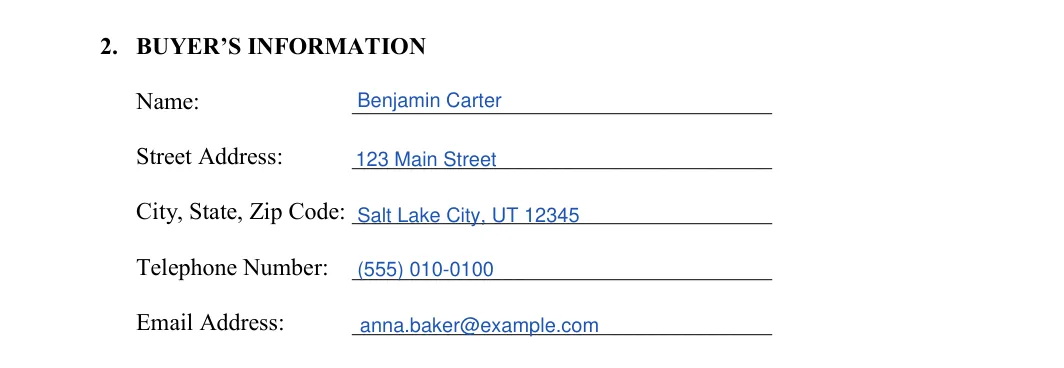
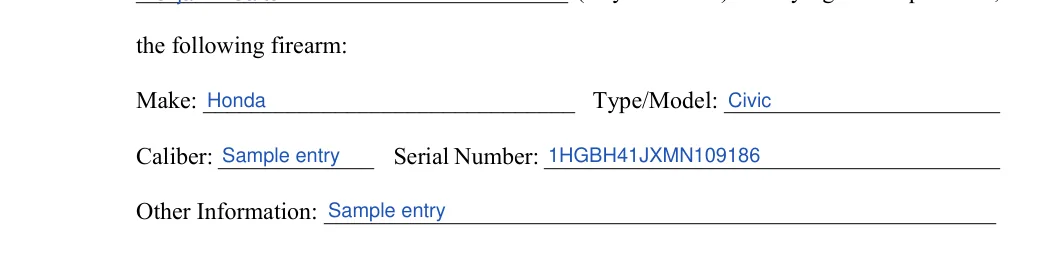
The screenshots under each step show the FormsPal Utah Utah Firearm Bill of Sale template filled with sample entries in blue, so you can see where each answer goes. The names, addresses, dates and amounts are examples only.
Step 1: Date
Write the date of the bill of sale on the DATE line at the top of page 1.

Step 2: Seller's Information
Enter the seller's name, street address, city, state and zip code, telephone number and email address.
Step 3: Buyer's Information
Enter the buyer's name, street address, city, state and zip code, telephone number and email address.
Step 4: Description
Write the seller's name and the buyer's name in the two blanks of the sentence that begins section 3.

Step 5: The Firearm
Fill in Make, Type/Model, Caliber, Serial Number and Other Information for the firearm. Copy the serial number exactly from the firearm.
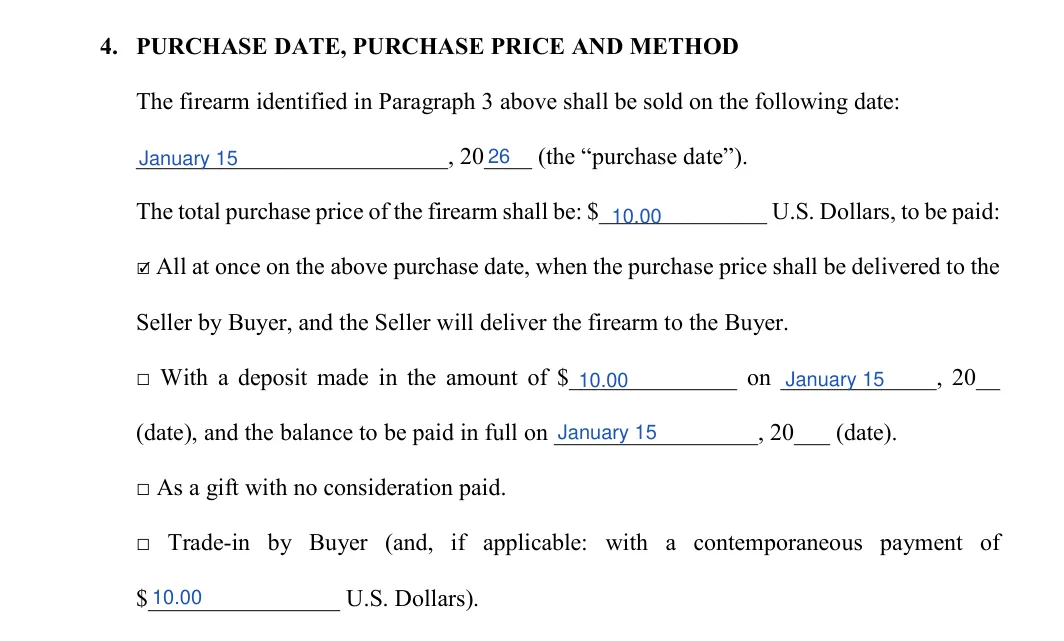
Step 6: Purchase Date, Purchase Price and Method
Enter the purchase date and the total purchase price. Then tick one payment option:
Step 7: Buyer's Firearm
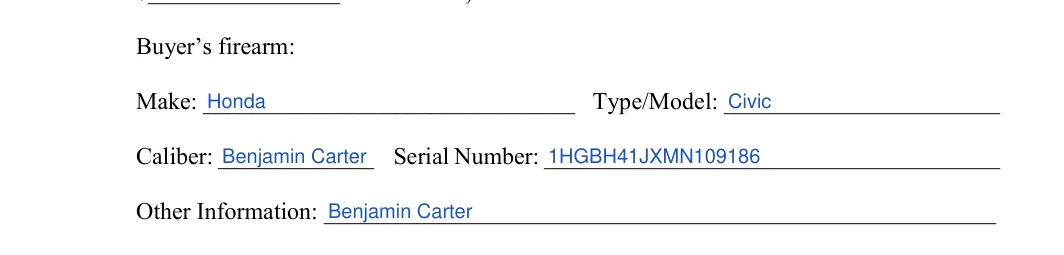
For a trade-in, fill in the Make, Type/Model, Caliber, Serial Number and Other Information of the buyer's firearm. The purchaser’s firearm description must also be contained in the document. Otherwise leave this part blank.
Step 8: Payment Method
Tick one method:

Step 9: Seller's Signature
Read the seller statements in section 5 on pages 2 and 3, then sign on the Seller's Signature line on page 3. Both parties must agree with essential disclosures by placing their signatures below each list respectively.

Step 10: Buyer's Signature
Read the buyer statements on page 3, then sign on the Buyer's Signature line. Section 6 on pages 3 and 4 holds the miscellaneous provisions. The “as-is” part states that the firearm owner provides no warranties and is not responsible for repairs after the transfer.

Step 11: Signatures
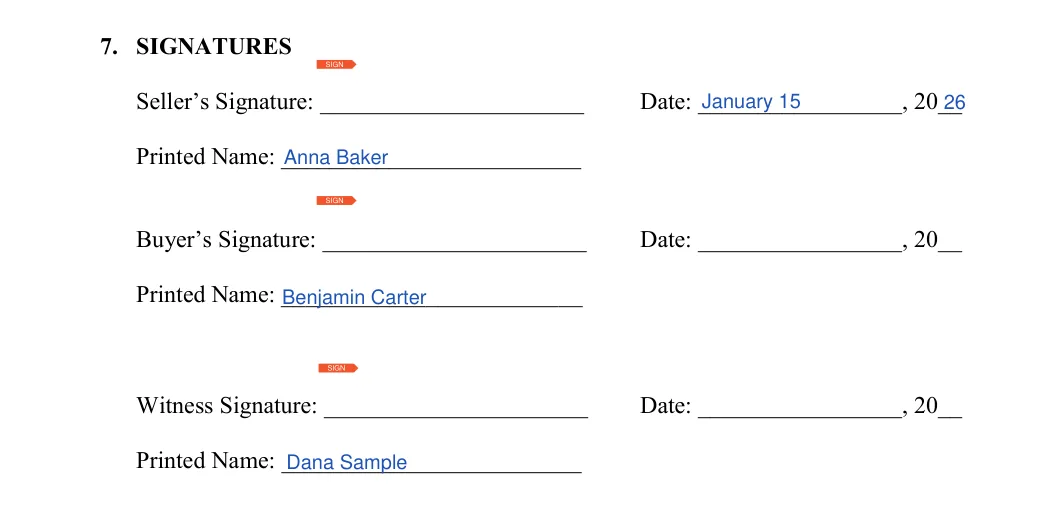
On page 4, date and sign for the seller and the buyer and print each name. The form has one witness line with its own date and printed name. The acknowledgment on page 5 is filled in with a notary public present.
Once every part of the form is filled in, a few steps remain. Check the entries, collect the signatures, add the notary public's part and keep a copy of the signed document. Our firearm bill of sale guide has more tips on using the document.
Looking for other paperwork? Browse more Utah bill of sale forms or read our bill of sale guide before you fill in any form.
A written record shows both sides what was agreed on the day of the sale. It names the people involved, the gun that changed hands and the price that was paid. A few small habits make the finished paperwork easy to read later, for the seller and for the buyer.
Swapping one gun for another? Our even trade bill of sale is a simple option for swaps. You can also browse the notary acknowledgment forms to see how other versions of that page look.
General information, not legal or tax advice.
