
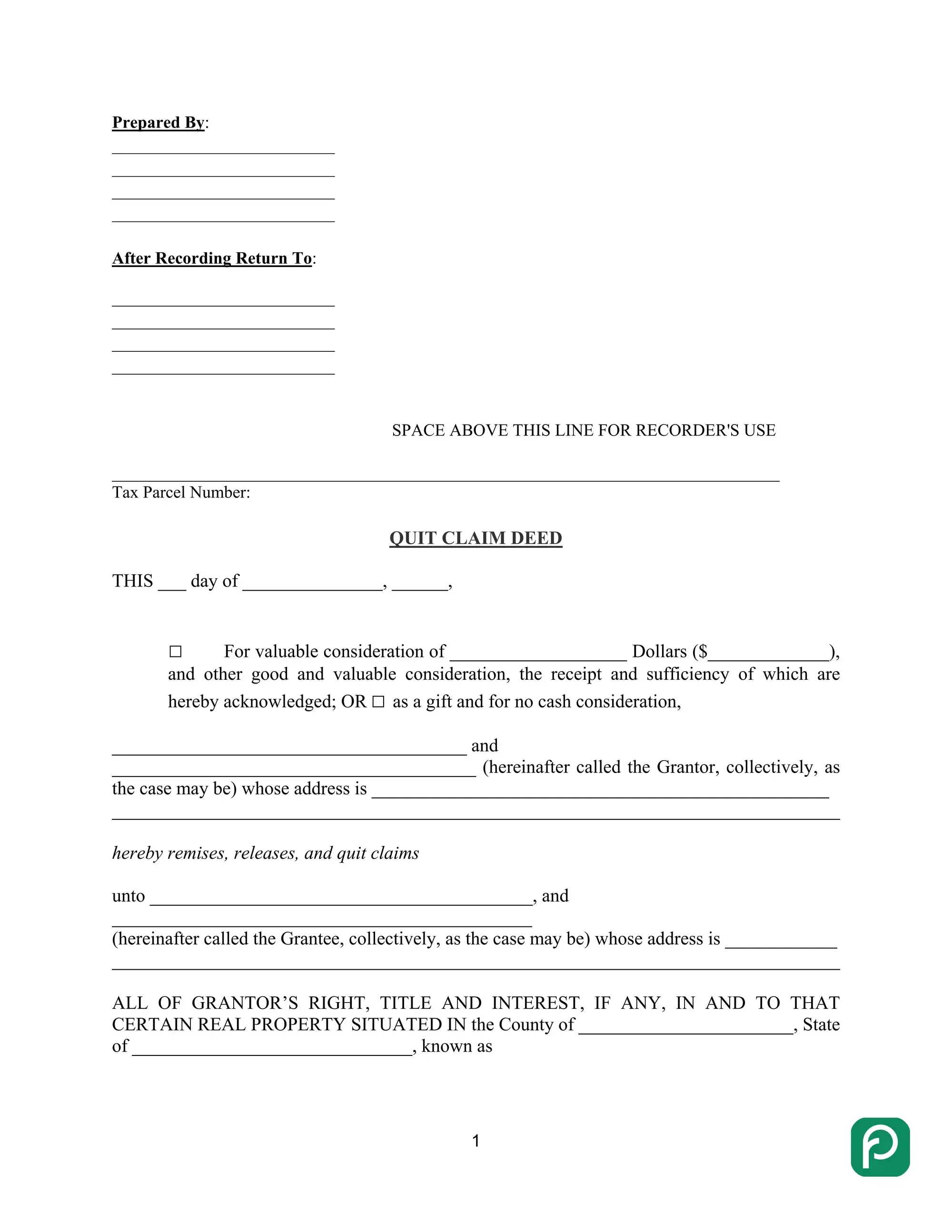
An Arkansas quitclaim deed is a document in which a property owner hands their claim on a property over to another person. Fill in the free fillable deed form below to make yours online, or download it as a PDF or Word file.
Last Updated: October 2026. This guide is reviewed and updated regularly to reflect current law. If you notice an error or outdated information, please contact us.
Build Your Document
Answer a few simple questions to make your document in minutes
Save and Print
Save progress and finish on any device, download and print anytime
Sign and Use
Your valid, lawyer-approved document is ready
A quitclaim deed hands a property owner’s claim on a property over to another person. The word “quitclaim” means the owner quits their claim and passes it on. The person who gives up the claim is the grantor, or seller, and the person who receives it and becomes the new owner is the grantee, or buyer. You can also browse the general quitclaim deed template.
The Arkansas quitclaim deed does not state that the property title is free of encumbrances. Therefore, this form is often used to conclude contracts between people who know each other, friends, or relatives.
You can find more information in Arkansas Code:
Read this part before you set up the signing. According to the Arkansas Code (§ 18-12-104), the quitclaim deed form must be authorized in the presence of a notary public and two disinterested witnesses.
Otherwise, the document is null and void even if it is filled in according to the rules. “Disinterested” means that this person is not in a close relationship with the grantor, has no personal interest in the deal, and is not a grantee.
Another particular feature of the Arkansas quitclaim is that after filling out the document and paying the tax, it must be recorded with the Circuit Court. Only then, the document enters into force, and the transfer of ownership is considered official and legal.
As we noted above, the quitclaim deed form is needed to transfer property rights if the parties are relatives or friends. This is due to the fact that quitclaim does not guarantee the title of the property.
Therefore, through the quitclaim, it is presumably possible to transfer property encumbered with debts or easements, and even real estate for which the so-called “Grantor” has no ownership rights.
The grantee has no protection against any encumbrances, so quitclaim transactions are not made between strangers. The most common examples of using the form are transferring ownership of a house or land to children and changing the property title after getting married or divorced.
The benefit of a quitclaim deed is the speed of the transaction. Arkansas warranty, which is used to transfer rights with a verified title of ownership, takes longer to process. If the parties trust each other and do not need official checks, why not use a quitclaim? Moreover, the form is easy to fill out and does not require any special attachments.
The main thing that distinguishes the Arkansas Quitclaim Deed From other property rights transfer deeds is some wording. Do not use the words “grant,” “bargain,” and “sell” in the quitclaim form because they transform the quitclaim deed into a warranty deed.
When applying, prepare to pay the property tax, which is $3.30 per $1,000 of the transferred real estate value in Arkansas.
The form asks for the names of both parties, a description of the property, and signatures. Follow the eight steps below to fill it in. Keep the property details and the names of both parties nearby before you start.
Start with the names of the grantor and the grantee. Then add the county, the amount, and a full description of the property. The eight steps above walk you through each part in order.
Yes. Download the PDF and complete it with the FormsPal PDF editor, or build the document online and print it when you are done.
The form comes as a PDF, a Word (.docx) file, and an OpenDocument (.odt) file. Pick the one that works with the software you already use.
Keep these items together in a safe place:
General information, not legal or tax advice.

