
A Utah quitclaim deed is a written transfer that passes whatever interest the grantor holds in a property to another person, called the grantee. Under the Utah Code, a quitclaim deed signed as the law requires has the effect of a conveyance of the grantor's right, title, interest and estate at the date of the conveyance.[1.1] Download the free Utah quitclaim deed PDF below, or fill it out online.
Last Updated: October 2026. This guide is reviewed and updated regularly to reflect current Utah law. If you notice an error or outdated information, please contact us.
Build Your Document
Answer a few simple questions to make your document in minutes
Save and Print
Save progress and finish on any device, download and print anytime
Sign and Use
Your valid, lawyer-approved document is ready
A Utah quitclaim deed conveys the grantor's interest in the property it describes. The Utah Code also covers acknowledgment, recording and the legal description that a recorded deed needs. Each rule below is cited in the Sources list. For the general idea behind this type of deed, see our guide to quitclaim deeds.
Section 57-1-13 of the Utah Code gives the effect of a quitclaim deed. The statute's own words are quoted below.[1.1]
A quitclaim deed when executed as required by law shall have the effect of a conveyance of all right, title, interest, and estate of the grantor in and to the premises therein described and all rights, privileges, and appurtenances thereunto belonging, at the date of the conveyance.
In plain words, the deed passes the grantor's interest in the property as of the date of the conveyance. A deed that follows the statutory form is sufficient. An equivalent instrument that makes the transaction plain is not invalid because it lacks the statutory wording.[1.1]
The Utah Code's rule on after-acquired title does not apply to a conveyance by quitclaim deed. By itself, the deed does not pass title that the grantor acquires later.[1.1]
Utah ties recording to acknowledgment. Under Section 57-3-101(1) of the Utah Code, a certificate of acknowledgment that the officer taking the acknowledgment signs and certifies entitles the document to be recorded. The recording happens in the office of the recorder of the county where the real property is located.[1.2]
The form on this page has an acknowledgment block for a notary on page 5. An acknowledgment is the step where the signer confirms the signature before an officer. In practice, that officer is often a notary public. A separate certificate is available in our Utah notary acknowledgement form.
Recording is what protects a deed against later buyers. Under the Utah Code, an instrument that is not recorded as the title provides is void as against a later purchaser of the same property. That holds for the whole property or any part of it, if both of these are true:
That is why people record the signed and acknowledged deed with the county recorder where the property is located.
A recording fee must be paid before the county recorder will record the deed (Utah Code 17-71-407).[3.1]
You may also attach a water rights addendum, on the state-approved form, when you record the deed. The addendum is optional, and it either describes the water rights transferred or states that none are transferred (Utah Code 57-3-109).[2.1]
A document executed after July 1, 2022 is entitled to be recorded only if it contains a legal description of the real property, as the statute requires. Recording is at the county recorder's office where the property is located.[2] A legal description identifies the land itself, not just its street address. The form on this page points to an Exhibit A for the legal description, so prepare that exhibit to go with the deed.
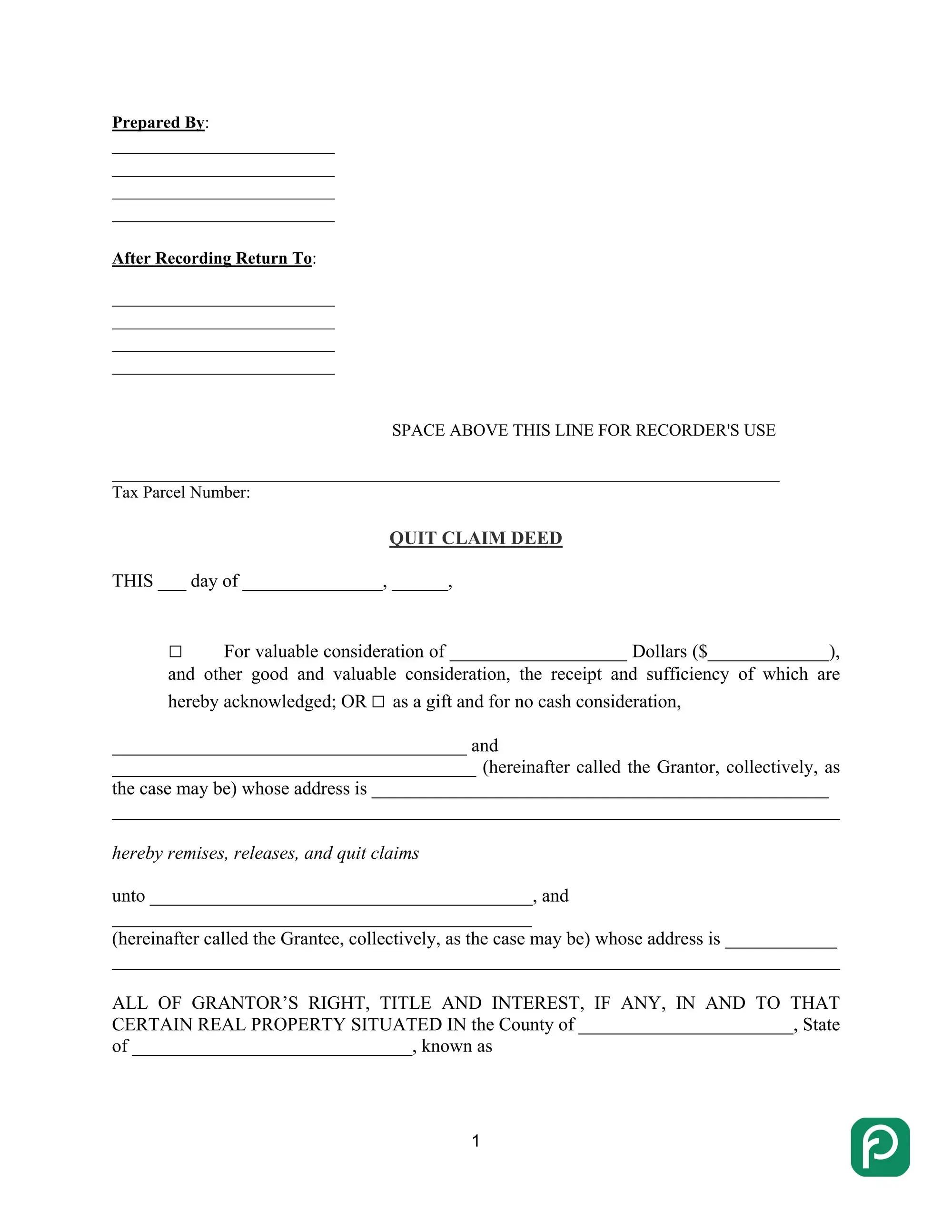
The Utah quitclaim deed form follows a fixed order. You fill in the header blocks, the date, the grantor, the grantee and the property on pages 1 and 2. The grantor signs on page 4, and the acknowledgment is on page 5. Download the PDF and fill it in on screen with our PDF editor, or print it and write by hand.
Keep a copy of the signed deed for your records.
These short answers cover the question people ask most about a Utah quitclaim deed. The answer rests on the Utah Code and points to the source below. For the steps on the form itself, see the how-to section above.
A quitclaim deed is one of several deed forms for transferring real property. In Utah, a quitclaim deed signed as the law requires has the effect of a conveyance. It passes the grantor's right, title, interest and estate in the property described, at the date of the conveyance.[1.1]

General information, not legal or tax advice.
