
This Oklahoma last will and testament template is a written legal document that lets a person who is at least 18 years old and of sound mind direct how their property is distributed after death.[1.1] It also lets you name an executor, also known as a personal representative, to manage your property and carry out your wishes after your death, and to propose a guardian for any minor children.
Making a will helps you avoid disputes among your family after your death, whatever property you own. Oklahoma recognizes a typewritten will, a handwritten (holographic) will, and, in narrow cases, an oral will, but each form has its own signing rules.[1.3]
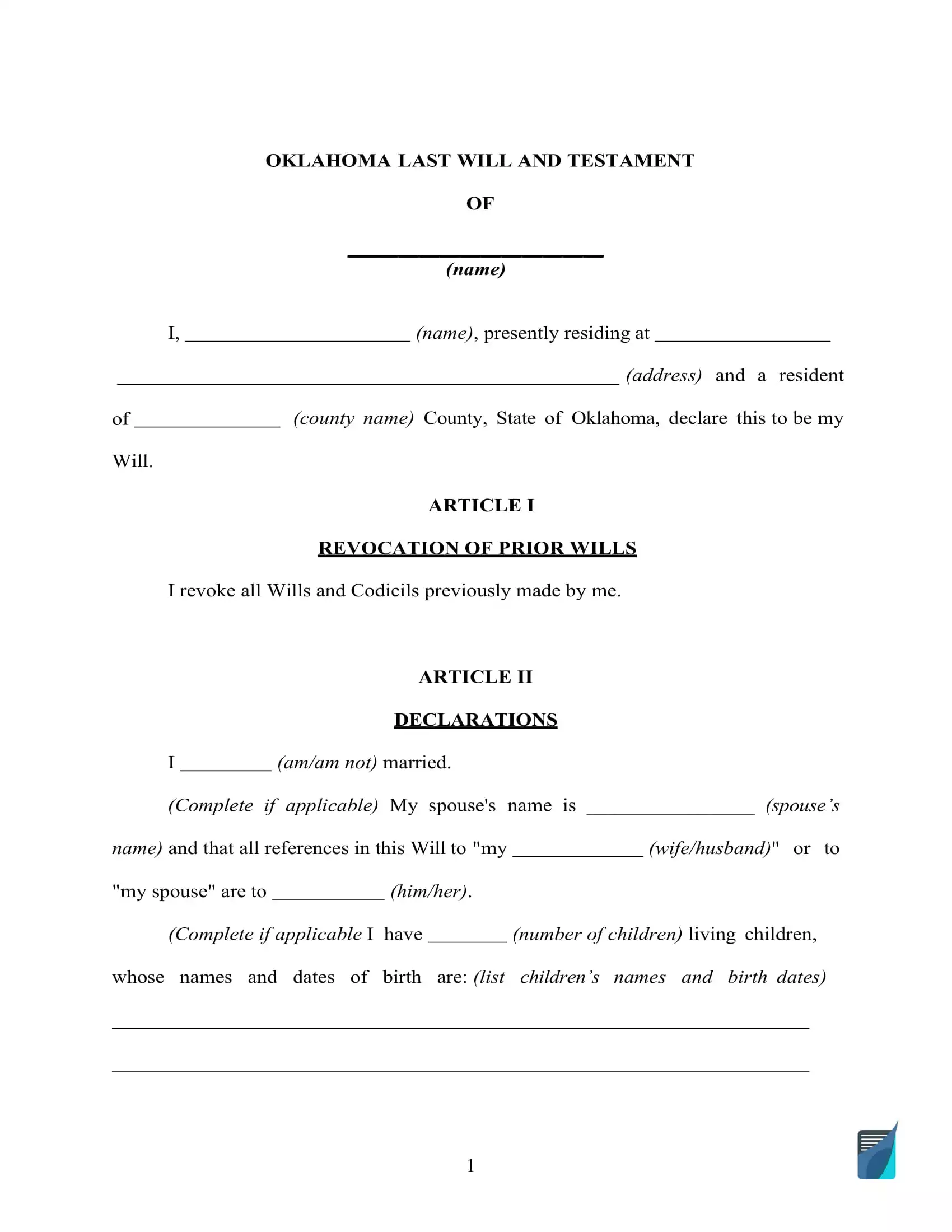
Below, you’ll find an Oklahoma last will and testament form for download and the tips that should solve your possible doubts related to estate planning, kinds of last will, and the way to make a valid document.
Build Your Document
Answer a few simple questions to make your document in minutes
Save and Print
Save progress and finish on any device, download and print anytime
Sign and Use
Your valid, lawyer-approved document is ready
Last Updated: September 2026. This guide for our Oklahoma last will and testament template is reviewed and updated regularly to reflect current Oklahoma law. If you notice an error or outdated information, please contact us.
Oklahoma law sets specific rules for a valid last will under Title 84 Wills and Succession of the Oklahoma Statutes. Meeting these requirements makes your last will and testament legally binding. These rules come from the state's wills and succession laws, and the table below summarizes the statutes behind each rule.
| Requirements | State laws | |
| Statutes | Title 84 – Wills and Succession | |
| Signing requirement | Two witnesses | §84-55. Formal requisites in execution – Self-proved wills |
| Age of testator | 18 or older | §84-41. Persons who may make a will – Persons subject to guardianship or conservatorship |
| Age of witnesses | 18 or older | §84-55. Formal requisites in execution – Self-proved wills |
| Self-proving wills | Allowed | |
| Oral wills | Recognized if meeting certain conditions | §84-46. Nuncupative wills – Requisites |
| Holographic wills | Recognized if meeting certain conditions | §84-54. Holographic wills – Requisites |
| Depositing a will | Optional, for safekeeping during your lifetime | §84-81. Wills deposited with judge of the district court[1.7] |
Oklahoma recognizes an oral will, also known as a nuncupative will, only in narrow cases, and it is still legally binding when it meets these conditions. The estate left this way cannot exceed $1,000, and it must be proved by two witnesses who were present. The testator must also have been in military service in the field, on shipboard at sea, or expecting death that same day from an injury.[1.2]
1. Think about your possible choices. Decide whether or not you prefer to hire attorneys or create your last will on your own (either by handwriting it or working with a free last will and testament form).
2. Specify your details. Fill out your full name and address (the city, county, and state of residence) to determine the testator of the last will. Review the remaining portion of the section, including the details you’ve written and the “Expenses and Taxes” paragraph.

3. Establish the executor. Select the executor of your estate and fill out their details: full name and place of residence, which should usually be in the same state the testator lives mainly because almost all states impose special rules on out-of-state executors. Although it isn’t mandatory, it’s a wise decision to choose one more person to be an executor if the first one is unwilling or incapable of carrying out your will.

4. Appoint the guardian (optional). You are able to specify a trusted person as a guardian in case you have underage or dependent children that need to be taken care of. If there are no instructions regarding who should look after your kids, the guardian will be assigned by the court.

5. Establish your beneficiaries. This is where you specify those who will inherit your property. Fill out their full names, places of residence, and your connection to them (e.g., spouse, child, friend).
6. Distribute possessions. You can set the terms for which of the inheritors receives this or that piece of property. If you don’t, the assets are going to be allocated equally amongst the beneficiaries. Money for arrearage, real estate, stocks, business control, cash, and any physical items of commercial worth in your possession can be mentioned in the will. Yet, shared and living will property, as well as your life insurance, can’t go in your last will.

7. Continue with the witnesses putting the signatures at the end of the document. Oklahoma law requires the will to be signed by two witnesses in the testator’s presence, and the testator must declare to the witnesses that the document is their will.[1.4] The witnesses must be at least 18 years old and have no interest in your last will, meaning they cannot also be beneficiaries.
As an extra safeguard, it is a wise decision to choose a witness younger than you. That way, they are more likely to still be available if your will is ever contested.
After a careful review of each passage in your last will and testament, all parties involved (you and the two witnesses) have to write their full names and addresses and sign the document.


A power of attorney is a legal document that assigns a person, also known as your agent or proxy (doesn’t need to be a lawyer), to take care of important things for you when you are alive. There are numerous types of power of attorney, the two principal ones being:
An executor is a person you have confidence in and appoint to ensure the will’s instructions are performed. You could appoint the same individual to act as an attorney-in-fact and will executor.
Under Title 84 Wills and Succession, a gift left to someone who also signs your will as a witness is void unless at least two other competent witnesses also sign the will.[1.6] The terms of the will, including how it distributes your property, still stand even if that one gift is voided.
Signature placement matters. Oklahoma law requires your last will to be signed at the end of the document, by you or by someone signing at your direction and in your presence.[1.4] Signing anywhere else, such as in a margin or before the final page, can put the will’s validity at risk.
Oklahoma law defines a holographic will as one entirely written, dated, and signed by the testator’s own hand. It needs no witnesses, is also known as a handwritten will, and becomes legally binding once these conditions are met.[1.3] Because of this, holographic wills are usually seen as a temporary option rather than a permanent plan.
Holographic wills can carry unclear instructions and miss key terms, so they are harder to enforce and can slow down probate. For that reason, many people choose an attested will instead.
An attested last will is normally typewritten because it’s commonly prepared by a legal professional or is based upon a will template, like the one you can get from us. To be valid, it must be signed by the testator and by two competent witnesses in the testator’s presence.[1.4] Meeting these terms makes the will legally binding.
Testamentary capacity describes the testator’s (the person creating the will) legal and mental capability, or “sound mind,” to write and modify their last will and testament.
In Oklahoma, you must be of sound mind and at least 18 years old to make a last will.[1.1]
“Sound mind” generally means you do not have a mental condition, such as dementia or a similar impairment, that stops you from understanding the effect of your actions.
Oklahoma law does not require you to attach a self-proving affidavit to your last will and testament, but you may add one.[1.4] A self-proving affidavit is signed by you and your witnesses, all in each other's presence, before a notary public or another officer authorized to take oaths.[1.4] During probate, it acts as a substitute for witness testimony in court and eases the process.
Oklahoma is not a community property state. Community property, also known as marital property, is a legal concept under which half of a married couple’s property and debts belong to each spouse and stays that way on divorce. In Oklahoma, you can disinherit your spouse, but state law still entitles them to a minimum share of your estate.
Except for a spouse, Oklahoma law lets you disinherit any other family member, including adult children. To do this, add disinheritance provisions to your last will and testament.
No, the will can be changed or revoked only by you. A third party is only able to sign the will when you are physically unable to do it.
Yes, it’s possible.
Title 84 Wills and Succession lets you revoke or change your will at any time before you die. You can do this by making a new written will with the same signing formalities, or by burning, tearing, or otherwise destroying the will with the intent that it be revoked.[1.9]
It can also be wise to revise your last will in such situations:
Oklahoma law allows a lost or destroyed will to be established in the cases the law provides for.[1.8] Even so, a probate court is unlikely to approve anything other than the will’s original for probate.
Under Oklahoma law, a missing will is presumed to have been revoked. Because of this, whoever offers the will for probate must prove the will’s validity, which can be difficult.
For a holographic last will, you will also need sworn witnesses and testimony. This makes the process more difficult. You must also explain why the original will cannot be produced.
Under Oklahoma law, someone else may sign the will for you if it is done at your direction and in your presence, which is known as signing by proxy.[1.4] You can state your wishes out loud, answer yes or no to a question, or use a clear gesture.
The witnesses to this kind of signing cannot have an interest, financial or legal, in any property the will affects. This keeps the process fair for everyone named in the document.
| Related documents | Cases when you may want to have one |
| Codicil | You want to make a single or a few small adjustments to your will. |
| Self-proving affidavit | You wish the probate to be faster when the time comes. |
| Living will | You would like to be sure your end-of-life treatment is carried out according to your wishes. |
| Living trust | You want additional safety and privacy once the time to distribute your property comes. |
This page is general information about Oklahoma last wills, not legal advice. For advice on your situation, talk to a Oklahoma attorney.
