
A Texas living will, called an advance directive under state law, tells your physician and family what medical treatment you want if illness or injury leaves you unable to decide for yourself.
Last Updated: September 2026. This guide is reviewed and updated regularly to reflect current Texas law. If you notice an error or outdated information, please contact us.
People often prepare an advance directive alongside other documents for a serious illness, such as a Texas Medical Power of Attorney or a Texas Out-of-Hospital Do-Not-Resuscitate Order. Some people also complete a separate directive covering organ or tissue donation.
Texas law sets specific rules for who signs a living will and who may witness it. The declarant signs the directive, and two witnesses sign to confirm it, or the declarant may instead have the signature acknowledged before a notary public.[1.2]
If your attending physician refuses to comply with your directive and does not use the ethics committee review in § 166.046, life-sustaining treatment must be provided until there has been a reasonable opportunity to transfer you to a physician or facility willing to comply (Tex. Health & Safety Code § 166.045(c)).[1.6]
No physician, facility, provider, insurer or health plan may require you to sign an advance directive to receive insurance or health care (Tex. Health & Safety Code § 166.007). You may revoke a directive at any time, whatever your mental state or competency, and a written or oral revocation takes effect when your attending physician is notified (§ 166.042).[1.5]
Any competent adult may sign a written directive at any time (Tex. Health & Safety Code § 166.032(a)). Your own wishes as a qualified patient supersede the effect of your directive (§ 166.037).[1.4]
Not just anyone can serve as a witness to your Texas living will. Each witness must be a competent adult, and at least one of your two witnesses must not be someone connected to your care or your estate. The list below states exactly who is excluded from serving as that independent witness:[1.1]
Keep a copy of your signed directive with your medical records, and give copies to your physician and to anyone you name to make decisions for you.
Tell your physician about your advance directive and keep a copy with your medical records so it is available if you are ever unable to speak for yourself. In practice, a physician who will not follow your directive often works to transfer your care to another physician or facility.
If you have already completed a Medical Power of Attorney, you do not need to separately name an agent in your living will. An agent has already been named there to communicate your wishes and make health care decisions on your behalf.[1.3]
| Document Name | Texas Living Will Form |
| State Form Name | Texas Directive to Physicians and Family or Surrogates |
| Signing Requirements | Two Witnesses, or Notary Public Acknowledgment[1.2] |
| Validity Requirements | § 166.003[1.1] |
| Avg. Time to Fill Out | 13 minutes |
| # of Fillable Fields | 48 |
| Available Formats | Adobe PDF; Microsoft Word |
| State Laws: Texas Health & Safety Code, Chapter 166 | |
No. Texas law gives you a choice between two ways to make your living will legally effective. You can sign it in front of two qualified witnesses, or you can sign it and have your signature acknowledged before a notary public instead.[1.2] Notarization is not required if you use the witness option.
"The declarant, in lieu of signing in the presence of witnesses, may sign the directive and have the signature acknowledged before a notary public."
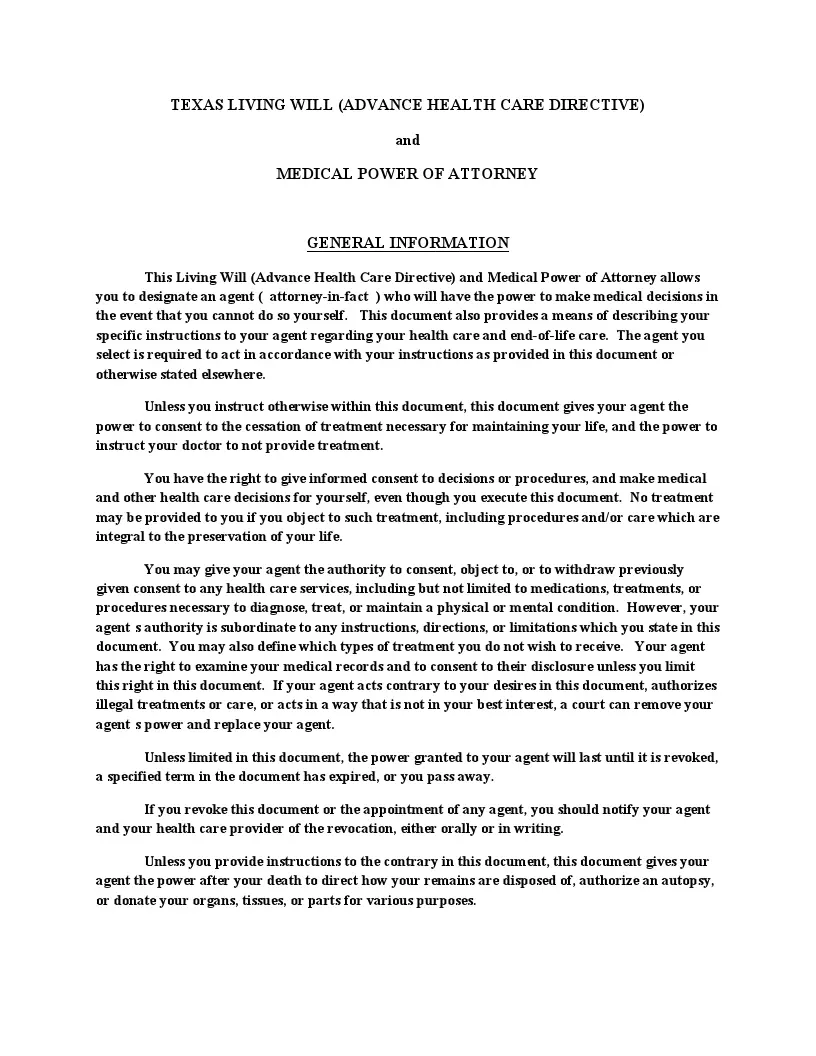
Texas's statutory living will form asks you to choose your treatment preferences under two scenarios: a terminal condition expected to cause death within six months, and an irreversible condition that leaves you unable to care for yourself. You initial the choice that reflects your wishes for each.[1.3]
The form also defines the key terms it uses:[1.3]
Fill out the Texas Directive to Physicians and Family or Surrogates in the order the form presents its sections. Download it, complete your declaration and treatment choices, add any optional instructions, name an agent, then sign with your witnesses or a notary.


General information, not legal or tax advice.
