
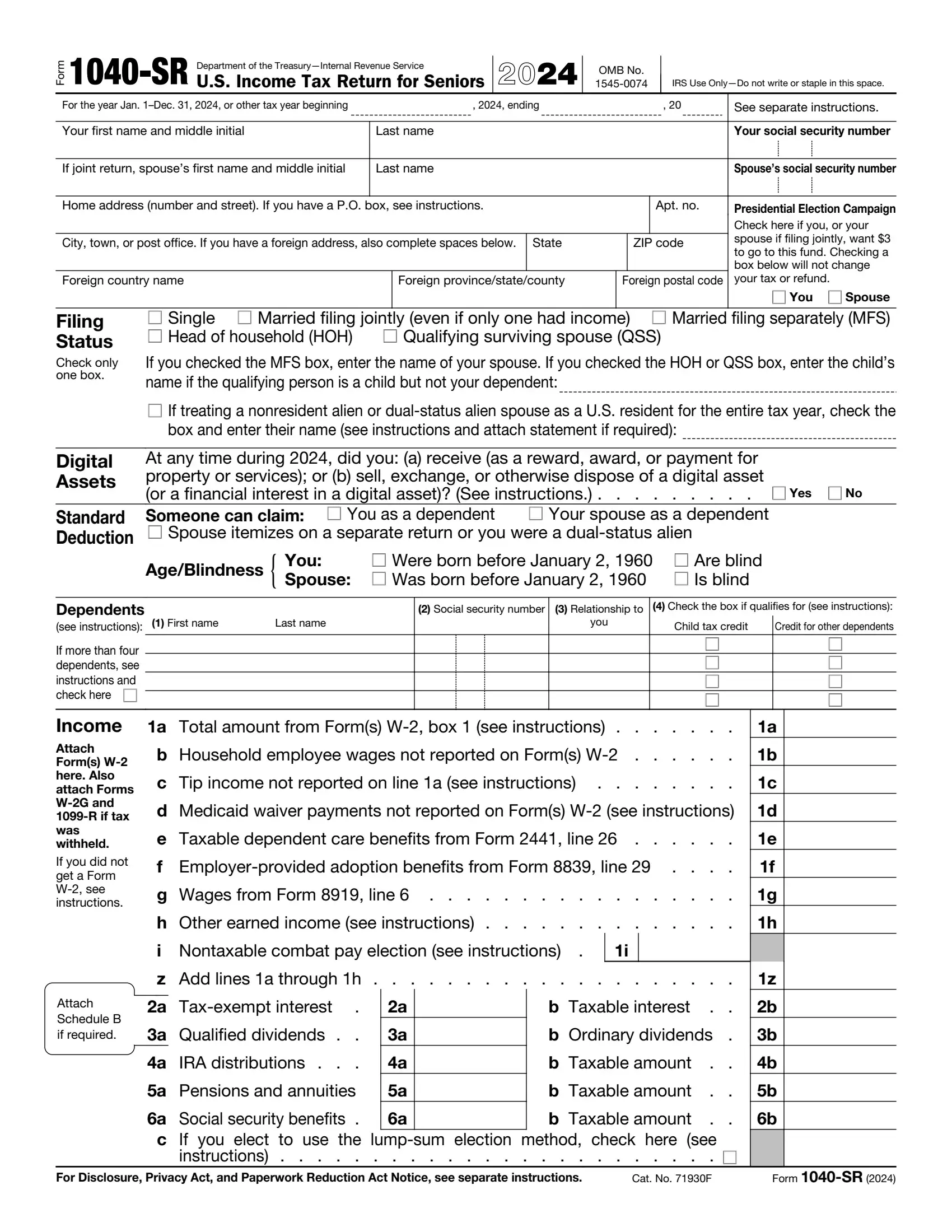
Form 1040-SR, titled “U.S. Tax Return for Seniors,” is a version of the standard Form 1040 designed specifically for taxpayers 65 or older. It offers a more readable format with larger print and a simpler layout, making it easier for seniors to view and understand. The form includes the same lines and schedules as the regular Form 1040, allowing seniors to report income, deductions, and credits in a format tailored to their needs. Additionally, Form 1040-SR includes a chart for calculating the standard deduction, which may be higher for seniors, depending on their filing status and whether they or their spouse are blind.
The purpose of Form 1040-SR is to provide seniors with an easier way to file their taxes while taking advantage of all the tax benefits available. By using this form, seniors can more easily cut through the complexities of tax preparation and ensure that they accurately report their income and deductions. This form was created to simplify the filing process and recognize older adults’ unique financial situations, helping them maintain financial independence and comply with tax laws without undue stress.
Other IRS Forms for Partnerships
Our online database comprises hundreds of various IRS forms. Check what other IRS forms you might need as an individual taxpayer.
If you are eligible to file Form 1040-SR, you need to download an up-to-date template and furnish all requirements provided in the paper. To generate a valid PDF file, use our form-building software. We also inspire you to read the guide below and learn the tips on how to fill out the referenced form.
Complete the Heading
Select the applicable variant that defines your status. Choose from the following:
Here, you should also submit the spouse’s name.
For the last two options, the declarant needs to enter the child’s name if they are not a dependent.

Introduce Yourself
Enter your first and last names and include the middle initial, if any. Also, you need to submit the social security number.

Introduce Your Spouse
If you decide to prepare the document jointly with the spouse, please include their name (first, last, and middle initial). Enter the SSN in the last box.

Specify the Living Address
In this section, the preparer should enter their living address details as follows:
Use the P. O. Box option only if the service does not deliver mail to your living location.

If your residency is situated in foreign territories, enter only the city name in the “City, town, or post office…” section. Also, you should indicate the foreign country name, province, and postal data.

Define Your Contribution to the Election Program
If you wish to participate in the Presidential Election Campaign, check the “Yes” box. Regardless of what you select, the tax amount won’t change. The contribution is distributed to support the candidates’ independence during the election programs. It is also invested in medical research programs.

Revise and Complete the Standard Deduction Heading Section
Here, you need to select the appropriate alternative to clarify your deduction case:

If your spouse wishes to claim privileges separately, ensure to check the needed slot.

Revise the deduction table at the bottom of the page to learn the conditions and amounts of benefit.

Define the Dependents
In this part, the declarant should list a maximum of four dependents. Include the following data to complete the table:

To find out if the dependent is qualifying to claim special conditions and benefits, see the IRS brochure on the service’s official web portal.
In case the number of dependents exceeds four, you are empowered to prepare an additional verification statement to submit the needed info.

Specify Your Revenue Details
In Units 1-11 (a, b), the declarant should submit their revenue, including the following:

Describe the Taxation and Payments
Use Units 12 (a) through 19 to cover info related to the taxation conditions and other payments. Also, include any Schedules required to describe the needed statements.

Compute the Refund Amounts
Units 20-22 are dedicated to explaining the refund amount that the declarant has overpaid (if any). Adjust the calculations and fill out the necessary info. Insert the refund amount you want to be paid in Unit 21 (a).

You can claim the refund via check or direct deposit. Using the second option, however, can be more preferable, as the repayments come faster and more secure. Also, you can distribute the refund among several accounts by completing Form 8888.

If you choose to get the refund by check or the direct deposit is declined due to some reason, you need to enter the routing and account number. Learn the valid data from your bank or financial organization. The routing number contains nine characters, while the account number can cover up to 17 digits.

Specify If You Use Refunds to Cover Taxes
In Unit 22, the declarant should enter the refund amount (if there is any) they want to apply to cover the current year’s estimated tax.

Compute the Tax Liability
For lines 23-24, enter the amount you are liable to pay to cover the debt before the due date. Otherwise, you can become subject to penalties and fees.
The service offers several ways to transact payments: you are empowered to pay online, by check, money order, in cash, by phone, or via a mobile app. Detailed info on withdrawal methods can be found in the 1040-SR Instruction brochure provided by the service.

Designate Another Person to Discuss the Return
You can appoint a third-party individual to negotiate your return form with the IRS. If positive, tick the “Yes” box and ensure to provide the designee’s data:

Authorize the 1040-SR Report
Complete the form by appending the declarant’s signature and current date. Also, the preparer should enter their employment background and an Identity Protection PIN (if any). Below the spouse’s section, the declarant enters the email and contact phone number.

If the wife and husband fill out the form jointly, ensure that both spouses sign and date the form, providing the required info.

Introduce the Paid Preparer (If Applicable)
If the declarant wishes, they can hire a paid specialist (self-employed or some licensed firm’s representative) to prepare the form for the declarant. If you decide to select this option, make sure to introduce the preparer in the last bottom section of the form as follows:

Also, if they are the appointed agent to discuss the respected form with the IRS on your behalf, make a corresponding guide-mark.

What it is: Form 1040-SR is the U.S. Income Tax Return for Seniors for 2025.
Who signs: Spouse's signature. If a joint return, both must sign. Joint return? See instructions.
Where to get it: Go to www.irs.gov/Form1040SR for instructions and the latest information.
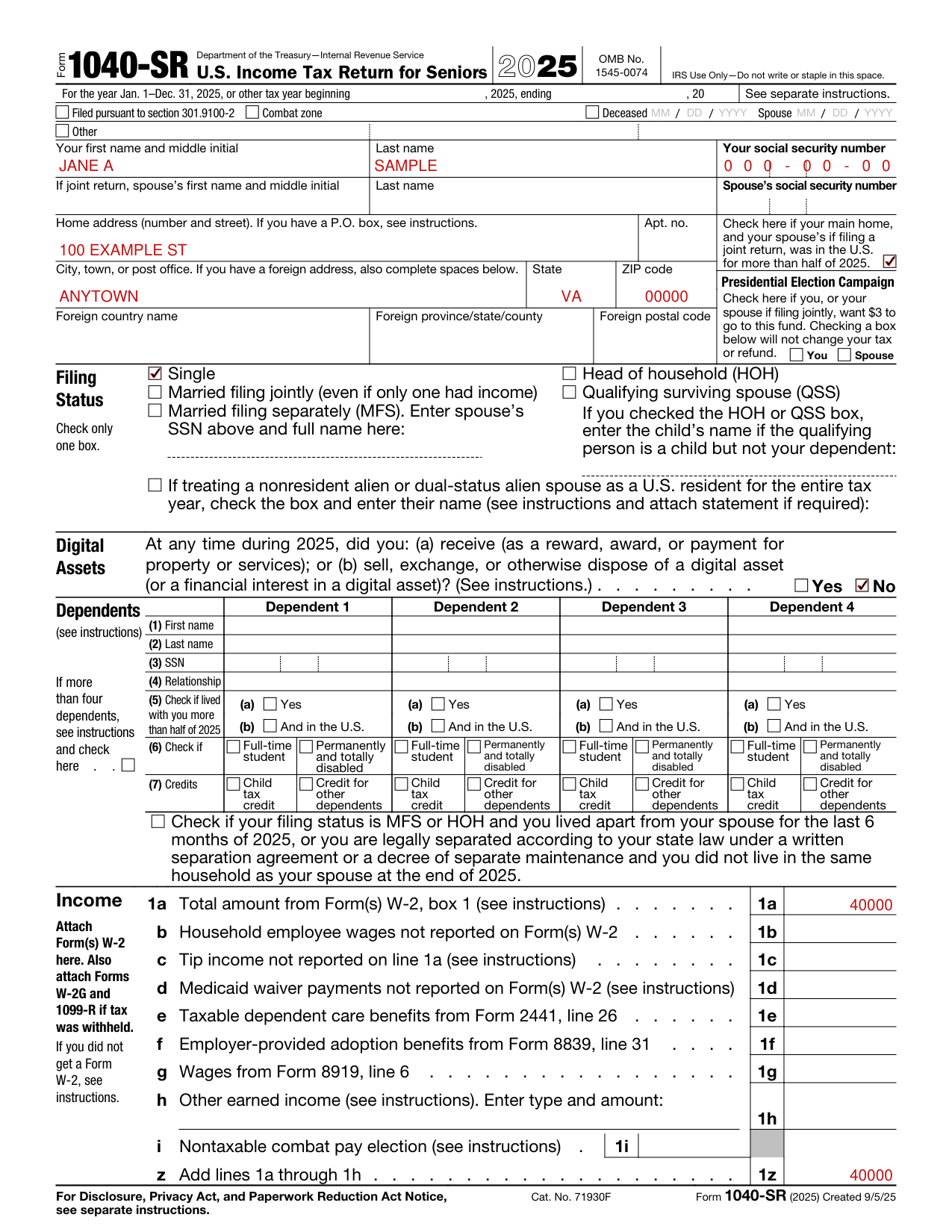
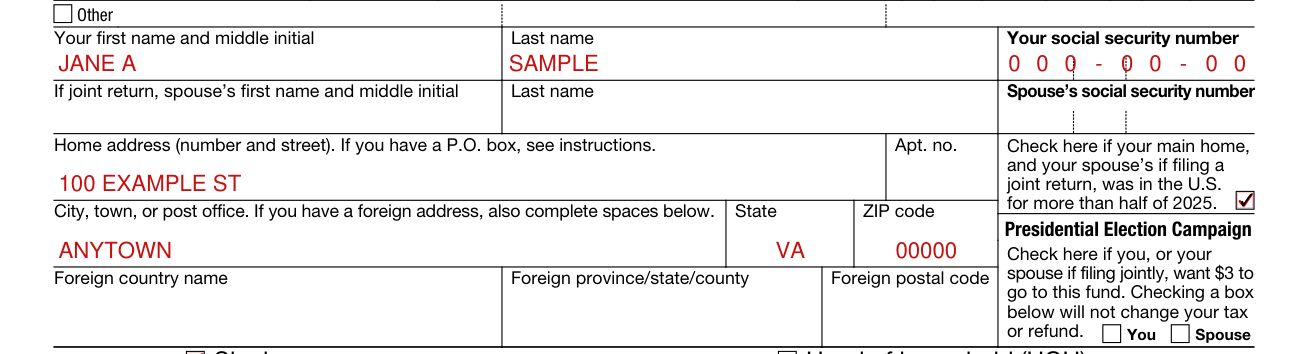
Enter Your first name and middle initial, Last name and Your social security number.
If joint return, enter spouse's first name and middle initial, Last name and Spouse's social security number.
Enter your Home address (number and street) and Apt. no. If you have a P.O. box, see instructions.
Enter City, town, or post office, State and ZIP code.
Check here if your main home, and your spouse's if filing a joint return, was in the U.S. for more than half of 2025.
Check here if you, or your spouse if filing jointly, want $3 to go to this fund. Checking a box will not change your tax or refund (checked October 19, 2026).
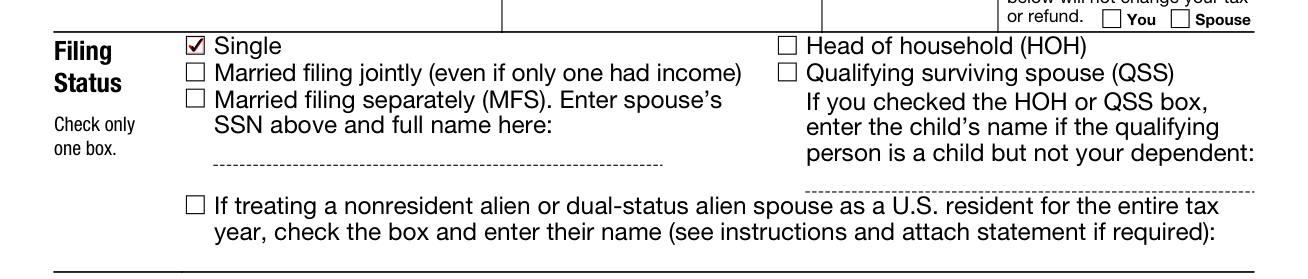
Common mistake: Check only one box.
Single. Married filing jointly (even if only one had income). Married filing separately (MFS): enter spouse's SSN and full name.
Head of household (HOH). Qualifying surviving spouse (QSS). If you checked the HOH or QSS box, enter the child's name if the qualifying person is a child but not your dependent.

Check Yes or No. At any time during 2025, did you: (a) receive (as a reward, award, or payment for property or services); or (b) sell, exchange, or otherwise dispose of a digital asset (or a financial interest in a digital asset)? (See instructions.)
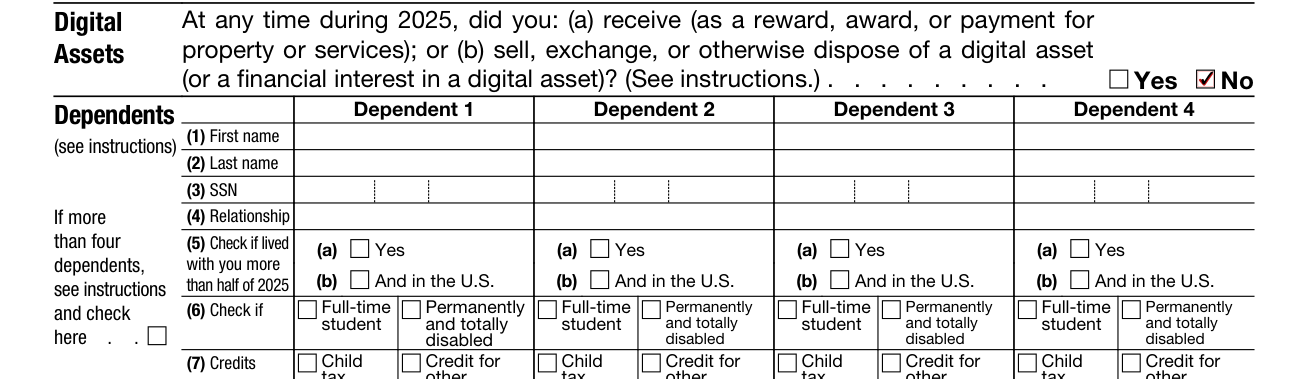
For Dependent 1, Dependent 2, Dependent 3 and Dependent 4, enter (1) First name, (2) Last name, (3) SSN, (4) Relationship and (5) Check if lived with you more than half of 2025: (a) Yes, (b) And in the U.S.
If more than four dependents, see instructions and check here.
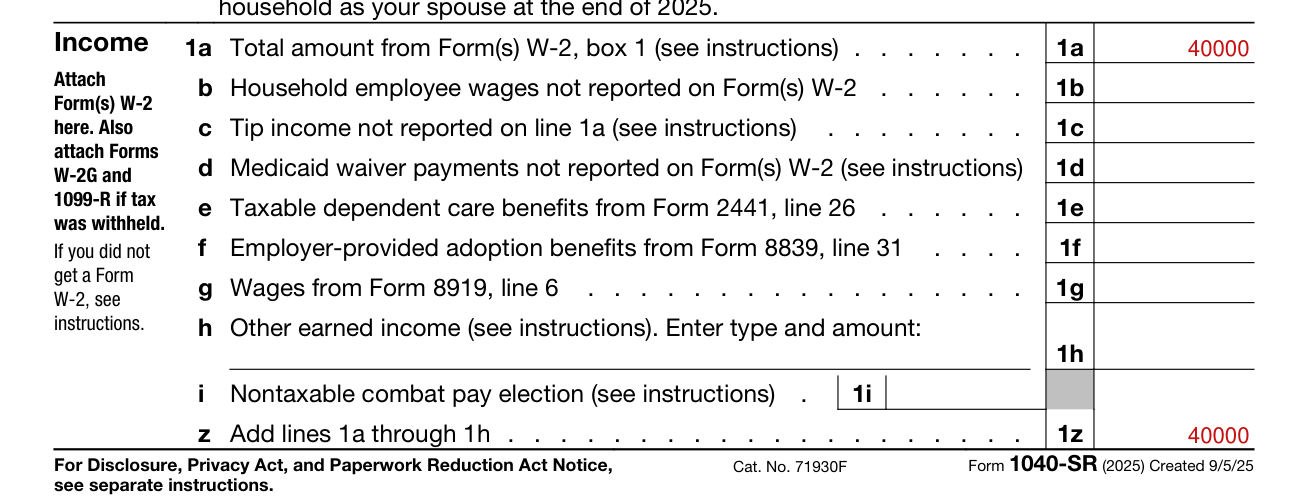
Line 1a: Total amount from Form(s) W-2, box 1 (see instructions). Attach Form(s) W-2. Also attach Forms W-2G and 1099-R if tax was withheld. If you did not get a Form W-2, see instructions.
Line 1b: Household employee wages not reported on Form(s) W-2. Line 1c: Tip income not reported on line 1a (see instructions). Line 1d: Medicaid waiver payments not reported on Form(s) W-2 (see instructions).
Line 1h: Other earned income (see instructions). Enter type and amount.
Line 1z: Add lines 1a through 1h.
Line 7a: Capital gain or (loss). Attach Schedule D if required. Line 7b: Check if: Schedule D not required; Includes child's capital gain or (loss).
Line 8: Additional income from Schedule 1, line 10. Line 9: Add lines 1z, 2b, 3b, 4b, 5b, 6b, 7a, and 8. This is your total income.
Line 10: Adjustments to income from Schedule 1, line 26. Line 11a: Subtract line 10 from line 9. This is your adjusted gross income. Line 11b: Amount from line 11a (adjusted gross income).
Line 12a, Someone can claim: You as a dependent; Your spouse as a dependent. Line 12b: Spouse itemizes on a separate return. Line 12c: You were a dual-status alien.
Line 12d, You: Were born before January 2, 1961; Are blind. Spouse: Was born before January 2, 1961; Is blind. See Standard Deduction Chart on the last page of this form. Line 12e: Standard deduction or itemized deductions (from Schedule A).
Line 13a: Qualified business income deduction from Form 8995 or Form 8995-A. Line 13b: Additional deductions from Schedule 1-A, line 38.
Line 14: Add lines 12e, 13a, and 13b. Line 15: Subtract line 14 from line 11b. If zero or less, enter -0-. This is your taxable income.
Line 16: Tax (see instructions). Check if any from: 1 Form(s) 8814, 2 Form(s) 4972.
Line 17: Amount from Schedule 2, line 3. Line 18: Add lines 16 and 17.
Line 19: Child tax credit or credit for other dependents from Schedule 8812. Line 20: Amount from Schedule 3, line 8. Line 21: Add lines 19 and 20.
Line 22: Subtract line 21 from line 18. If zero or less, enter -0-. Line 23: Other taxes, including self-employment tax, from Schedule 2, line 21. Line 24: Add lines 22 and 23. This is your total tax.
Line 25, Federal income tax withheld from: a Form(s) W-2, b Form(s) 1099, c Other forms (see instructions). Line 25d: Add lines 25a through 25c.
Line 26: 2025 estimated tax payments and amount applied from 2024 return. If you made estimated tax payments with your former spouse in 2025, enter their SSN (see instructions). If you have a qualifying child, you may need to attach Sch. EIC. Line 27a: Earned income credit (EIC).
Line 28: Additional child tax credit (ACTC) from Schedule 8812. If you do not want to claim the ACTC, check here. Line 31: Amount from Schedule 3, line 15.
Line 32: Add lines 27a, 28, 29, 30, and 31. These are your total other payments and refundable credits. Line 33: Add lines 25d, 26, and 32. These are your total payments.
Line 34: If line 33 is more than line 24, subtract line 24 from line 33. This is the amount you overpaid.
Line 35a: Amount of line 34 you want refunded to you. If Form 8888 is attached, check here. Direct deposit? See instructions. Line 35b: Routing number. Line 35c: Type: Checking or Savings. Line 35d: Account number.
Line 37: Subtract line 33 from line 24. This is the amount you owe. For details on how to pay, go to www.irs.gov/Payments or see instructions.
Do you want to allow another person to discuss this return with the IRS? See instructions. Check Yes or No. Yes. Complete the Designee's name, Phone no. and Personal identification number (PIN).
By signing, you declare under penalties of perjury that you have examined this return and accompanying schedules and statements, and to the best of your knowledge and belief, they are true, correct, and complete.
Enter Your signature, Date and Your occupation. Spouse: enter Date and Spouse's occupation. If the IRS sent you (or your spouse) an Identity Protection PIN, enter it (see inst.).
Common mistake: Spouse's signature. If a joint return, both must sign. Joint return? See instructions.
Enter Phone no. and Email address.
Keep a copy for your records.
Standard Deduction Chart on Form 1040-SR: Add the number of boxes checked on line 12d on page 2. Don't use this chart if someone can claim you (or your spouse if filing jointly) as a dependent, your spouse itemizes on a separate return, or you were a dual-status alien. Instead, see instructions. If your filing status is Single, then your standard deduction is $17,750 if the number of boxes checked is 1, 19,750 if 2 (checked October 19, 2026). If your filing status is Married filing jointly, then your standard deduction is $33,100 if the number of boxes checked is 1, 34,700 if 2, 36,300 if 3, 37,900 if 4 (checked October 19, 2026). If your filing status is Qualifying surviving spouse, then your standard deduction is $33,100 if the number of boxes checked is 1, 34,700 if 2 (checked October 19, 2026). If your filing status is Head of household, then your standard deduction is $25,625 if the number of boxes checked is 1, 27,625 if 2 (checked October 19, 2026). If your filing status is Married filing separately, then your standard deduction is $17,350 if the number of boxes checked is 1, 18,950 if 2, 20,550 if 3, 22,150 if 4 (checked October 19, 2026). You can check the boxes for your spouse if your filing status is married filing separately and your spouse had no income, isn't filing a return, and can't be claimed as a dependent on another person's return.
Line 38: Estimated tax penalty (see instructions).
[1] Form 1040-SR (2025), U.S. Income Tax Return for Seniors, Internal Revenue Service (the Official source link on this page).