
Updated:
Get Form Now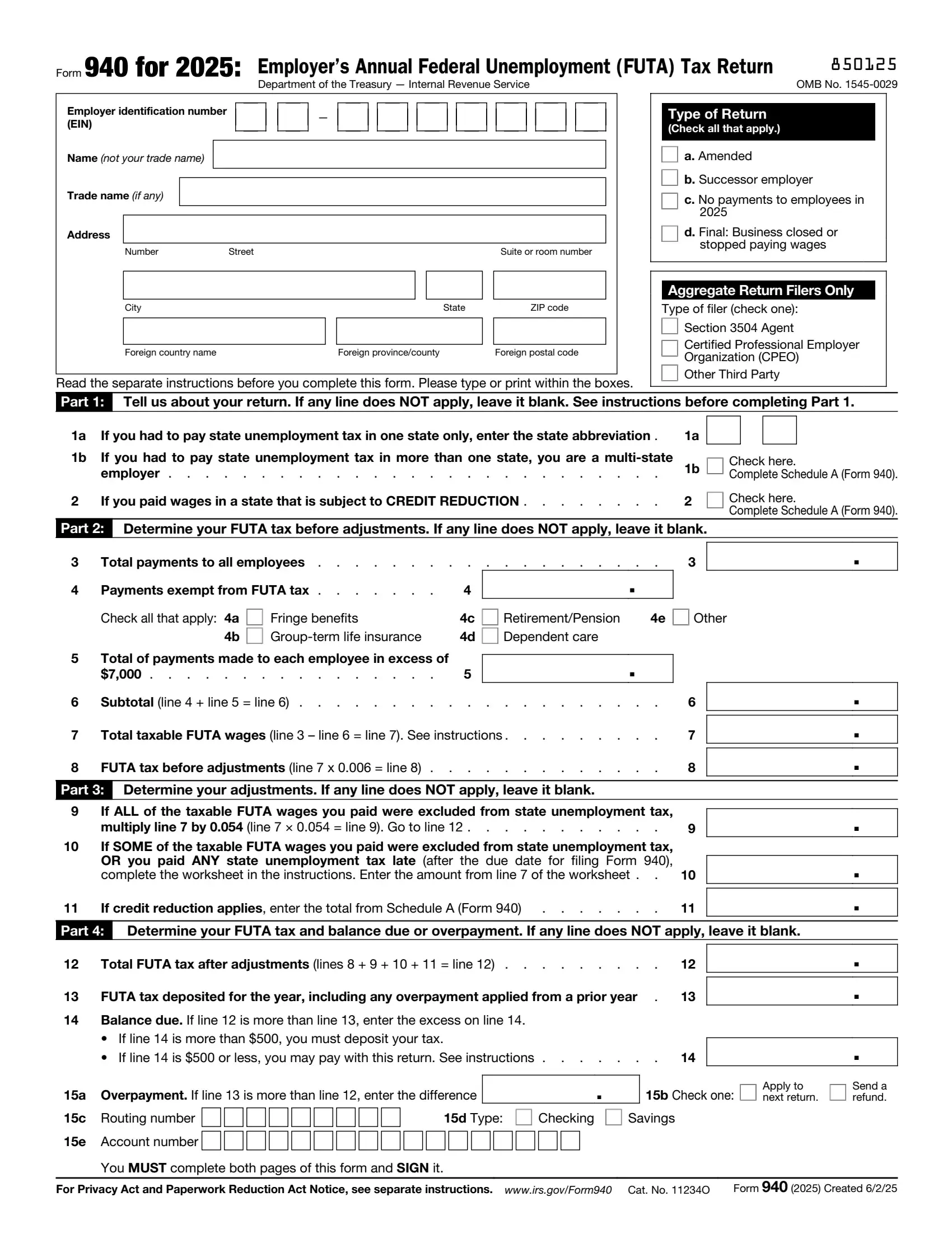
IRS Form 940, also known as the Employer’s Annual Federal Unemployment (FUTA) Tax Return, is used by employers to report their annual Federal Unemployment Tax Act (FUTA) tax. This tax provides funds for unemployment compensation to workers who have lost their jobs. Most employers pay federal and state unemployment tax, but only the federal tax is reported and paid via Form 940.
The form is required for any employer who paid wages of $1,500 or more in any calendar quarter or had one or more employees for at least some part of a day in any 20 or more different weeks in a year. The information on Form 940 helps the IRS determine if the employer has paid the correct unemployment taxes throughout the year.
Other IRS Forms for Partnerships
Employers in the US have to file numerous IRS forms on a regular basis. Look what other forms might be necessary for your type of business.
As usual, there are two ways to submit the report to the IRS: online using their website or using a post. If it is more convenient for you to mail this document find the address in the table below according to your physical address.

What it is: Form 940 is the Employer's Annual Federal Unemployment (FUTA) Tax Return, which you use to report your annual Federal Unemployment Tax Act (FUTA) tax.[2]
Tax deadline: The due date for filing Form 940 for 2025 is February 2, 2026. However, if you deposited all your FUTA tax when it was due, you may file Form 940 by February 10, 2026.[2]
Who signs: You MUST complete both pages of this form and SIGN it.
Except as noted, you must file Form 940 if you answer "Yes" to either one of these questions. Did you pay wages of $1,500 or more to employees in any calendar quarter during 2024 or 2025? Did you have one or more employees for at least some part of a day in any 20 or more different weeks in 2024 or 20 or more different weeks in 2025? (checked November 16, 2026)[2]
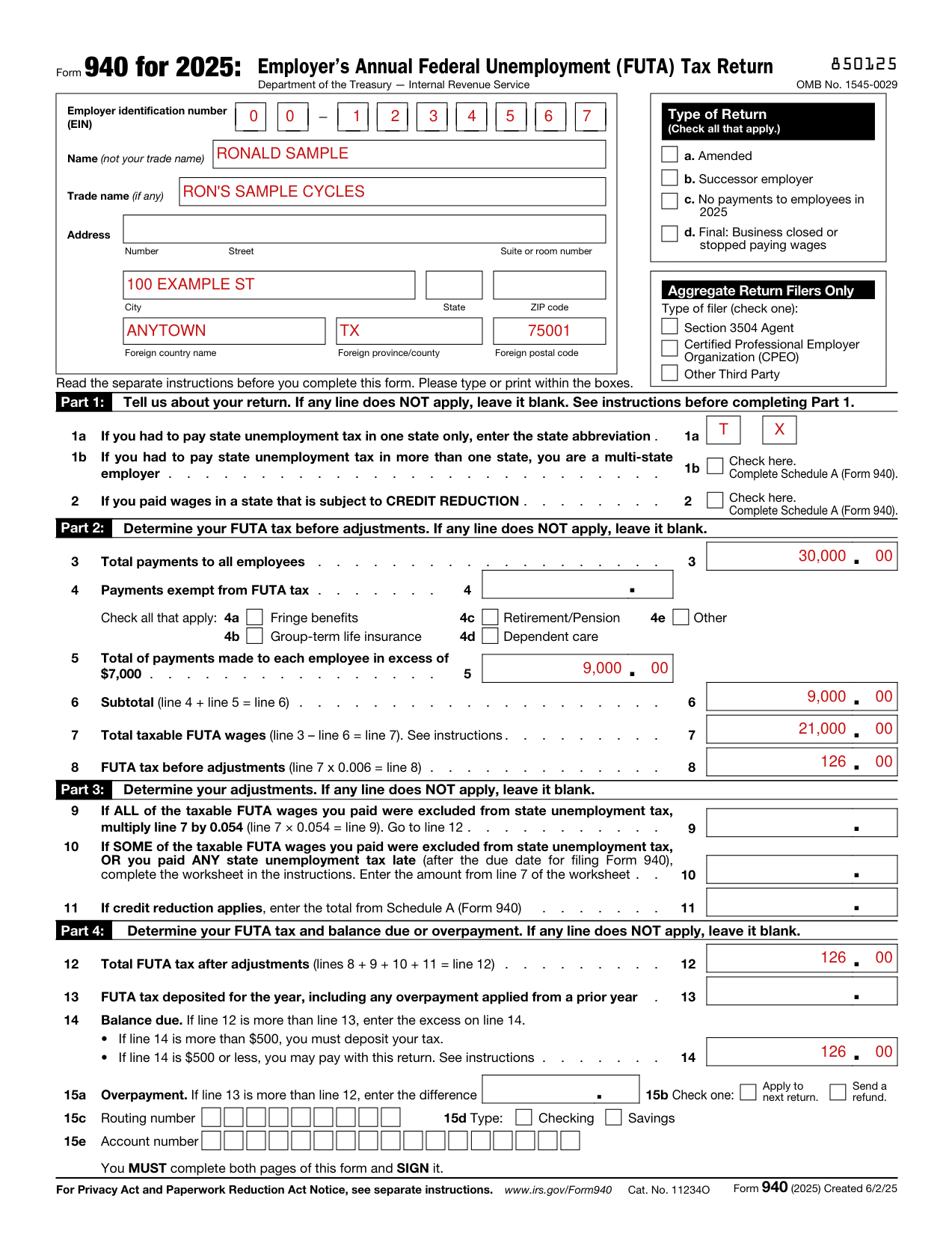
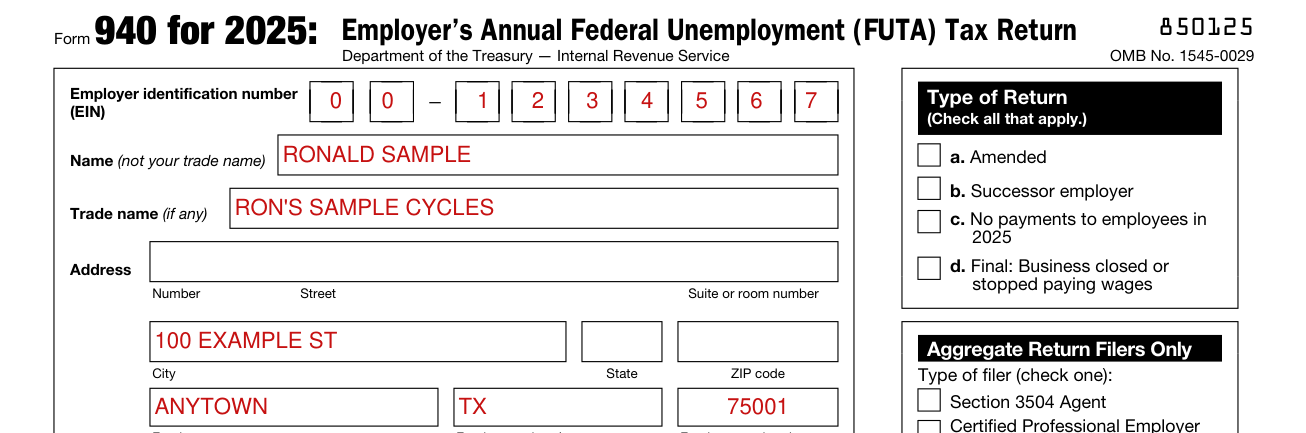
Enter your EIN, name, and address in the spaces provided. You must enter your name and EIN here and on page 2.[2]

If any line applies to you, check the appropriate box for the type of return you're filing. You may check more than one box.
If this is an amended return that you're filing to correct a return that you previously filed, check box a.
If you're not liable for FUTA tax for 2025 because you made no payments to employees in 2025, check box c. Then, go to Part 7, sign the form, and file it with the IRS.
If this is a final return because you went out of business or stopped paying wages and you won't be liable for filing Form 940 in the future, check box d.[2]

If you were required to pay your state unemployment tax in one state only, enter the two-letter USPS abbreviation for that state on line 1a.
If you're a multi-state employer (more than one state), check the box on line 1b. Then, fill out Schedule A (Form 940) and attach it to your Form 940.
A state that hasn't repaid money it borrowed from the federal government to pay unemployment benefits is called a credit reduction state. If you paid wages that are subject to the unemployment tax laws of a credit reduction state, check the box on line 2 and fill out Schedule A (Form 940).[2]
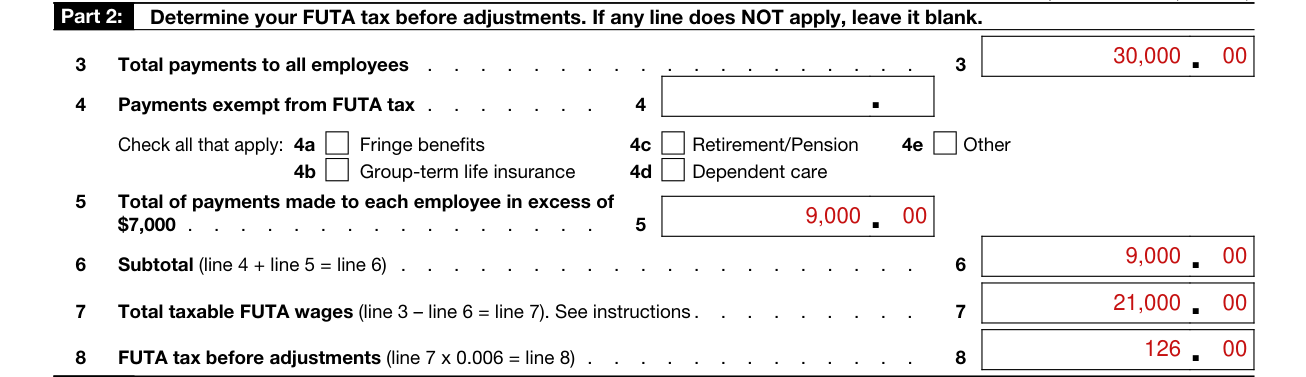
Report the total payments you made during the calendar year on line 3. Include payments for the services of all employees, even if the payments aren't taxable for FUTA.
If you enter an amount on line 4, check the appropriate box or boxes on lines 4a through 4e to show the types of payments exempt from FUTA tax.
Only the first $7,000 you paid to each employee in a calendar year, after subtracting any payments exempt from FUTA tax, is subject to FUTA tax (checked November 16, 2026). Enter on line 5 the total of the payments over the FUTA wage base you paid to each employee during 2025 after subtracting any payments exempt from FUTA tax shown on line 4.
To figure your subtotal, add the amounts on lines 4 and 5 and enter the result on line 6.
Total taxable FUTA wages (line 3 - line 6 = line 7).
FUTA tax before adjustments (line 7 x 0.006 = line 8).[2]

If all of the taxable FUTA wages you paid were excluded from state unemployment tax, multiply line 7 by 0.054 and enter the result on line 9. If you weren't required to pay state unemployment tax because all of the wages you paid were excluded from state unemployment tax, you must pay FUTA tax at the 6.0% (0.060) rate.
You must fill out the worksheet if some of the taxable FUTA wages you paid were excluded from state unemployment tax, or any of your payments of state unemployment tax were late. After you complete the worksheet, enter the amount from line 7 of the worksheet on Form 940, line 10.
If you paid FUTA taxable wages that were also subject to state unemployment taxes in any states that are subject to credit reduction, enter the total amount from Schedule A (Form 940) on Form 940, line 11.[2]

Add the amounts shown on lines 8, 9, 10, and 11, and enter the result on line 12. If line 9 is greater than zero, lines 10 and 11 must be zero because they don't apply.
Enter the amount of FUTA tax that you deposited for the year, including any overpayment that you applied from a prior year.
If line 13 is less than line 12, enter the difference on line 14. If line 14 is more than $500, you must deposit your tax; see When Must You Deposit Your FUTA Tax (checked November 16, 2026). If line 14 is $500 or less, you can deposit your tax, pay your tax by EFT, pay your tax with a credit card or debit card, pay your tax by EFW if filing electronically, or pay your tax by check or money order with your return (checked November 16, 2026).
Complete Form 940-V if you're paying your balance due on Form 940 by check or money order. Don't use Form 940-V to make federal tax deposits.
If your FUTA tax for the fourth quarter (plus any undeposited amounts from earlier quarters) is more than $500, deposit the entire amount by February 2, 2026 (checked November 16, 2026).[2]
Fill out Part 5 only if line 12 is more than $500 (checked November 16, 2026). If line 12 is $500 or less, leave Part 5 blank and go to Part 6 (checked November 16, 2026).
Enter the amount of your FUTA tax liability for each quarter on lines 16a-16d. Don't enter the amount you deposited. If you had no liability for a quarter, leave the line blank.
Your total tax liability for the year must equal line 12. Copy the amount from line 12 onto line 17.[2]
If you want to allow an employee, your paid tax preparer, or another person to discuss your Form 940 with the IRS, check the "Yes" box. Then, enter the name and phone number of the person you choose as your designee.[2]
Under penalties of perjury, I declare that I have examined this return, including accompanying schedules and statements, and to the best of my knowledge and belief, it is true, correct, and complete, and that no part of any payment made to a state unemployment fund claimed as a credit was, or is to be, deducted from the payments made to employees.
On page 2, in Part 7, sign and print your name and title.[2]
Services rendered by employees of a state, or a political subdivision or instrumentality of the state, are exempt from FUTA tax and no Form 940 is required.
Religious, educational, scientific, charitable, and other organizations exempt from tax under section 501(a) and described in section 501(c)(3) generally aren't subject to FUTA tax.[2]
Form 940 is the Employer's Annual Federal Unemployment (FUTA) Tax Return, which you use to report your annual Federal Unemployment Tax Act (FUTA) tax. Together with state unemployment tax systems, the FUTA tax provides funds for paying unemployment compensation to workers who have lost their jobs.[2]
You're encouraged to file Form 940 electronically. If you file a paper return, where you file depends on whether you include a payment with Form 940.[2]
A fee may be charged to file electronically.[2]
Penalties and interest are charged on taxes paid late and returns filed late at a rate set by law. If you don't deposit as required and pay any balance due with Form 940, you may be subject to a penalty.[2]
[1] Form 940 (2025), Employer's Annual Federal Unemployment (FUTA) Tax Return, Department of the Treasury Internal Revenue Service (the Official source link on this page).
[2] 2025 Instructions for Form 940, Department of the Treasury Internal Revenue Service.