
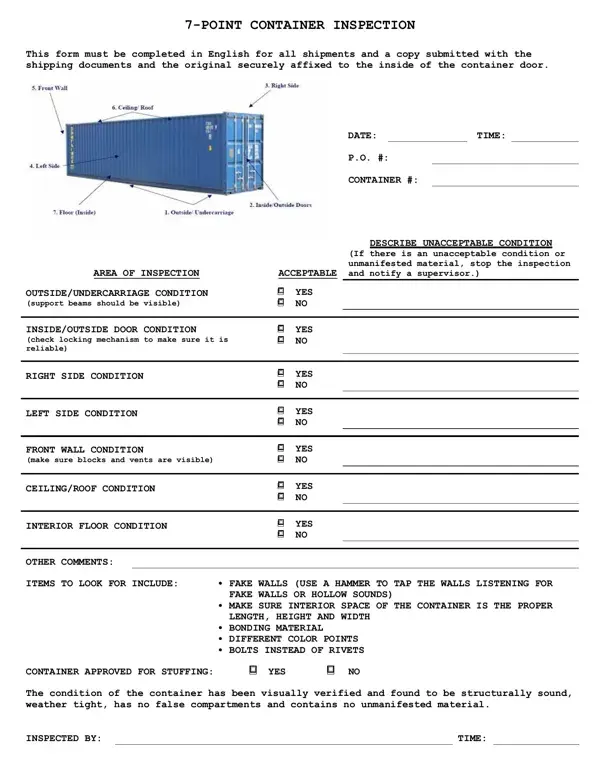
The C-TPAT (Customs-Trade Partnership Against Terrorism) program is a voluntary supply chain security initiative administered by U.S. Customs and Border Protection (CBP). Companies enrolled in this program must complete a 7-point container inspection before sealing and shipping any cargo. Failure to follow this protocol can result in shipment delays, penalties, or loss of CTPAT certification.
Each inspection covers a distinct area of the shipping container. The inspector must check all seven points and document findings on the form:
The inspector must record the container number, seal number, and inspection date at the top of the form. For each of the seven areas, mark either an acceptable or unacceptable condition. If any area is unacceptable, describe the issue in the comments field. The form must be signed and dated by the person who performed the inspection. All inspection records should be retained for a minimum of one year for audit purposes.
Companies engaged in international freight operations often need additional compliance forms. Use our air cargo manifest to document shipment contents or our shipping manifest form to record cargo details. For fleet and vehicle compliance, see the pre-trip inspection checklist and the 4-point inspection form.
| Question | Answer |
|---|---|
| Form Name | 7-Point CTPAT Container Inspection Checklist Form |
| Form Length | 1 pages |
| Fillable? | No |
| Fillable fields | 0 |
| Avg. time to fill out | 15 sec |
| Other names | 7-Point Ocean Container Security Inspection Checklist Form, ISO Container Inspection Checklist Form |
7-Point CTPAT Container Inspection Checklist Form isn’t the one you’re looking for?