
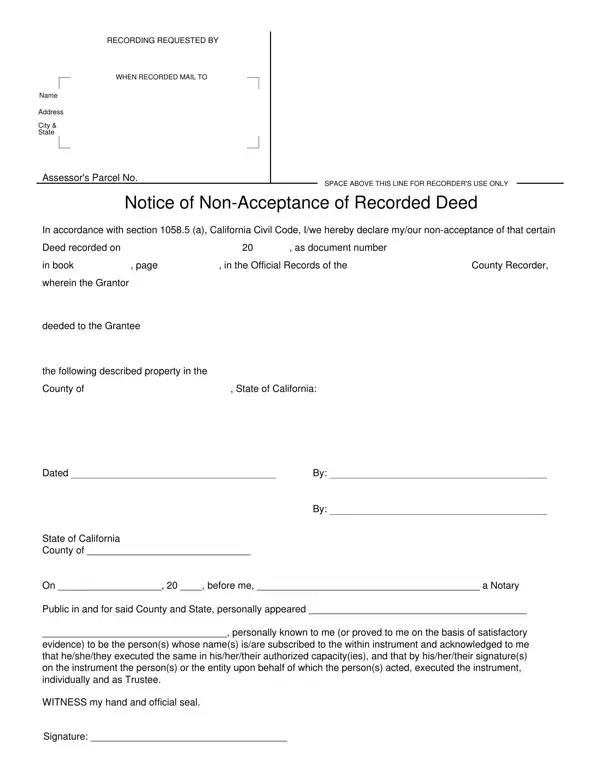
The Acceptance Recorded form is a formal legal instrument under California Civil Code section 1058.5(a) that allows a property owner or grantee to officially reject a deed recorded in their name. This document is filed with the County Recorder's office to establish on the public record that the named party does not accept the conveyance of property rights.
This form applies when a California grant deed or another conveyance is recorded without the recipient's prior knowledge or consent. It also applies when a grantee inherits property through a recorded deed but does not wish to take on the associated liabilities, taxes, or title obligations. Filing this form provides a clear legal mechanism to disclaim the transfer under California law.
To complete the Acceptance Recorded form, gather the following information from the original deed as recorded in the County Recorder's Official Records:
Each entry must match the recorded document exactly. Any discrepancy may delay filing or create ambiguity in the public property record.
The form must be executed before a notary public, who will verify the declarant's identity and apply an official seal. This notarized acknowledgment is required before the County Recorder will accept the filing. After notarization, submit the form to the County Recorder in the jurisdiction where the original deed was recorded. If you are managing related estate matters, also review our California small estate affidavit for additional guidance.
Once accepted by the County Recorder, the Acceptance Recorded form becomes part of the public property record. This formally establishes that the named grantee has rejected the conveyance, which is critical for title clarity and prevents future ownership disputes. If the property has other encumbrances, review the California deed of trust to understand how those may interact with your non-acceptance filing.
| Question | Answer |
|---|---|
| Form Name | Acceptance Recorded Form |
| Also Known As | Notice of Non-Acceptance, California Non-Acceptance of Deed |
| Governing Law | California Civil Code Section 1058.5(a) |
| Jurisdiction | State of California |
| Who Files It | The named grantee rejecting the deed |
| Where to File | County Recorder's Office (same county as original deed) |
| Notarization Required | Yes - must be signed before a notary public |
| Form Length | 1 pages |
| Fillable? | No |
| Fillable fields | 0 |
| Avg. time to fill out | 15 sec |
| Other names | california non acceptance, california acceptance deed, acceptance recorded, ca notice acceptance |
Acceptance Recorded Form isn’t the one you’re looking for?