
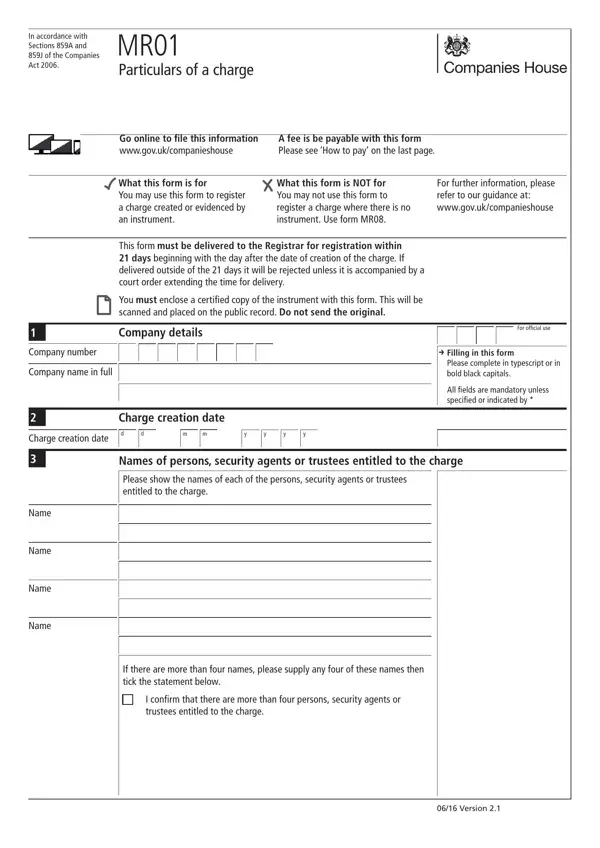
The Companies House MR01 form is the required legal document for UK registered companies to notify Companies House of a charge created over company assets. Grounded in Sections 859A and 859J of the Companies Act 2006, the form records the existence of a security interest - such as a mortgage, fixed charge, or floating charge - held by a creditor against the company. Registering the charge makes it a matter of public record, establishing the creditor's priority and providing notice to other parties dealing with the company.
The MR01 form is required whenever a UK company creates a charge that is evidenced by an instrument - a formal written document such as a debenture, deed of charge, or loan agreement. It covers a broad range of asset types including land, buildings, ships, aircraft, and intellectual property. If the charge was created without an instrument, the MR08 form must be used instead. For releasing or discharging a registered charge, the MR04 form applies. The MR01 is not suitable for charges over assets held by a Scottish company under Scots law, which have their own separate registration requirements.
The MR01 form must be delivered to Companies House within 21 days of the date the charge was created. This deadline is strictly enforced. Late registration is not automatically permitted and requires a court application for an extension of time, which adds legal cost and delay. Along with the completed MR01, you must include a certified copy of the instrument creating the charge. The certification must confirm that the copy is a true copy of the original. A registration fee is also required, payable by cheque or postal order made out to Companies House. The form can be submitted by post or electronically through the Companies House online filing service.
An unregistered charge is void against a liquidator, an administrator, and any creditor of the company. This means that if the company enters insolvency, the charge holder loses the security advantage they would otherwise have over other unsecured creditors. The loan itself remains repayable as an unsecured debt, but the lender forfeits priority over the charged assets. This makes prompt and accurate filing of the MR01 form critical for any lender taking security over company assets.
Businesses managing company finances often need several related documents alongside the MR01. A charge account form can help structure credit arrangements before formalising the charge. A business registration form is needed when incorporating a new company in preparation for secured borrowing. For resolving outstanding financial obligations, an arrears discharge form provides a structured process for clearing past-due amounts. If you need to verify or update corporate resolutions related to the borrowing, a corporate resolution form documents board authority for the transaction.
| Question | Answer |
|---|---|
| Form Name | Companies House Mr01 Form |
| Form Length | 3 pages |
| Fillable? | Yes |
| Fillable fields | 60 |
| Avg. time to fill out | 45 sec |
| Other names | companies house, form mr01 word version, mr01 form, form mr01 pdf |
Companies House Mr01 Form isn’t the one you’re looking for?